












- WAŻNE
- WIADOMOŚCI
Davos 2026 as a center of rivalry

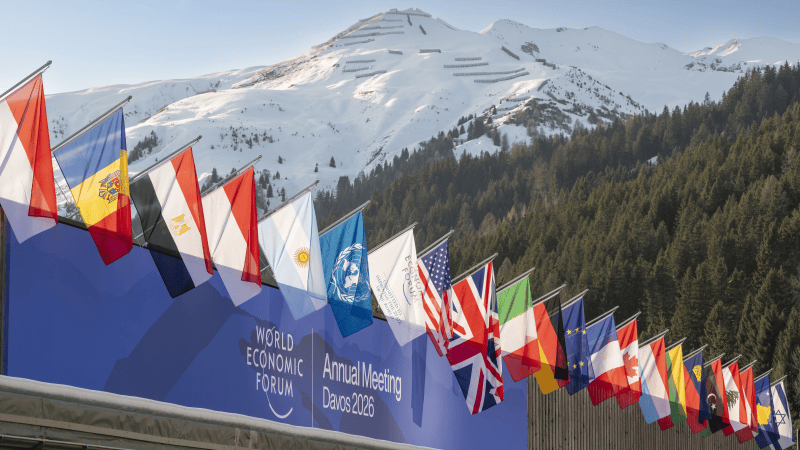
The opening day of the Davos Forum confirmed a fundamental shift in global priorities. Traditional market stability topics were sidelined by a hard security agenda. Key friction points now include the use of economic interdependence as a tool of pressure, competition for influence in the Arctic, and a deepening lack of cohesion within the transatlantic alliance. Davos has ceased to function as a platform for agreement, becoming instead a venue for manifesting divergent interests and preparing for long-term confrontation.
The greatest tension followed the actions and declarations of Donald Trump. Although he did not appear on the main stage, he dominated the narrative. Threats of high tariffs against European nations in the context of Greenland placed the Arctic at the center of security talks. The US administration argues that Greenland is critical for global defense, including early warning infrastructure. Trump was quoted saying:”Greenland is imperative for national and world security.”However, the issue in Davos was not just the island itself, but the precedent: using trade instruments to force concessions on strategic matters.
The EU response was immediate and unusually firm for Davos. Ursula von der Leyen adopted a tough rhetoric, directly referencing the principles of allied cooperation:”A deal is a deal… when friends shake hands, it must mean something.” The speech sent a clear message: the EU rejects the instrumentalization of agreements as a form of political pressure. The announcement of a security package for the Arctic confirms a redefinition of Brussels« priorities, the region is no longer viewed solely through a climate lens, but as a strategic theater of competition.
French President Emmanuel Macron took an even sharper tone, breaking with diplomatic restraint:”We do prefer respect to bullies. And we do prefer the rule of law to brutality.” This was one of the strongest statements of the day, signaling that parts of Europe are ready to openly confront pressure from Washington.
Canada backed the European position. Prime Minister Mark Carney opposed linking tariff policy with sovereignty and security, warning that the militarization of trade threatens to permanently destabilize the international order. In the corridors, mid-sized powers assessed the US-EU dispute as a phenomenon exceeding a bilateral conflict, it is seen as a stress test for the entire Western alliance system.
Belgian Prime Minister Bart De Wever sent a particularly clear signal of possible escalation, stating that „Europe must tell Trump: not a step further - either he withdraws the pressure, or Europe responds in full.” This was regarded as one of the most explicit warnings of transatlantic confrontation.
While Greenland drew media attention, Ukraine remained a vital reference point. Kyiv representatives confirmed that talks with the US regarding the war and continued support resumed in Davos. Concurrently, Ukraine announced it would start sharing extensive combat datasets with allies, including millions of hours of drone footage, to train military AI models. The conflict was also analyzed at Ukraine House Davos as a primary source of experience for future warfare, particularly in drone operations, logistics, and long-term attrition.
The forum also highlighted the militarization of AI. Discussions focused on three areas: autonomous ISR (intelligence, surveillance, reconnaissance) and command systems, the use of AI in target selection, and the lack of international legal regulations. In the sphere of information warfare, disinformation was classified as a strategic tool directly correlating with decision-making processes and military support levels.
These transatlantic disputes were supplemented by signals from the organizers. WEF Managing Director Børge Brende emphasized that Davos is taking place under unprecedented uncertainty, stating:”Dialogue is not a luxury in times of uncertainty; it is an urgent necessity.”
The first day of Davos 2026 brought no definitive resolutions. It did, however, outline the directions of future debate: the merging of security and economics, the increasing role of economic pressure, and the strategic importance of the Arctic, technology, and information warfare. The coming days will show whether these tensions lead to renewed dialogue or further strategic escalation.
Author: Sylwia Kubica


