- WAŻNE
- WIADOMOŚCI
- KOMENTARZ
Davos 2026: Donald Trump’s words as strategy

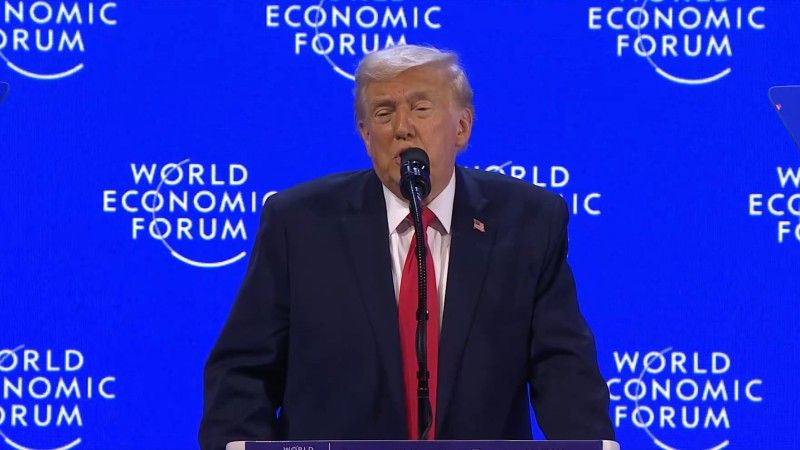
Donald Trump’s performance during the World Economic Forum on January 21, 2026, marked not only a speech to the world elite. It became a political act extended over 90 minutes and continued in further discussions, especially after his conversation with Mark Rutte.
It becomes clear when one focuses on the bigger picture that all of the above amounts to more than just plain talk. All of the above messages point towards a shift in the way there will be a focus in terms of entering into transactional partnerships; the language of coercion will therefore be used effectively as a tool of leverage when it comes to matters of security.
One of the most revealing points of Trump’s speech is that it contained a prominent mention of Greenland. It is put in a context that is less about a territorial claim than about urgency and necessity. „Immediate negotiations,” Trump talks of these in relation to a need that is clear and inevitable.
His words were imbued with the simplest form of logic: accept or there would be consequences. „You can say yes… or you can say no, and we will remember,” he warned - a formulation that made diplomatic relations tantamount to keeping score. Notice the precision of the language. It would not be an unremarked „no”; rather, it would be registered and taken into account in future American decisions.
As such, the case of Greenland represented a proving ground for the strength of alliance solidarity and the principles of sovereignty as well as the level of US patience with procedural politics.
Trump’s views about NATO were one of the most closely watched during the speech. When stating that the US will also continue to be part of NATO, Trump’s concerns about the level of reciprocation were clear: „We’re there for NATO 100%. I’m not sure if they’d be there for us.” It came just short of disavowing Article 5 but politicized it nonetheless. The clear message was: there are assurances in place, but only if Europeans share the burden of doing so. The language of the new leader was already foretelling a less institutionalized, less automatically committed NATO in the future.
For European allies, particularly those in eastern Europe who are part of NATO’s eastern flank, this is an important shift from the politics of reassurance to the politics
One of the passages that received the most attention was the one regarding the possible use of force. Trump admitted the capability rather than ruling out the action: „We won’t get anything unless I use excessive strength and force. I won’t use force.”
This rhetorical act was important. On one hand, the threat of overwhelmingly superior force restated the primacy of U.S. power; but afterwards, refusing to use the threat indicated the ability to choose restraint rather than being constrained to do so. The dual message of strategic reassurance and coercive threat contained in the reminder of the ability to escalate, if only delayed, was potent.
Trump’s Europe diagnosis was direct. „Europe is destroying itself,” the new president said. „We want strong allies, not seriously weakened ones.” This is important analytically. Europe has stopped being seen as a competing strategic pole to now being a partner that makes its own decisions and therefore has implications for its credibility as a partner from a U.S. point of view. Security has to do with issues ranging from defense to issues of energy security or migration control to economy.
Turning to Ukraine, Trump spoke in broad terms, hewing to the importance of acting sooner rather than later, saying „They’ve got to get that war stopped.” This was in keeping with Trump’s want for »deals« rather than strategic confrontations. It was important to note that the discussion of Ukraine focused less on it as an ethical issue and more on it as an issue that needed to be resolved, in keeping with Trump’s aim to recast his role in U.S. foreign policy.
The Post-Davos period introduced a critical element to the situation. After consultation with Dutch PM Mark Rutte, Trump made clear that a „framework of a future deal” covering both Greenland and the Arctic zone in general has been established. More importantly, however, the establishment of such a framework was combined with a removal of tariffs that were intended to be introduced in early February. Such an order of events is of considerable analytical interest. As a means of getting a message across in a speech, Greenland started out as a leverage issue; having talks with Trump transformed the issue into one of formalized discussion.
Davos 2026 confirmed that Trump used language as an action instrument. This wasn’t some provocation extemporized; it was a calibrated message, using one system of coordinates on allies, his domestic base, and strategic rivals at the same time. The chief signals were clear: U.S. commitments are still there, but they are no longer absolute. Alliances have to justify themselves in hard financial and strategic terms where pressure becomes a tool of securing an outcome, and de-escalation is done after the deal is struck, not as a gesture of goodwill.
The takeaway for Europe and NATO is sobering: stability is no longer a guaranteed byproduct of American leadership; it needs to be negotiated, bought, and politically defended. While European leaders did their best to project firmness and unity on the first day of the forum, Trump’s narrative has made that stance much harder to hold. Despite early posturing from the EU, the sheer weight of Trump’s „America First” logic has forced Europe back into a defensive position, where early displays of resolve start to look increasingly hollow.
Author: Sylwia Kubica