












- ANALIZA
- WIADOMOŚCI
- KOMENTARZ
Greenland in the great power race for critical minerals

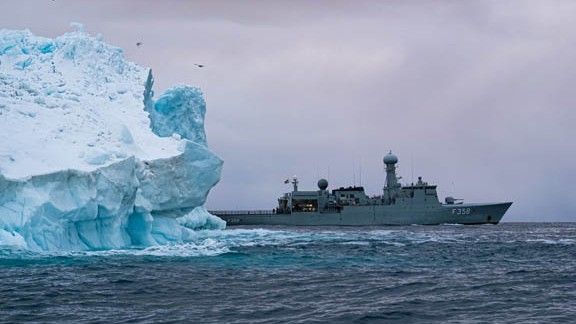
Beneath Greenland’s ice lie rare earth elements vital to modern technology. China is not sending warships. It is building leverage by controlling processing and supply chains.
At first glance, Greenland is just a gigantic, glaciated island at the end of the world. However, beneath a layer of ice hundreds of meters thick lies something that ignites the geopolitical appetites of the world’s major powers. Contrary to Donald Trump’s loud narratives about Chinese ships circling the island, the reality is far more complex. The Chinese dragon isn’t sending a naval fleet there, but for years, it has been patiently investing in something else: access to Greenlandic „sand,” meaning deposits of critical raw materials that could determine the future of the global economy and technological dominance.
Climate change is transforming the Arctic at breakneck speed. Melting ice is opening new shipping lanes that could shorten the journey from Asia to Europe by up to a third compared to the traditional route via the Suez Canal. For China, whose economy relies on exports, this is a fundamental issue: cheaper and faster transport means billions in savings and reduced dependence on trade chokepoints, such as the Malacca Strait, which is controlled by the US Navy.
But it is not just about logistics. Greenland lies on a strategic route between North America and Europe, and its waters form a crucial corridor for submarine movements. For the United States, the presence on the island, primarily through Pituffik Space Base (formerly Thule), is an element of its missile early warning system.
However, the real treasure attracting Beijing’s attention is what lies beneath the ice and rocks.

What is Greenlandic "sand"? The wealth at stake
When talking about Greenlandic „sand,” it is not about ordinary construction sand. It is about raw materials without which the modern world cannot exist. Greenland possesses enormous deposits of rare earth elements: a group of 17 elements essential for producing everything from smartphones and electric cars to fighter jets, laser systems, and MRI scanners.
The island ranks eighth in the world for rare earth element resources, with estimated deposits of 1.5 million tons, including two of the largest known deposits on the globe. Moreover, Greenland holds 25 of the 34 minerals deemed critical for the EU’s economy by the European Commission.
The most famous and controversial deposit is Kvanefjeld, which, besides rare earth metals, also contains uranium. It is the presence of this radioactive element that became a bone of contention and led to the collapse of mining plans. The Greenlandic parliament imposed a ban on uranium mining, effectively blocking the development of the deposit.
See also 

Chinese aspirations in the Arctic. From the "Polar Silk Road" to investments
China officially announced its Arctic ambitions in 2018 by publishing a white paper in which it defined itself as a „near-Arctic state” and introduced the concept of the „Polar Silk Road”.
Over the past decade, China has tried to gain a foothold in Greenland through investments in key sectors. According to expert analyses cited by Radio-Canada, Beijing sought to invest in airport infrastructure, mining projects, and even considered taking over a former naval base and installing telecommunications equipment. However, most of these plans met with resistance, either from Denmark or under pressure from the United States, which argued that critical infrastructure could be used for military purposes.
Despite this, China hasn’t completely withdrawn. Instead of direct infrastructure investments, Beijing has adopted a more sophisticated strategy, focusing on what it is a global leader in — raw material processing. The Chinese company Shenghe Resources became the second-largest shareholder in the Kvanefjeld project, giving Beijing influence over the supply chain without needing to be directly involved in the mining itself.
Experts emphasize that while direct Chinese investments in Greenland remain limited, economic relations exist mainly in fishing, tourism, and seafood exports. However, none of the mining projects involving Chinese partners, proposed seven to eight years ago, are active today.
Myths vs. Facts. Are Chinese ships sailing around Greenland?
Donald Trump has repeatedly pushed the narrative of Chinese and Russian ships „surrounding Greenland,” using it to justify the need for the United States to take control of the island. On January 4, 2026, he stated in an interview with The Atlantic: „Right now, Greenland is surrounded by Russian and Chinese ships.” A few days later, he warned that if the US doesn’t take over Greenland, Russia or China will.
What is the reality? In January 2026, Danish Foreign Minister Lars Løkke Rasmussen went to Washington to flatly deny these claims. After meeting with Vice President JD Vance and Secretary of State Marco Rubio, he told journalists: „According to our intelligence services, there hasn’t been a Chinese warship in the vicinity of Greenland for about a decade.” He added that there are also no massive Chinese investments on the island.
His words were confirmed anonymously by Nordic diplomats cited by the Financial Times. One of them stated bluntly: „This idea that the waters around Greenland are teeming with Russian and Chinese ships or submarines is simply not true. They are in the Arctic, yes, but on the Russian side.”
Norwegian Foreign Minister Espen Barth Eide added in a conversation with NRK that „it’s untrue that Russia or China are active around Greenland.” Their activity is visible near Norway, but in the Greenland region, there is very little.

China's Strategy: Control from the end
Although Chinese ships aren’t sailing around Greenland, and investments aren’t as large as some suggest, Beijing still holds a massive advantage in the global race for critical raw materials. According to analyses, China currently controls 85 to 90 percent of the world’s rare earth metal refining capacity and about 90 percent of the production of powerful magnets.
This means that even if Greenland starts extracting raw materials, they would still largely be sent to China for processing. What American analysts call „control from the end,” meaning dominance in the final stage of the supply chain, gives Beijing an advantage that no military bases can threaten.
China’s strategy towards Greenland is not about sending ships or seizing territories, but about patiently building influence where it is most profitable: in the processing industry. This is a far more effective and cheaper form of dominance than military confrontation.
Why is exploiting the deposits so difficult?
If extracting resources in Greenland were simple and cheap, private companies would have been there long ago. However, experts point to a series of barriers that mean the „Greenlandic sand” remains just a promise for now.
Firstly, the natural conditions are extreme. Deposits are often located in hard-to-reach regions, frequently under thick ice caps. For most of the year, it is dark, and infrastructure is practically non-existent. On an island three times the size of Texas, there are only 150 kilometers of roads. Malte Humpert from The Arctic Institute states plainly: „The idea of turning Greenland into an American rare earth metal factory is science fiction. You might as well mine on the Moon, and in some respects, the Moon would be easier.”
Secondly, since World War II, only nine mines have operated in Greenland. Today, only two are functioning, and neither produces rare earth metals. Environmental regulations and harsh weather conditions remain key obstacles.
Thirdly, politics and the local community pose a significant barrier. Greenland has strict environmental and uranium mining regulations, which led to the blocking of the Kvanefjeld project. Local political parties and communities are sensitive about their autonomy, and any investments must consider their interests. A poll from January 2025 showed that only 6 percent of residents support Greenland joining the US, while 85 percent are opposed.

The new Cold War in the Arctic. What is the real game?
The rivalry over Greenland is not just a dispute over resources. It is primarily a symbol of profound shifts in the global balance of power. Russia, which controls about half of the Arctic territory and two-thirds of its GDP, has been strengthening its military position for years. China, through cooperation with Moscow, gains access to Arctic routes and resources without being a formal Arctic state.
For the United States, Greenland is key to maintaining technological and military superiority over China. According to analyses by the US think tank CSIS, cited by Taiwanese Youth Daily, the rivalry over the island forces all parties to rethink their strategies.
Greenland is becoming a place where two models, authoritarian and democratic, clash. Whether the West can offer Greenland an attractive alternative to Chinese investments, based on respect for its autonomy and the interests of the local community, will determine the future shape of the Arctic. As analysts aptly summarize, the real challenge is not what lies under the ice, but whether trust and stable institutions can be built to allow for the sustainable use of these resources.


