












- KOMENTARZ
- WIADOMOŚCI
- WAŻNE
French growing presence in Greenland

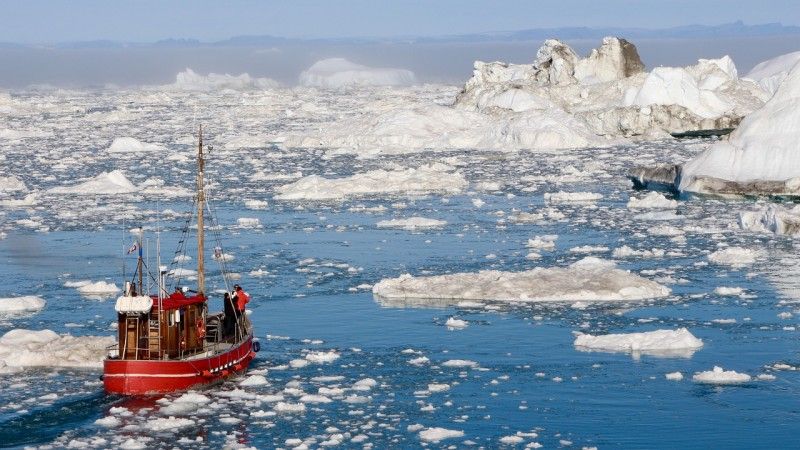
French presence in Greenland has increased dramatically in recent weeks facing U.S. threats. French soldiers participating in the joint military exercise Operation Arctic Endurance alongside the U.K., Germany, Sweden, Norway, the Netherlands and Finland.
French President Emmanuel Macron has expressed his intention to deploy additional „land, air and sea” forces in future days, while calling for accelerated rearmament efforts in France and the European Union. Beyond these recent events, how can France’s growing presence in Greenland be explained?
The U.S. are openly pursuing, through methods perceived as coercive by Europe, objectives that other countries also seek to achieve: the protection of their strategic interests and control over Greenland and more broadly, the Arctic region.
The Arctic is a strategic region on multiple levels. It is estimated to contain 13% of the world’s undiscovered oil reserves and 30% of natural gas resources, in addition to rare earth and other critical minerals. The melting of permafrost and sea ice is opening new maritime routes through the North-East passage that has attracted growing international interest. During the summer, this route now connects Europe and China, while reducing travel time by up to 40%. Also, it would facilitate exports of Russian liquefied natural gas. Looking ahead, China intends to integrate the North-East passage into its Belt and Road Initiative as a regular trade route.
Global warming is therefore profoundly transforming the Arctic, prompting major powers to assert dominance over the region, notably China, Russia, and more recently the U.S. The Arctic was defined by France as a potential area of confrontation in the 2017Strategic Review of the Ministry for the Armed Forces. In the 69th report from the French Arctic Observatory published in January 2026, French polar strategy describes the three countries as fighting for control of polar resources, being first critical minerals and energetic resources.
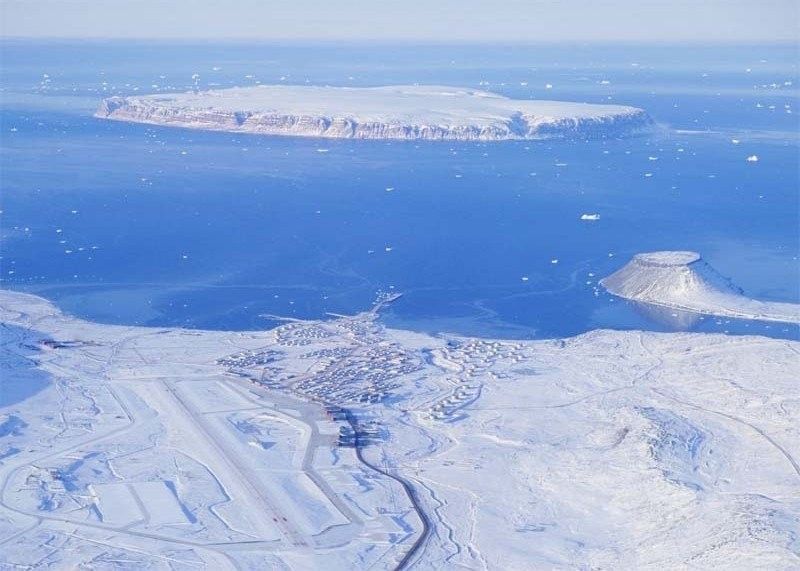
Why is France interested the Arctic? Spanning from Greenland to Svalbard, the Arctic regroups European strategic, economic and environmental interests. France’sArctic Defence Strategy, published by the General Directorate of International Relations and Strategy (DGRIS) in March 2025, highlights the need to secure French interests in a rapidly evolving region. This strategy emphasizes France’s commitment to regional stability and preserving freedom of action in the region. France prioritizes cooperation with Arctic territories including Greenland.
French engagement in the Arctic is multidimensional, encompassing scientific research, environmental protection, economic involvement and strategic considerations.
It is important to note that France’s Arctic strategy did not emerge in reaction to recent U.S. blackmail. The 2022 French Polar Strategy highlighted the central role of Greenland and the need for a science-based cooperation to address the impacts of climate change and rising sea levels. This strategy recalls the historical depth of France’s presence in Greenland:
- 1948: First French Arctic scientific missions conducted along the western coast of Disko Bay by theExpéditions polaires françaises, led by French ethnologist Paul-Emile Victor, whose name was given to the French Polar Institute.
- 1950s: First geographic and ethnographic mission in Northern Greenland by Jean Malaurie.
But it is worth saying that recent geopolitical developments have reinforced France’s commitment to Greenland. Emmanuel Macron became the first French President to visit the territory on June 15th 2025, marking a historic milestone in France and Greenland relations. This visit aimed to demonstrate support against U.S. pressure and to affirm „European solidarity” in defending Greenland sovereignty and territorial integrity.
As tensions surrounding Greenland have intensified, France has announced the opening of a Consulate General in Nuuk on February 6th, a move defined by French Ministry of Foreign Affairs Jean-Noël Barrot as a „political signal”. These tensions have also prompted European countries to strength cooperation and defense mechanisms aimed at ensuring stability in the region. However, while Europe seeks to act as a multilateral actor, it remains unable to operate as a unified entity. As a result, several states have pursued national initiatives, including participation in Operation Endurance.
In conclusion, even though France’s actions can be understood as a response to an emerging crisis, these actions are far from being improvised. Rather, they build upon a well-articulated Arctic strategy.
Author: Emma Dupuy
Bibliography:
- Anews. (2025). France to open its consulate in Greenland on Feb. 6 amid rising US threats.
- Choquet, A. (2025). « La coopération scientifique, amorce d’une relation renforcée entre la France et le Groenland ».
- Direction générale des relations internationales et de la stratégie. (n.d.). « Stratégie de défense pour l’Arctique (FR/UK) ». Consulté le 21 janvier 2026, sur
- Direction générale des relations internationales et de la stratégie. (2025). « Observatoire de l’Arctique ».
- Fondation pour la Recherche Stratégique. (2026). Observatoire de l’Arctique, Bulletin Mensuel, n°69. https://www.observatoire-arctique.fr/wp-content/uploads/2026/01/ObsArctique\Bulletin\33\Janvier\2026.pdf
- Legrand, N. (2026). « Chasseurs alpins et forces spéciales : l«élite française du « grand froid »déployée au Groenland ».
- Ministère des Armées. (2026). « Stratégie de défense pour l’Arctique : défendre nos intérêts dans une région en mutation ».
- Rogal, A. (2025). « »Message of solidarity and friendship«: Emmanuel Macron visits Greenland ». _


