












- ANALIZA
- WIADOMOŚCI
- KOMENTARZ
Greenland's riches: opportunity or a myth?

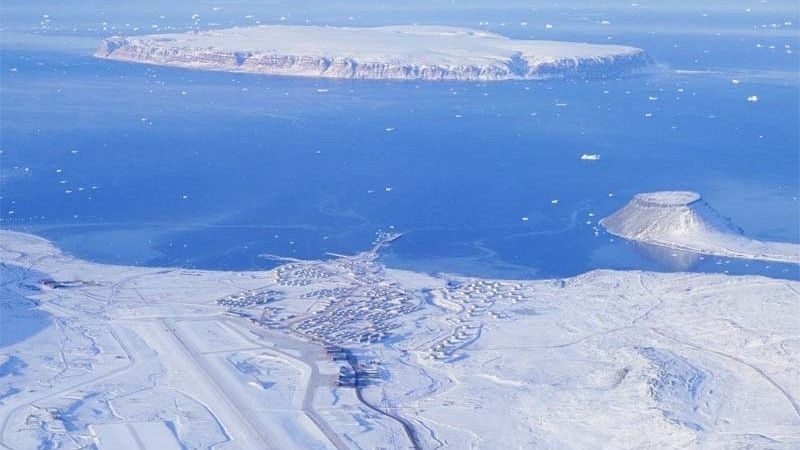
Photo. Wikipedia
The debate surrounding the possible takeover or purchase of Greenland by the US repeatedly revolves around the island’s natural resources. But is Nuuk really a modern-day “gold mine”? And does Washington need to gain full control of Greenland to reap the benefits of extracting critical raw materials?
“We need Greenland (…) from a national security standpoint,” the US president told reporters aboard Air Force One on January 4. And although the United States wanted to acquire Greenland as early as 1946, and Trump hinted at this during his first term in 2019 and almost immediately after his re-election in 2025, these proposals have so far seemed like an absurd pipe dream.
In the beginning, there was oil
One of the arguments cited in the discussion about the acquisition of Greenland is its natural resources. Indeed, the island has deposits of oil, precious metals, and critical raw materials, and even precious stones such as diamonds, rubies, and sapphires. However, in the beginning, the focus was primarily on the possibility of extracting “black gold.”
Interest in potential oil reserves had been evident since the 1970s, but it increased significantly at the beginning of the 21st century. According to a 2007 report by the US Geological Survey (USGS), Greenland’s offshore and onshore areas contain approximately 31.4 billion barrels of oil equivalent and 10 billion cubic meters of natural gas.
Oil companies rushed to obtain licenses for exploration and exploitation of the deposits. Industry giants such as Shell, Chevron, ExxonMobil, Equinor, and Eni participated in the projects. However, almost 50 years of exploration did not bring the expected results, and the island did not turn into an oil Eldorado.
Despite the completion of several dozen exploratory oil wells, most of them turned out to be “dry” or did not contain enough gas and oil to start commercial operations. As a result, not a single barrel of oil has been extracted in Greenland to date, despite the fact that billions of dollars have been spent on exploration.
Finally, in 2021, the island’s government decided to ban the issuance of new licenses for oil and gas exploration, citing environmental concerns and low economic profitability, which also took into account the global shift away from fossil fuels.
“This step was taken for the sake of our nature, for the sake of our fisheries, for the sake of our tourism industry,” said Greenland’s Minister of Natural Resources, Naaja Nathanielsen.
See also 
New “green” gold
However, the end of the oil dream did not mean the end of the dream of wealth. The Greenlandic government decided to turn its attention to rare earth metals and critical elements—the future of mining and the cornerstone of the global energy transition.
And there is no shortage of these in Greenland. As Nick Bæk Heilmann of the consulting firm Kaya Partners points out, the island has 43 of the 50 critical raw materials listed by the USGS.
This is also confirmed by a report by the Geological Survey of Denmark and Greenland (GEUS): there are a total of 35 deposits containing critical raw materials and rare earth metals, some of which contain significant reserves of lithium, tantalum, niobium, molybdenum, zirconium, and hafnium.

Scientists from the Danish GEUS point out that in many cases, deposits of critical raw materials are comparable to those in Australia, Canada, or Scandinavia, and Greenland has great potential in terms of undiscovered resources.
All of the elements mentioned are essential in key sectors of the economy, such as defense and energy: from LEDs, semiconductors, and solar panels to batteries for energy storage and electric cars.
Nevertheless, GEUS scientists emphasize that although the island’s raw material potential is significant, the estimated quantities of critical raw materials “are subject to considerable uncertainty and require further verification.”
It's not that simple
Drilling in the Arctic region is a risky and costly undertaking. The northern ecosystem (soil, vegetation, and microorganisms) regenerates extremely slowly compared to temperate climates.
Environmental pollution or habitat change can disproportionately harm bird and mammal populations, and mining-generated water pollution threatens traditional fishing, which is the basis of the local economy.
However, environmental concerns are not the only issue. Extreme weather conditions require the use of advanced technological solutions, which hinders the work of mining companies and increases investment costs.
Due to the Arctic climate, machine maintenance costs are high (temperatures can drop to -40°C), and the exploration window is limited to about four months per year. Similarly, shipping access is limited by sea ice, even though the deep fjords are ideal for large transport vessels. Even assuming scenarios of increased land accessibility resulting from global warming and glacier retreat, it should be noted that exposed ground is often unstable and prone to landslides.
Most areas on the island can only be reached by helicopter and boat, and any mines would have to secure their own energy and water sources, as well as communication lines. It is therefore essential to build all infrastructure elements from scratch.
An additional problem is the lack of labor on the island—only 5 percent of the population works in technical professions, and the Greenlandic authorities are aiming for 30 percent local employment in mines, which may slow down the development of projects. A complex tax system (rates ranging from 30-45% of mining profits) and license fees do not encourage investment, nor does the suspension of uranium mining (which co-occurs in many ores containing rare earth metals).
All this affects the profitability of mining projects. According to industry analysis by SNL Metals&Mining, operating costs in the Arctic are 2-3 times higher than in comparable investments in temperate climates. According to Discovery Alert, former Greenland Prime Minister Dr. Aleqa Hammond pointed out that infrastructure gaps increase the initial costs of large projects by $0.5-1 billion, creating serious barriers to development.

Not a unique situation?
Nick Bæk Heilmann also tempers the excitement generated by potential critical raw material resources. “We need to debunk a myth. Greenland is not unique in terms of the size of its rare earth metal deposits; they also exist in many other places,” emphasizes the Kaya Partners expert.
There is still no business case for mining critical minerals in Greenland. China controls the prices. Critical minerals, rare earth minerals, are sold at very low prices.
Nick Bæk Heilmann, Senior Associate at Kaya Partners
American and Canadian companies, as well as the European Union, seem to have a different opinion. Currently, many mining projects involving REE and critical raw materials are being developed in Greenland, including:
- Sarfartoq (neodymium, praseodymium, and niobium deposits)
- Dundas (metallic titanium deposits, the project has received support from the European Raw Materials Alliance
- Amitsoq (high-quality graphite deposits, crucial for EV battery production)
- Malmbjerg (molybdenum deposits, important for the steel industry)
- White Mountain and Majoqqap Qaava (anorthosite deposits, used in the production of fiberglass)
It is worth mentioning that Neo Performance Materials (which manages the Sarfartoq project) also owns a REE processing plant in Estonia (Silmet). The integration of the Greenland mine with the Estonian smelter would create a complete intra-EU supply chain, which is one of the European Commission’s priorities.

However, the largest concentration of REE has been found in the province of Gardar, in the Ilímaussaq and Motzfeldt deposits. It is there, in the south of the island, that the Tanbreez project of the American company Critical Metals operates, working on one of the world's largest undeveloped REE deposits outside China, with resources estimated at 4.7 billion tons of multielement ore.
As reported by Reuters in December last year, Critical Metals has already pre-sold 75% of Tanbreez’s planned production, which has been divided between the United States and Europe. The company has declared that it is open to investments from Washington. Mining is scheduled to begin in 2027, with initial production planned for 2028.
Nevertheless, it should be remembered that currently, only the White Mountain mine is active in Greenland, along with two other facilities mining gold and precious stones. Sarfartoq is not yet mining on a commercial scale, Dundas is awaiting full financing, and Amitsoq and Malmbjerg have received a 30-year mining license.
The extraction of rare earth metals is therefore still in its infancy, with most of them coming from trial mining operations such as Tanbreez.
The purchase of the island is not necessary
Given these investments, is the US really forced to take over the island in order to exploit its raw material resources? The answer is no.
Greenland remains open to foreign investment, including from the US, as best illustrated by the Tanbreez project. The Greenlandic government also plans to develop REE and critical raw material mining on the island, while maintaining the principles of sustainable development and benefits for local communities. The goal remains to create a stable investment environment, especially for European and (at least so far) American companies.
“I firmly believe that critical raw materials are not the driving force behind the US’s takeover of the island,” Heilmann emphasizes. “Greenland is open to investment in the mining sector and the extraction of critical elements, and all green areas are covered by a general social license for mining.”
So why does Washington keep coming back to the topic of purchasing the island, given that there are no legal, business, or social obstacles to the extraction of raw materials that are crucial to both the US and European economies? Perhaps geopolitical factors do indeed prevail here, or perhaps… the interests of tech billionaires.
To sum up: Greenland has oil and gas deposits, but despite 50 years of exploration licenses and the involvement of global oil giants, it has not been possible to find sufficient resources to start commercial operations. Perhaps with the melting of the ice cap, their availability would increase, but the question is: is it worth risking damage to the delicate Arctic ecosystem (without being sure that the investment costs will actually pay off)?
Greenland’s current wealth lies in its critical raw materials and rare earth metals, which could measurably support European and American supply chains, especially if companies and politicians focus on rebuilding the processing and refining of elements, which is currently dominated by China. It is in this area that the EU and the US face their biggest challenge in regaining supply chain independence. Nevertheless, the acquisition of Greenland by the United States is not a prerequisite for developing a profitable mining industry there that would benefit Washington.


