- WIADOMOŚCI
The American army is introducing a new hand grenade into service. The first such change since the Vietnam War

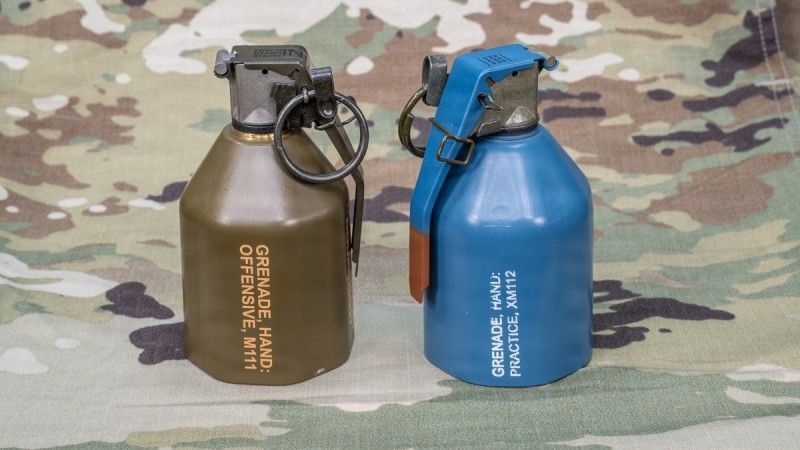
Photo. U.S. Army
A new offensive hand grenade, the M111, has been approved for service. It will replace the old MK3A2.
The outdated series of grenades will be phased out, as their usefulness had already been limited due to safety concerns regarding their asbestos body. The body of the new grenade is made of plastic and is fully utilised upon detonation.
The design of the grenade incorporates lessons learned from the Iraq War, where combat operations were often conducted in urban environments. In confined spaces, fragmentation grenades posed a particular danger to friendly forces.

An important aspect of the M111’s design is its standardisation. As the U.S. Army notes: “The new grenade and its training version, the M112, leverage the same five-step arming process as the M67 and its training version, the M69, allowing Soldiers to train as they fight, improving combat performance and effectiveness. In addition, the M111 and M112 use the same fuses as the M67 and M69 respectively, thereby enabling Army acquisition professionals to save costs by leveraging economies of scale made possible by common fuse production lines when sourcing both grenades.”
The first version of the MK3 grenade was developed in March 1918 and underwent two modifications, the last of which occurred in 1968 (the MK3A2 version). Instead of fragments, the M111 relies on blast overpressure. It generates a powerful shockwave upon detonation, which is just as lethal as conventional shrapnel. The new grenade will be primarily used in enclosed and restricted terrain.