












- WIADOMOŚCI
Defence at the final frontier: space and U.S.-India prospects

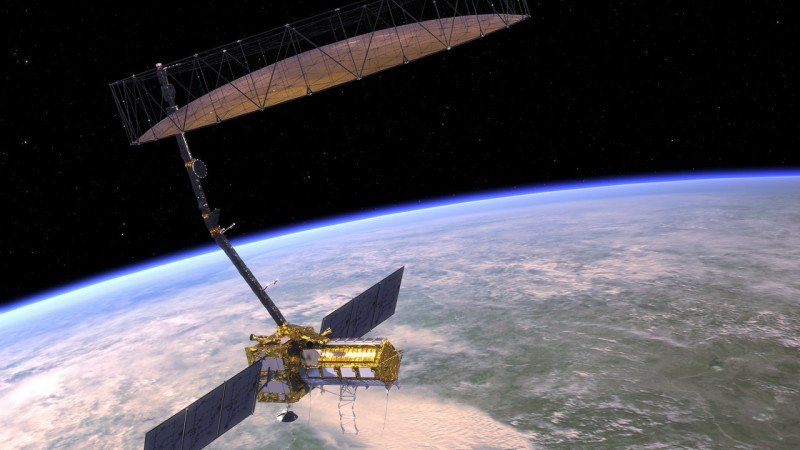
Photo. NASA
Launched this past July, NISAR has been touted as one of the most advanced radar systems in NASA’s tenured history. So, it is surprising to some, but not all, that this project was the result of a collaboration between NASA and the Indian Space Research Organization (ISRO).
The ISRO was the first international partner to share interests with NASA on the mission, even taking responsibility for one of the two advanced radar systems used by the satellite. While the system is predominantly dedicated to Earth-observation capabilities, the broader implications of the mission suggest a pair of countries willing and able to test the boundaries of spacecraft. Furthermore, the boundaries of space reveal an uncharted environment that can blur the civil-military line, making it a priority for future defense objectives.
Accounting for India’s self-reliant initiative and defense modernization, space stands out as a critical dual-use frontier, where civil applications such as climate monitoring and communications intersect with military-strategic imperatives like intelligence, surveillance, reconnaissance (ISR), missile defense, and satellite resilience. As described in the above example, projects are moving away from „handouts” and more closely aligning with co-developed initiatives. In this evolving landscape, the U.S.-India defense partnership has emerged as a pivotal factor, not only supporting India’s technological ascent but also shaping its role as a rising space power with both regional and global implications.
Drivers of India’s defense modernization
Since make in India was officially announced in 2014, the push to reduce reliance on foreign suppliers became tangible, both broadly and in defense. In the defense sector, indigenous production has increased, and the procurement process has been revamped to prioritize the domestic industry. As a part of India’s new 15-year plan, the Ministry of Defense notes that space warfare, as an effect of an unprecedented technological revolution, will have a revolutionary impact on the battle, suggesting that the defense apparatus be „equipped accordingly.” The TPCR-2025 outlines India’s push to expand satellite-based applications for its armed forces, including secure satellite communications, intelligence-surveillance-reconnaissance (ISR) payloads, meteorological monitoring, and integration with the Indian Regional Navigation Satellite System (IRNSS).
These advancements are undertaken with the larger geopolitical environment in mind. For China’s space-defense capacity, the recent PLA parade celebrated innovations and enhancements made by its military, including the HQ-19. This device acts as an interceptor used to target low Earth orbit (LEO) objects such as satellites. And, just as China adopts gray zone tactics when interacting with territory in the South China Sea, it could soon be deployed into space, especially with Chinese plans to construct a permanent moon base by 2030 in partnership with Russia. Even Pakistan has picked up its space modernization, launching its newest remote sensing satellite from a Chinese space center, signaling its commitment to China through deepening cooperation, as well as desires to become a key space player.
At the 16th annual McAleese Conference, Vice Chief of Space Operations Michael Guetlein suggested that the standard of international space behavior is shifting, implying future space exploration and force capabilities may very well need to extend beyond what the current set of rules and regulations safeguard. Furthermore, space is the next big economic sector, with estimates that the space economy will reach up to $1.8 trillion by 2035. Finally, space will run parallel with cyber toward developing connectivity at a pace unseen before in humanity’s history, benefiting supply chains and digital communication alike. Therefore, space is seen not just as a rapidly changing security environment, but a technological and economic imperative, with ramifications extending to profits and global influence.
Paras defence and India’s emerging space-industrial base
Paras Defence and Space Technologies (PST) has emerged as a critical player in India’s evolving space-industrial ecosystem, with its contributions spanning both strategic and technological domains. Its investment in an optics manufacturing park in Maharashtra promises to generate over 2,000 jobs while strengthening India’s indigenous capacity for high-precision systems. In the space sector, PST’s development of satellite and antenna technologies directly supports India’s efforts to reduce foreign dependence in critical infrastructure. Its partnership with Germany’s HPS GmbH on deployable antenna systems positions the company to play a role in future global satellite supply chains, aligning with India’s ambitions to become a competitive space power. Though just one example, PST highlights the growing strategic importance of the space industry, which is only heightened by future implications of space as a battlefield.

Space as the next frontier in India’s defense modernization
To frame this challenge, the insights of Paul Szymanski, whose work dissects the dynamics of space warfare, offer a valuable guide, raising questions about whether space systems are already under attack, how adversaries might employ counter-ISR strategies, and what political and military consequences follow. As India expands into the space domain, this work is instructive because it is a reminder that space power must be assessed not only in terms of technology, but also through the intentions, perceptions, and escalation dynamics that shape conflict. His overall reasoning on the significance of space highlights that the real questions are less about whether countries can build satellites, and more about how adversaries might interpret, target, or exploit them in ways that affect terrestrial security and political outcomes.
India’s space program has recently achieved several significant milestones that underscore its growing technological and strategic capabilities. Chandrayaan-3’s success and the ongoing Aditya-L1 solar mission highlight India’s expanding expertise in planetary and solar science, as well as its cost effectiveness. The $1.5 billion NISAR project, a collaboration with NASA, provides advanced Earth observation and disaster management capabilities, while the Gaganyaan human spaceflight program and plans for an Indian space station by 2035 indicate ambitions to establish a sustained presence in low-Earth orbit. Collectively, these developments demonstrate India’s commitment to leveraging space not only for scientific and civilian applications but also as a potential cornerstone of its defense modernization agenda.
India must also consider the evolving threat environment for its space assets. Both non-kinetic attacks, such as jamming, spoofing, or cyber intrusions, and kinetic threats are being constantly shaped by the regional security landscape. China’s demonstrated ASAT capabilities in 2007, 2013, and 2021 highlight a credible risk of direct attacks on satellites, whereas Pakistan is more likely to employ electronic warfare to disrupt India’s ISR capabilities. Adversaries may exploit counter-space operations to degrade India’s situational awareness prior to terrestrial conflicts, whether along contested land borders or in the maritime domain. As such, securing space-based assets remains a central focus for India’s defense modernization.
The U.S.-India relationship: Defying gravity
Despite trade turmoil, U.S.-India defense relations are continuing to drive ahead, exemplified by the recent 10-year bilateral defense pact. And like other defense domains, space offers shared strategic interests for both the U.S. and India. Both countries worry about China’s expanding space capabilities, including gray-zone non-attributable attacks and cyber interference. Space has become a pillar of the U.S.-India TRUST („Transforming the Relationship Utilizing Strategic Technology”), with high-profile collaborations such as the NISAR mission demonstrating trust, technology sharing, and operational alignment. Returning to the Trump-Modi meeting in February, civil space collaboration focused on long-duration missions and planetary protection, as well as „connectivity, advanced spaceflight, satellite and space launch systems…and advanced space manufacturing.”
The strategic implications of this space cooperation are profound. India is already positioning itself as a regional space hub, contributing to Quad and broader Indo-Pacific coordination while now promoting domestic space-industrial growth. For instance, India launched the 4,410 kg CMS-03 communications satellite on November 2nd, providing multi-band coverage for the Indian Navy’s operations. These implications loom larger when considering some of the divergence between the U.S. and India on the international stage. India abstained from the 2022 and 2024 U.N. resolutions on limiting space threats, reflecting its concern that such norm-making processes are exclusionary or insufficiently representative.
Potential space conflict carries significant consequences: disabling Indian satellites could degrade terrestrial warfighting capabilities, trigger escalation in the Indo-Pacific, generate political backlash, and challenge India’s reputation as a responsible space power. Additionally, even successful defense of assets may provide adversaries with lessons for future conflict, highlighting the importance of resilient public-private R&D ecosystems and robust deterrence strategies to maintain strategic advantage.

Conclusion
Ultimately, the outcomes of conflicts in space can translate into effects on the ground, making space a growing priority for states seeking to enhance defense capabilities. In India, defense modernization and space strategy are converging through coordinated public sector planning and private sector innovations, while the U.S.-India partnership plays a growing role, with collaborative space initiatives reflecting a trust-based, forward-looking relationship. For both Washington and New Delhi, the space frontier is a critical domain for shaping the strategic landscape of the 21 st century.
Author: Tyler Lissy is a Motwani-Jadeja U.S.-India Fellow at the Pacific Forum, researching India’s defense modernization and U.S.-India strategic cooperation. A Dickinson College graduate and 2025 class commencement speaker, he has worked with the U.S. Army War College, Diamond6 Leadership, and U.S. Congressman Ryan Mackenzie’s office. He will pursue a Global Policy M.A. at the University of Maine.


