












- KOMENTARZ
- WAŻNE
- WIADOMOŚCI
Putin’s Visit to India – extended protocol, but the real money lies elsewhere

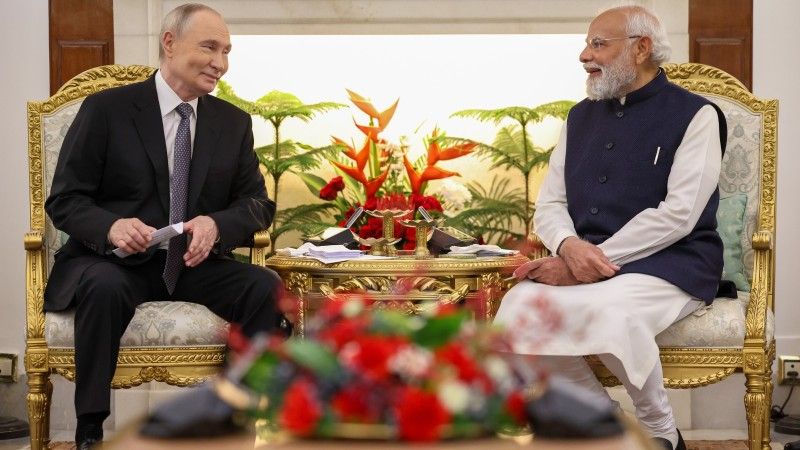
Putin’s visit to India may attract attention with protocol, symbolism and carefully staged photographs, but the key negotiations are not happening in front of cameras. The real value lies in energy deals, defence cooperation and access to technologies that both sides will quietly pursue after the visit ends.
On 4–5 December 2025, Russian President Vladimir Putin arrived in New Delhi for his first visit in four years. The Indian government welcomed him with an exceptionally elaborate protocol seldom afforded to foreign leaders, underscoring both the importance of the visit and the unique nature of Indo-Russian relations. Images and footage circulated globally, serving as a subtle message to Western capitals. Efforts were made to discuss expanding areas of cooperation, yet Moscow had little new to offer. Today, the bilateral trade relationship hinges almost entirely on India’s purchases of Russian arms and crude oil. Advanced technologies and meaningful sectoral investment come from other partners – which is precisely why India is moving toward the imminent conclusion of a free-trade agreement with the European Union till the end of this year.
Putin’s previous trip to India took place in 2021, before Russia launched its full-scale invasion of Ukraine. The intervening years saw two parallel dynamics: India’s massive purchases of discounted Russian oil, and New Delhi’s refusal to condemn Moscow – tempered, however, by an effort to avoid ostentatious displays of closeness that might irritate Western partners.
During this period, bilateral trade ballooned sevenfold. From roughly USD 10 billion in 2020 (for comparison: Poland–India trade totals USD 6–7 billion; India–U.S. stands at around USD 210 billion), turnover surged to nearly USD 70 billion in 2025. The jump is driven almost entirely by India’s large-scale imports of Russian oil. Having lost most European customers after invading Ukraine, Moscow sought new markets; India agreed to buy, but only at sharply reduced prices. As a result, trade soared – though overwhelmingly in one direction. Of the USD 70 billion, an estimated USD 60 billion consists of Russian exports, principally crude.
At the same time, India has been deepening dialogue with Western partners. Negotiations with the EU – with which India conducts around USD 120 billion in annual trade – are expected to yield a free-trade agreement by year’s end. Relations with the United States are more strained: Washington has imposed 50% tariffs on most Indian goods, with President Trump citing India’s continued purchases of Russian oil. By showcasing ties with Moscow, New Delhi appears to be applying pressure on Washington to reconsider its stance.
The pomp and media saturation surrounding Putin’s visit surpassed anything seen in years – more expansive than the G20 summit hosted by India, perhaps even more extravagant than President Trump’s lavishly staged 2020 ”Namaste Trump” rally in Ahmedabad. Indian media was consumed by the visit for days (until a wave of mass flight cancellations abruptly shifted domestic attention). Reporters tracked Putin’s every move, underscoring the „exceptional” nature of Indo-Russian ties. Prime Minister Narendra Modi personally greeted Putin at the airport before escorting him to the PM’s residence. Modi presented him with a Russian-language edition of the Hindu sacred text, the Bhagavad Gita. Posters in Hindi and Russian – pointedly omitting English language and Latin alphabet – lined central Delhi. The visit concluded with a grand banquet, complete with unending handshakes and smiles broadcast worldwide. India did raise the topic of Ukraine, but in cautious, deferential terms designed not to offend their Russian partners.
Substantively, the visit produced sixteen agreements spanning defence, trade, the economy, healthcare, academia, culture, and media, alongside a joint call to raise bilateral trade to USD 100 billion by 2030. Russia pledged continued oil supplies. Both sides sought new avenues of cooperation – with little success. Moscow shows scant interest in importing Indian goods and has few offerings beyond military technologies and raw materials. Tellingly, on the very day of Putin’s visit, major Indian media outlets featured advertisements for French defence equipment – France has become Russia’s chief competitor in India’s arms market. Achieving the projected USD 100 billion in annual trade appears unlikely unless India further increases oil imports. It is equally difficult to imagine Indian parents suddenly opting to send their children en masse to Russian universities; for higher education, the Indian middle class continues to look West, above all to the United States.
The visit was intended, following the Shanghai Cooperation Organization summit in Tianjin, to demonstrate that India maintains close ties even with states currently ostracized by the West. The long-standing Indo-Russian partnership, rooted in the 1970s, also carries an implicit counter-China dimension – one that Beijing likely greeted with little enthusiasm. Numerous agreements were signed, and a breadth of topics discussed, but the concrete output of the visit remains modest.
For India, the real priority lies in securing favorable deals with the European Union and the United States. These are the sources of advanced technologies and substantive economic cooperation – not just discounted raw materials, as it is with Russia. New Delhi is fully aware of this, but also recognizes that Putin’s visit can be leveraged to strengthen its negotiating position. At the same time, Western partners must come to terms with the fact that India will not sever ties with Russia; at most, it may dial those relations up or down. Preserving constructive links with all sides of global conflicts remains one of the core principles of Indian foreign policy.


