












- WIADOMOŚCI
- W CENTRUM UWAGI
- WAŻNE
Defence24 Days: The Eastern flank of NATO is key to the defence of Europe

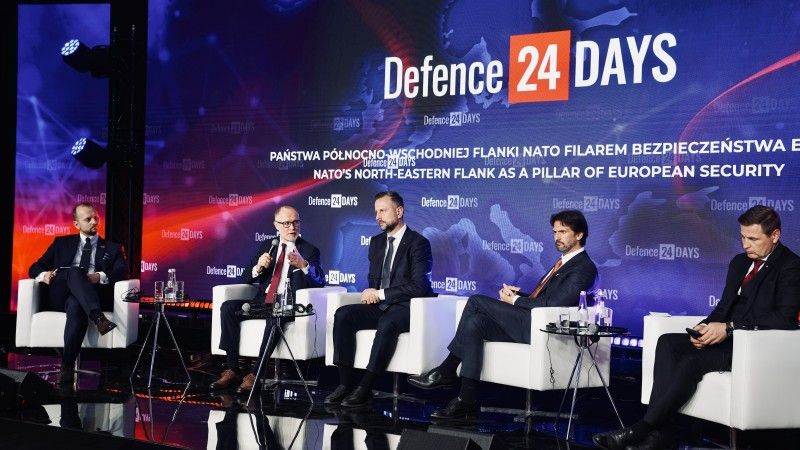
During the opening debate of the 8th edition of the Defence24 Days conference, the ministers of defence from Poland, Latvia, Estonia, and Slovakia discussed security issues in Europe, with particular focus on NATO’s northern and eastern flanks.
The discussion, titled “The Countries of NATO’s Northeastern Flank as the Pillar of Europe’s Security,” featured the following participants:
- Deputy Prime Minister and Minister of National Defence Władysław Kosiniak-Kamysz,
- Deputy Prime Minister and Minister of Defence of Slovakia Robert Kaliňák,
- Minister of Defence of Latvia Andris Sprūds,
- Minister of Defence of Estonia Hanno Pevkur.
The alliance has demonstrated that it can be flexible and capable of meeting tasks and challenges. Currently, the greatest challenges lie in production capacity, ammunition manufacturing, and increasing defence spending.
“Europe has 1.5 million soldiers — that’s a considerable force. We are spending more and more on defence, investing increasingly in security. We are transforming and modernising our forces. Here on the eastern flank, we serve as an example for the rest of Europe on how to act. From our perspective, we have a clear security vector — the threat from Russia. We feel this threat; it is our shared mindset across Central and Northern Europe,” said Andris Sprūds, Minister of Defence of Latvia.

“Our strategic goal is to maintain unity. That should be the most important thing. The next area is cooperation, which consists of three pillars. From a political standpoint, in our region we have no problem with this because of our common threat. The second pillar is military cooperation. In our region, we have very close cooperation, and large-scale military exercises are currently underway. The third pillar is industrial cooperation. We see that everyone is trying to act on their own, supporting their own industry. This should change — we should all act for the security of Europe. Our challenge is how to make good decisions about what to buy for our armed forces. Technologies are changing very quickly, and allocating funds to the right projects has become increasingly difficult,” said Hanno Pevkur, Minister of Defence of Estonia.
“The strength of NATO does not lie in individual capabilities, but in interoperability, experience, and joint commands. That makes deep sense. In reality, this has not yet been tested, but I do not believe that short-term politics will disrupt our long-term security policy. Previously, the focus was on combating terrorism. What is Poland’s role? It is about strategic capabilities and the security architecture in the Baltic region. Every day we face the escalation of hybrid warfare in the Baltic — airspace violations, maritime incidents, acts of sabotage on land. Our role is to be a leader in this part of the world. As Andris mentioned, we are present in Latvia, and our presence there will continue to grow,” said Władysław Kosiniak-Kamysz, Deputy Prime Minister and Minister of National Defence of Poland.

“Our regional cooperation is expanding — as evidenced by the signing of cooperation agreements between Polska Grupa Zbrojeniowa (PGZ) and Estonian companies. Soon, we will present the Borsuk Infantry Fighting Vehicle equipped with the Turra-30 turret for export markets,” added Kosiniak-Kamysz. “However, the key element remains internal security. In Poland, there is no problem going out into the city at night and feeling safe. That is no longer possible in the West. We, sitting here, have defended our cultural identity, and I believe we will become one of the destinations for migration — including young French people who will also want to experience this sense of peace,” the Polish defence minister added.
“Slovakia wants to engage in regional security. Next year, we plan to participate for the first time in the Baltic Air Policing mission with our new F-16V aircraft. We also plan to deploy two Barak air defense system batteries as part of a rotational mechanism to strengthen the security of the Baltic States and the eastern flank,” said Robert Kaliňák, Deputy Prime Minister and Minister of Defence of Slovakia.


