












- WIADOMOŚCI
Hybrid warfare with Russia. Migration as a weapon

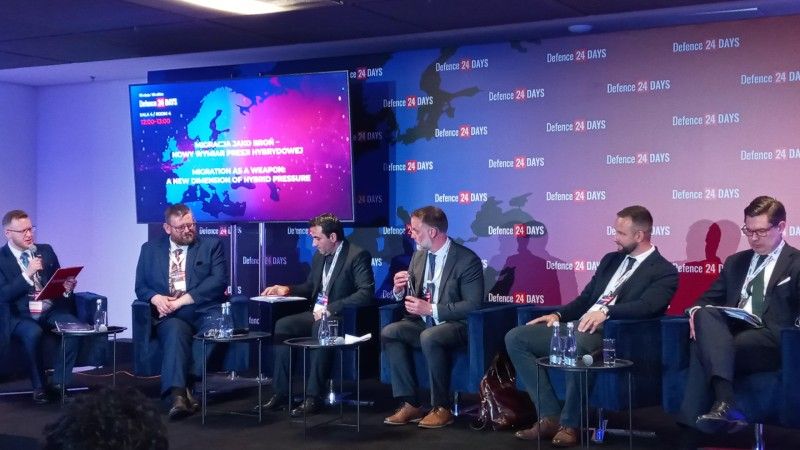
Defence24Days is underway. A panel
Dr Matti Pesu, Senior Research Fellow at the Finnish Institute of International Affairs (FIIA), talked about the Finnish perspective. He explained that Russia began orchestrating migration to Finland in 2023. The numbers were not enormous compared to Poland and Lithuania, but they were still a danger to be reckoned with. In response, Finland has closed its entire land border with Russia in late 2023. The expert insisted on remaining cautious regarding the risk of over‑exaggerating the situation. It is unlikely that this hybrid warfare will turn into a full-scale Russian war with NATO. Too strong actions could cause misunderstandings within NATO.
Dr Michał Piekarski from the University of Wrocław talked about the Polish approach. The question is not „will another act of sabotage happen?” but „when?” Poland is being attacked in different ways; the aggressor chooses the place and method of attack, and we are not able to predict whether these attacks will be simple, less expensive, or more sophisticated. Polish railway is a realistic target for sabotage. It will be attacked because of its use in many ways: as a means of civilian transport, as a way to export grain from Ukraine, as a transport of support for Ukraine. In a crisis situation, the railway will become a tool for evacuating the population. This is a threat to the infrastructure that is strategically important to us. We need to know which railway lines are important to us because they will be attacked. Dr Piekarski has also touched on the topic of the Polish border with Belarus. The number of people trying to cross the Polish border illegally is very low. In his opinion, it is probably time to demilitarise the border with Belarus. However, the whole Polish society needs to understand that we are not in state of peace in which we were for the last 30 years.
Dr Niklas Nilsson, Associate Professor in War Studies at the Swedish Defence University, brought us closer to the Swedish perspective. He emphasised that Sweden is not exposed to the hybrid threat in the same way that Poland is. They managed to evade most of the kinetic aspects of it—no sabotage actions, etc. After 2022, some efforts of Russian espionage have been seen and brought to court. Sweden has experienced an increased number of cyberattacks. There is certainly an increased hybrid activity. It is a reality when you decide to support Ukraine. The current stance is quite measured—so as not to incorrectly attribute every incident to Russia. What Sweden experiences more than others are the activities of the Russian shadow fleet. The coast guard has already stopped four such vessels. Dr Nilsson has also emphasised the importance of the emotional dimension, in which hybrid threats are most effective—changing our view of reality.
Major Festim Alimadhi, Officer at NATO COE DAT, touched on the topic of terrorism in regard to hybrid threats. He expressed the need to understand that those activities could be both military and non-military. There still is a problem with discussing terrorism, as it is mostly associated with suicide bombers. Now that we are in the future, we need to adapt. Terrorism does not need to kill a number of people to deal great damage. The major gave an example of cutting cables used by Yemeni banks, which caused a loss of several billion dollars. In his opinion, some forms of terrorism should be treated as a form of hybrid warfare.

Dr Filip Bryjka, analyst at the Polish Institute of International Affairs (PISM), talked about how Russia recruits potential agents. It has quite effectively adapted to the new situation after its aggression against Ukraine. There is an increased role of so‑called „illegals”: low‑cost agents, recruited online, motivated financially, not really specialised in anything. First, they are given very simple tasks like painting graffiti or publicising propaganda. Afterwards, they are given more sophisticated tasks, like planting hidden cameras in critical spots, for example. Russia wants to discourage us from supporting Ukraine further, especially via hiring Ukrainians to perform such tasks. And it works. There is also an increased number of Latin Americans used in their operations.
Russia has not used all of its assets yet. They are still testing our vulnerability. We are being forced to allocate our resources to less important sectors, while the important ones may be left open. We should respond proactively to Russian actions. Ukraine proves that with attacks inside Russian territory. We should be more offensive; current tackling of the shadow fleet is a good example.


