












- ANALIZA
- WIADOMOŚCI
- WYWIADY
Determinants and evolution of the Russian concept of information warfare

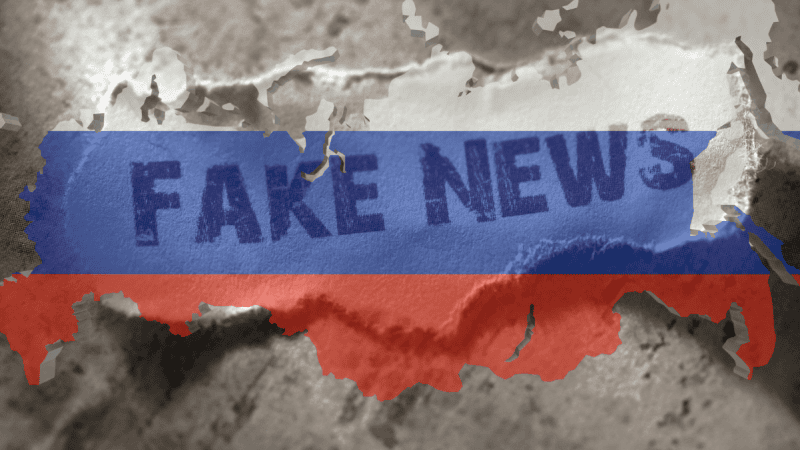
Photo. Canva/edycja: CyberDefence24
Information warfare constitutes one of the key elements of Russia’s strategic competition. In Russian doctrine, information is not perceived solely as a tool supporting military operations, but also as an independent instrument for shaping the strategic environment, influencing adversaries and securing national interests.
Understanding the Russian concept of information warfare requires taking into account a range of historical and ideological factors that have shaped the state’s approach to the use of information in strategic competition. From the military traditions of the Russian Empire it follows that control over information and manipulation of narrative are not new phenomena. Already in the nineteenth century, during conflicts with Turkey, Sweden and in the Napoleonic wars, Russian command recognised the importance of influencing the morale of opponents, disorganising their activities and strengthening its own political position.
Propaganda, both written and oral, was used to legitimise state actions and shape public opinion in regions under Russian control. These experiences became the foundation for later activities in which information was treated not merely as a means but as an element of strategy.
The period of the Soviet Union significantly developed the idea of using information in a systematic and comprehensive manner. Propaganda, control over the media and the organisation of psychological operations were central tools in both domestic and foreign policy. The USSR introduced into its military doctrine the concept of psychological warfare, assuming the use of information to destabilise the opponent, weaken its morale and influence political decision-making without the need to employ military force. The experience of the Cold War also played a crucial role, as information struggle became an instrument of ideological competition with the West. During this period an awareness developed that information could serve a strategic function and that control over it could give the state an advantage both militarily and politically.
The ideological foundations of contemporary Russian information warfare are equally significant. Marxist-Leninist thought in the USSR introduced a deeply rooted conviction that control over social consciousness is the foundation of power. Propaganda served as a tool for legitimising authority and shaping public opinion, both domestically and abroad.
After the collapse of the Soviet Union and during the period of political transformation in Russia, this ideology was modified but retained its central assumptions: the state should maintain full control over information in order to protect its strategic interests and strengthen its international position. Contemporary Russian doctrine combines Soviet traditions with national-conservative and geopolitical elements, emphasising the importance of „Great Russia” and the protection of its influence in the post-Soviet space and globally. In this context, information warfare is not merely an element of military conflict but an asymmetric instrument enabling the pursuit of strategic objectives without full-scale mobilisation of the armed forces.
The geopolitical context and rivalry with the West constitute another factor shaping the Russian concept of information warfare. The Russian Federation perceives itself as a participant in multipolar global competition in which informational superiority may determine the outcome of strategic confrontation.
Information therefore becomes an asymmetric tool allowing Russia to act effectively against states with economic or military superiority. The strategic use of media, cyberspace, disinformation campaigns and propaganda narratives enables the achievement of political and military objectives with limited direct involvement of armed forces. In this sense, Russian information warfare constitutes an integral part of state strategic policy, in which historical experience and ideology are closely connected with contemporary geopolitical challenges.
The theoretical foundations of the Russian concept of information warfare were described by Russian theorists already in the twentieth century. Yevgeny Messner – author of the concept of „rebellious wars” – predicted that future conflicts would be characterised by the blurring of boundaries between war and peace, and between regular and irregular operations. In his view, mass psychology would become decisive, and the objective of struggle would not be the physical destruction of enemy forces but the control of social consciousness. Messner anticipated that actions such as diversion, sabotage, terror, disinformation, agitation and propaganda would gain greater importance than classical armed clashes. He argued that victory could be achieved by undermining morale, introducing chaos and creating a sense of helplessness within the enemy society.
Practical confirmation of these predictions appeared in post-Soviet conflicts involving Russia. The war in Chechnya illustrates how regular forces could be combined effectively with guerrilla tactics, terrorism and psychological operations. Chechen forces, using mobile radio and television broadcasting, were able to lower the morale of Russian soldiers, and their actions extended beyond the battlefield to include attacks in Russian cities. The conflict became a laboratory of future hybrid wars, in which the front line is elusive and combat occurs simultaneously in physical and informational space.
A new quality emerged with the annexation of Crimea and operations in eastern Ukraine in 2014. Russia employed the full spectrum of measures – from diplomacy and economic pressure, through cyber operations and information warfare, to covert use of special forces. The so-called „little green men” seized key facilities in Crimea within dozens of hours, while an intensive disinformation campaign was conducted simultaneously in state and social media, gas supply cut-offs were threatened and Ukraine’s information infrastructure was attacked.
These actions were perfectly synchronised and extended over time, making them difficult to identify clearly and slowing the reaction of the international community. Analysis of the Ukrainian conflict allows rejection of the thesis that hybrid warfare is the domain solely of non-state actors – the Russian Federation used this strategy as a state possessing full military and political potential. Similar patterns appeared in Syria, where military intervention was covered by a narrative of counter-terrorism while simultaneously producing political effects in Europe through the migration crisis.
Russian military theorists further developed these concepts, adapting them to new technological conditions. General Makhmut Gareyev emphasised the significance of information warfare, which enables destabilisation of the opponent without formal declaration of war by manipulating public opinion, creating a „fog of war” and paralysing command systems.
Vladimir Slipchenko described future conflict as „contactless warfare”, in which precise long-range strikes destroy key infrastructure elements before a classical clash occurs. Finally, General Valery Gerasimov, Chief of the General Staff of the Armed Forces of the Russian Federation, pointed to the growing role of non-military means – political, economic, informational and psychological – which may be more effective than traditional armed operations. In his view, twenty-first-century wars are characterised by the blurring of the boundary between war and peace, between offensive and defensive operations, and military actions often appear only in the final phase of the conflict.
In practice, Russian information warfare employs a broad spectrum of techniques: manipulation of historical narratives, creation of fake accounts and bots on social media, generation of fake news, instigation of social protests and support for pro-Russian political parties in Western states. The aim is to produce „informational chaos” in which facts mix with half-truths, society loses trust in its own institutions and becomes susceptible to directed psychological influence. Equally important is the „fog of war” – a condition of uncertainty and ambiguity that hinders the opponent’s ability to recognise the Kremlin’s real intentions and make adequate decisions.
The evolution of the Russian concept – from Soviet propaganda traditions, through experiences in Chechnya and Ukraine, to contemporary cyber operations – demonstrates that Moscow consistently develops the capacity to conduct so-called wars of the new generation. Their essence lies in the integration of military and non-military activities, in which information and mass psychology play a key role.
Control over narrative and social perception may produce strategic effects comparable to, and often greater than, traditional military operations. Russia therefore conducts conflict in a „grey zone”, where the boundary between war and peace becomes fluid and aggression is difficult to identify unequivocally. In this way the Kremlin achieves geopolitical objectives – from weakening adversaries and destabilising neighbouring regions to strengthening its own position as a global power – without the need to undertake full-scale military operations.
In conclusion, the development of the Russian concept of information warfare demonstrates that the Kremlin treats information not merely as a means of communication but as a strategic resource equivalent in importance to military potential. The evolution of this doctrine – from Soviet experience, through the chaotic experiments of the 1990s, to the formalised hybrid doctrine of the twenty-first century – confirms that information has become a central instrument for influencing social perception, public opinion and political decision-making both domestically and internationally.
The integration of propaganda, cyber and psychological activities with foreign policy and military operations enables Russia to conduct conflicts of a new generation in a systemic and multidimensional manner, in which the boundary between war and peace is fluid. At the centre of this strategy lies the conviction that control over narrative and perception may produce strategic effects often exceeding traditional military actions, and information warfare becomes not merely an offensive tool but an integral part of the state security system, enabling the pursuit of long-term geopolitical objectives.


