












- WIADOMOŚCI
- ANALIZA
Europe to significantly boost military mobility - shortening troop transfer times on the continent

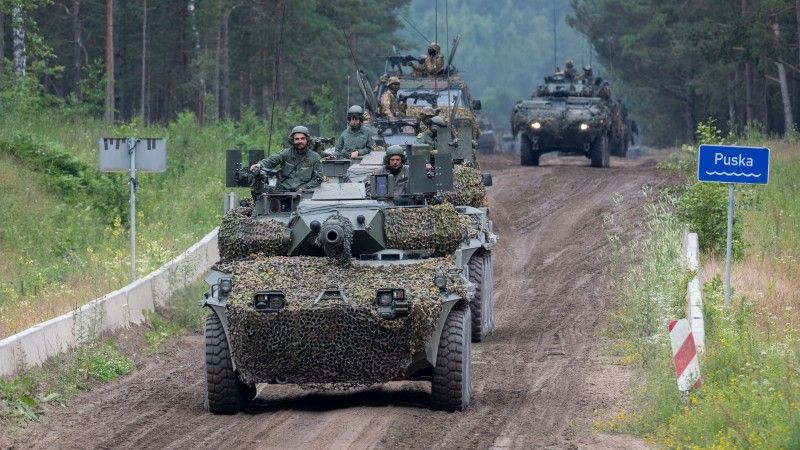
Photo. NATO Multinational Brigade Latvia/X
European NATO countries want to tackle the problem of insufficiently fast transport of military equipment across the continent. The EU’s military mobility zone is intended to help significantly.
For some time now EU decision-makers have been puzzling over how to ensure the effective movement of military resources to the east of Europe. Recent initiatives (a document on EU military mobility was presented on 19th November — ed.) indicate that existing solutions have not been adequate, and that, faced with the growing threat from the Kremlin, allowing them to continue without substantial modification poses a danger to individual EU and NATO countries.
List of issues to tackle
Extensive bureaucracy, incompatible track gauges and poor road infrastructure are just a slice of the reality that in recent years has become a significant problem for the European Union and NATO. According to calculations by EU officials, moving an army from strategic ports in Western European countries to states on NATO’s eastern flank can currently take as long as 45 days. That is not the end of the problems. Reports indicate that „right away” there is a need, among other things, to modernize nearly 2,800 critical transport infrastructure points across the continent.
The Financial Times described several examples of logistical issues that slow the ability of individual European armies to react quickly. One such example dates to 2022, when the delivery of French Leclerc tanks to Romania was significantly delayed by customs clearance in Germany, which judged the transport of those machines to be too heavy for German infrastructure. That refusal meant the tanks ultimately ended up on the Danube, but arrived via a roundabout route (from the port of Marseille by sea to a Greek port, and from there by rail to Romania).
The start of change
The problems identified and the enormous needs (according to the Financial Times, a division of 15,000 soldiers supplemented by 7,500 vehicles may require up to 200 trains to transport, which could total as many as 8,000 train cars) require appropriate solutions. Fortunately, the search for and implementation of such solutions has been underway for some time. One example is the 870-kilometre railway line being built in the Baltic states, which will be adapted to the Western European track gauge. Rail Baltica, costing nearly €24 billion, is a project being developed (although not without problems) so that Lithuania, Latvia and Estonia can receive assistance as quickly as possible in the event of possible Russian aggression on their territories.
Facilitating the transport of important military equipment is also proceeding on the legislative and diplomatic fronts. Earlier this week a letter of intent was signed at NATO Headquarters in Brussels to create the Central–Northern European Military Mobility Area (Poland is one of the signatories). As we reported here, the aim of the agreement is to: unify and simplify border procedures, adapt the development of critical infrastructure, develop digital tools to streamline movement, and increase the exchange of information between member states. It is also worth adding that last year Poland, together with the Netherlands and Germany, concluded an agreement to simplify cross-border military transport.

Germany's course of action
Germany, given its location and the role it plays in NATO, bears special responsibility for the logistics and mobility of allied military equipment. It is worth noting that the largest number of U.S. soldiers in Europe is currently stationed in our western neighbor (in the first half of 2025 this was about 37,000 people — ed.). We are therefore talking about forces whose rapid transport to NATO’s eastern flank would be particularly important in the early days of a potential conflict.
The Financial Times reports that Berlin is taking its role increasingly seriously. An example is the planning of multi-billion euro investments to modernize German roads. German rail is also to be made more suitable for military transport (an agreement between the Bundeswehr and the cargo division of state-owned Deutsche Bahn). The private sector is also being encouraged to help increase the mobility of military equipment (the government’s agreement with Rheinmetall on technological support for convoys passing through the country).
Summing up...
„Military mobility is an essential element of effective security and defence, and appropriate infrastructure helps allies ensure that we can bring the right forces to the right place at the right time,” one NATO representative told the Financial Times. Those words show that awareness within the North Atlantic Alliance of the need for the investments described is growing year by year. It is no coincidence that the goal set in June at the NATO Summit in The Hague — obliging member countries to spend 5% of GDP on defence — stipulates that 1.5% of that amount must be allocated specifically to infrastructure. Without it, even the best equipment may not be fully utilizable.


