












- KOMENTARZ
- WAŻNE
- WIADOMOŚCI
France after four years of war. Shift or the end of support?

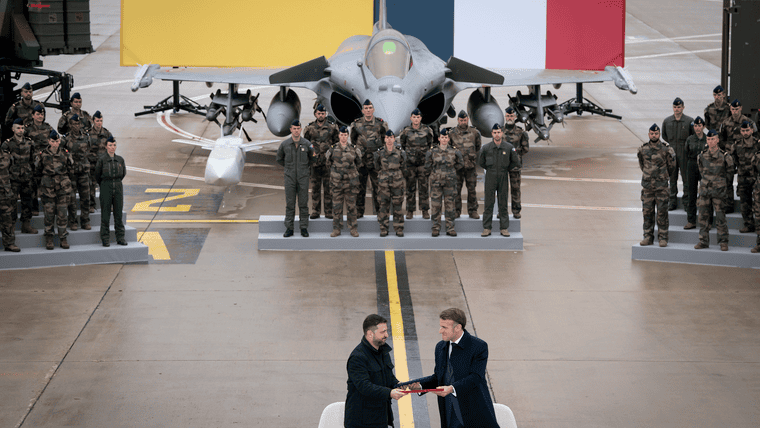
The major evolution of the French Republic — or rather of President Macron himself — has been described many times. After 2014, the Russian Federation remained a very important partner and meetings at the highest level took place regularly. For years, Paris, believing it was acting pragmatically, sold arms both to Kyiv and to Moscow. In 2022 a major shift towards Ukraine occurred and relations were severed. Now, after four years of war, France is fully aware of the situation. The problem, however, is that it can neither assist in negotiations nor provide large deliveries of weapons. Paris offers support in words, observes, and waits.
Over the past 48 months the French Republic has undergone a genuine evolution regarding assistance to Ukraine. Significant deliveries appeared not only in humanitarian aid but also in direct military assistance, which immediately reached the front. It is enough to say that French support played an important role in slowing the Russian offensive. The most significant were thousands of rounds of ammunition, hundreds of missiles, dozens of CAESAR self-propelled howitzers, air-defence systems including SAMP/T and, finally, Mirage 2000 fighter aircraft.
A drawback in cooperation was the limited effectiveness of Ukrainian use of the AMX-10RC light tanks/fire-support vehicles, the collapse of a Kyiv brigade trained in France, and the shortage of Ukrainian pilots capable of completing fighter training (ultimately only six aircraft were transferred, one of which has already been lost), as well as France’s continued imports of Russian LNG and the continued presence of French companies in Moscow. At the beginning of the conflict Ukraine also waited a long time for equipment deliveries.
Overall, the Kyiv–Paris relationship has become one of the strongest. President Zelensky accepted that discussions on peace solutions for Ukraine would be conducted by President Macron, both at EU level and with President Trump. Moreover, the Ukrainian leader has repeatedly thanked France, publicly presenting it as a key ally, despite the fact that at the beginning of the conflict in 2022 Paris sought dialogue with Moscow. A sign of good relations was also economic cooperation, including an agreement on the purchase of 100 Rafale fighter aircraft and significant concessions enabling French investment in Ukraine.
The role of President Macron
It is also significant that President Macron manages the „coalition of the willing”, a grouping of more than 30 states ready to provide security guarantees to Ukraine and potentially deploy troops after the conflict ends. In this scenario French soldiers would be positioned near the front line, monitoring whether Russia violated peace agreements. The initiative currently remains in the background, but the French leader has a chance to achieve his objective of leading an international project.
Four years after the outbreak of the conflict, most French politicians continue to send signals of support to Kyiv. Of course, „war fatigue” is visible and France’s domestic situation is not ideal, but the direction of assistance is being maintained. The problem, however, is that Paris has run out of options to be the key state in ending this war.
Politically, President Macron stands alongside President Zelensky, yet presidential elections in France are effectively only a year away. Neither the left nor the centre enjoys significant public support. If Kyiv is to receive meaningful assistance from Paris in the coming months, it will be very difficult domestically, as citizens feel the absence of many reforms, including pensions, healthcare, policing and illegal migration policy. Moreover, France’s public debt is at a concerning level. Macron therefore faces very difficult months ahead, during which domestic issues will dominate.
Internationally, France does not wish to be the actor that deals the cards. It is President Trump who conducts the Russian-Ukrainian negotiations, not Macron. More broadly, the absence of a European leader is a harsh lesson for Europe. The only opportunity for Paris to demonstrate its ambition for European strategic autonomy (as emphasised recently by the President of Finland) would be to offer extended nuclear deterrence or significant conventional reinforcement. However, this does not appear likely, or would be very limited.
The end of support?
Militarily, France does not intend to transfer large quantities of equipment any longer. There will be no breakthrough in the form of a new fighter squadron, hundreds of armoured vehicles or a greater number of air-defence systems. Assistance will be limited to financial support within European Union packages and expressions of backing in international forums. The willingness on the French side still exists, but that alone is insufficient. If France aspires to the role of a power, it must demonstrate it as a power.
Four years of war in Ukraine, nine years of Macron’s presidency and twelve years since the Russian attack on Ukraine have passed. Everything has a beginning and an end. France deserves credit for recognising that Russia is an adversary. It has also moved significantly closer to Poland, reflected in many joint projects, including in the military sphere. Now France should demonstrate its capabilities more visibly, signalling that Europe possesses a nuclear power whose voice must be taken seriously.
I fear such a decisive conclusion may not occur. We have seen the evolution of France and of the President himself — and perhaps that is what should be valued most. French forces are strengthening the entire eastern flank of NATO. Perhaps stronger rhetoric will come later. Hopefully the conflict in Ukraine will end as soon as possible and France will prove that it does not change its position — or its allies — so easily. The year 2027 will be crucial.


