












- WYWIADY
- WIADOMOŚCI
- WAŻNE
France searches for a successor to the M270. Korea’s Chunmoo leads the race

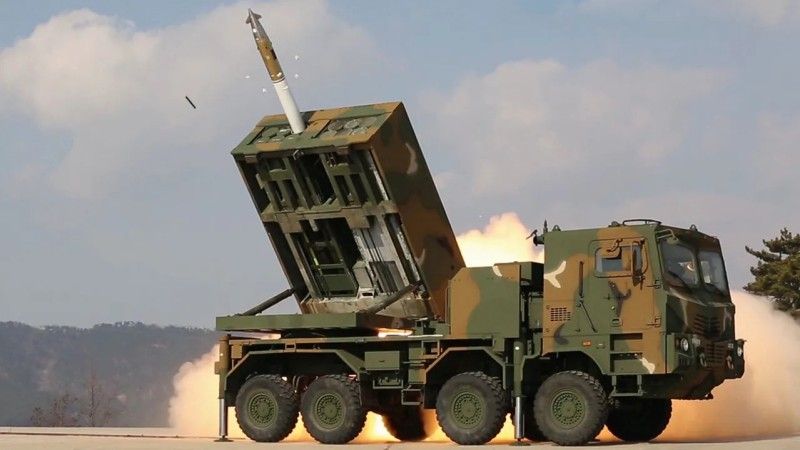
France is facing an urgent decision regarding the future of its rocket launcher capabilities. The planned retirement of the M270 systems in 2027 risks creating a capability gap in long-range rocket artillery. Pending the development of a sovereign 150-kilometer rocket, Paris is assessing off-the-shelf solutions: the American HIMARS, the Israeli PULS, and South Korea’s K239 Chunmoo.
The choice will carry not only operational implications but also industrial and strategic consequences, shaping France’s position within Europe’s evolving security architecture. Aleksander Olech, PhD, speaks with Léo Péria-Peigné of IFRI about the implications of this decision.

Aleksander Olech, PhD (AO): IFRI recommended that the French armed forces consider acquiring the K239 Chunmoo system, already used in Poland (Homar-K) and purchased by Norway and Estonia. What explains such a recommendation?
Léo Péria-Peigné (LPP): France’s M270 multiple launch rocket systems are scheduled to leave service in 2027, primarily because their chassis are no longer economically viable to sustain. In 2023 Paris launched a program to develop a sovereign 150-kilometer rocket capability, but this solution will likely not be available before 2030. To avoid a capability gap, the French Army must therefore procure an interim off-the-shelf system. At present, only three modern and credible options exist: the US HIMARS, the Israeli PULS, and the South Korean Chunmoo.

HIMARS is expensive, delivery timelines are very long, and, most importantly, the issue of sovereignty over munitions remains significant. The current political climate in transatlantic relations further complicates the option. The PULS system is less widespread in Europe and relations between France and Israel have deteriorated since 2024. Additionally, concerns exist regarding potential technological vulnerabilities or access limitations in the system architecture.
Chunmoo, by contrast, remains relatively little known in France despite being the most numerous modern MLRS system currently proliferating across Europe. Beyond Poland and Estonia, French partners such as the United Arab Emirates and Saudi Arabia have also adopted it. It is an open architecture platform capable of integrating national munitions, and Hanwha has developed a wide range of ammunition types, some of which will be produced in Poland.
Chunmoo is not a perfect solution, but it is the most pragmatic one available to France. It is a capable, rapidly deliverable, interoperable system that would allow France to integrate its future domestic munitions and potentially export them within what could be described as a future „Chunmoo user community.”

AO: Do you see prospects for Franco-Polish cooperation around Chunmoo, for example, integrating a future French 150 km missile into the system?
LPP: France plans to acquire 13 MLRS by 2030 and potentially another 13 by 2035, for a total fleet of 26 systems. Poland has already fielded more than 150 Homar-K launchers alongside WR-40 Langusta systems. One practical solution would be for France to lease Homar-K launchers from Poland in order to preserve operational capability while integrating its future munitions.
A deeper level of cooperation is also conceivable. A Franco-Polish artillery unit based in Poland could be established, similar to the long-standing Franco-German formations. The Homar-K is particularly attractive because the Korean base chassis is too heavy for certain French operational standards, whereas the Polish Jelcz chassis is significantly lighter and more suitable. Such a development would represent a strong symbolic step in the renewal of Franco-Polish relations following the 2025 Treaty of Nancy.

Estonia could even be integrated into such a structure after its 2025 Chunmoo acquisition. Currently, France and Poland lack major shared systems that facilitate operational cooperation. Potential Polish acquisition of tanker aircraft—or even A400M transport aircraft—would improve this, as would a French acquisition or leasing of Homar-K.
In the longer term, France intends to develop longer-range rockets and missiles, possibly under the ELSA framework. French industry possesses substantial expertise in missile development due to its nuclear deterrence programs. A jointly developed ground-launched ballistic missile with a range of approximately 1,000 km or more could therefore be relevant to both French and Polish strategic requirements.
AO: Beyond 155 mm ammunition cooperation, where else could Franco-Polish defence cooperation realistically expand?
LPP: Historically, cooperation was limited because the two militaries operated in very different strategic contexts. Poland was closely aligned with Washington, while France maintained a more autonomous strategic posture. Operational priorities differed as well: France focused on Afghanistan and later counter-terrorism in the Sahel, while Poland’s attention increasingly turned toward Russia after 2008 and especially 2014. That divergence has now disappeared. French and Polish operational requirements are more similar than at any time in the last three decades, opening real possibilities for joint future capability development.

The Polish Krevet program, a wheeled 155 mm howitzer concept, could potentially be revived as a basis for a next-generation successor to the CAESAR for the 2030s, possibly featuring a longer barrel for extended range. By 2035 France will also need to modernize its wheeled infantry fighting vehicle, the VBCI. This could be an opportunity for joint work with Poland, either on a successor platform or an advanced Rosomak variant. France does not currently plan to acquire a tracked IFV, but if the Polish Borsuk proves successful, certain collaborative developments might still be explored.
Cooperation already exists in specialized engineering capabilities such as mobile bridging systems, an area where Polish operational experience could be valuable to France. Paris could also show interest in the Baobab-K mine-laying system, although little public information has emerged recently. In the air domain, cooperation on combat aircraft platforms remains unlikely. However, integration of munitions such as the A2SM Hammer could create shared capability components. Possible Polish acquisition of tanker aircraft and potential Swedish AWACS procurement by both Paris and Warsaw would open important opportunities in training and maintenance cooperation.
Naval cooperation appears more limited given Poland’s selection of British frigates and Swedish submarines and France’s relatively modest presence in the Baltic.

AO: Is South Korea becoming a major actor in European rearmament?
LPP: South Korea is not a new defence actor in Europe, but its presence was long discreet, beginning with Turkey’s T-155 howitzer derived from the Korean K9. The K9 then gained momentum after 2017 with Finnish, Norwegian, and Estonian orders. Korean systems benefit from the characteristics of an industry supporting a conscription-based military: relative simplicity, solid performance, and competitive pricing enabled by large-scale production. At a time when European defence industries were shrinking force structures and facing rising production costs, these advantages became decisive. The large Polish orders in 2022 triggered criticism that Warsaw was purchasing outside Europe. However, the decision was rational. South Korea was effectively the only supplier able to deliver large quantities within the required timelines. Europe did not produce an MLRS equivalent nor a light fighter comparable to the FA-50, and modern tank production in Europe was limited to roughly fifty Leopard 2 units annually. In tracked artillery, Poland itself maintained the only active production line (Krab) while the PzH 2000 was temporarily out of production.

The Polish purchases highlighted the capabilities of Korean industry and led to a wave of interest across Europe. Romania, Estonia, and Norway announced acquisition plans, Denmark and Sweden began testing, and countries such as Finland may also consider Korean systems to replace aging inventories. Traditional European producers—France, Germany, and the United Kingdom—still tend to see Korea as a competitor, sometimes even a secondary one. However, many medium-sized European powers view it as an opportunity to rearm against Russia without the financial burden of significantly more expensive European systems.
As European-US relations become less predictable and American equipment is no longer automatically associated with political security guarantees, European states are seeking alternatives to maintain credible deterrence. South Korea cannot replace the US security umbrella, but it can supply weapons faster and in greater quantity than most traditional European industries while maintaining acceptable performance levels. In the absence of alternatives, South Korea is therefore likely to remain a major actor in Europe’s emerging security architecture. Turkey, which possesses similar industrial advantages, could potentially join this dynamic.

Léo Péria-Peigné is a researcher at the Security Studies Center of the French Institute of International Relations (IFRI), where he works within the Future Conflicts Observatory on capability development in armaments and the employment of emerging and advanced weapons systems.
The interview was conducted by Dr. Aleksander Olech – Head of International Cooperation and Editor-in-Chief of Defence24.com, analyst and lecturer specializing in Franco-Russian relations, African security, and NATO security policy.


