












- ANALIZA
- OPINIA
- WIADOMOŚCI
Indonesian defence in the Indo-Pacific. How France became the main partner?

Indonesia is accelerating the modernisation of its armed forces in the shadow of intensifying rivalry in the Indo-Pacific, with France emerging as its key defence partner. Contracts for the purchase of French equipment and joint industrial projects are intended to strengthen Jakarta’s position, yet they also raise questions about the real extent of Indonesia’s defence capabilities. What does this partnership mean in practice, and how does it fit into the ambitions of both states?
Under the leadership of President Prabowo Subianto, who took office at the end of 2024, Indonesia is seeking to break with the label often ascribed to it as “the world’s largest invisible country”. As the fourth most populous country in the world and a member of the G20, it has begun to make efforts to increase its visibility on the international stage. Since the start of Prabowo Subianto’s presidency, Indonesia’s growing engagement across various domains of foreign policy has been evident. This has manifested itself both in the diplomatic sphere – including Indonesia’s accession to the newly established Board of Peace initiated by Trump – and in the economic domain, exemplified by the conclusion of negotiations on the CEPA trade agreement with the European Union after almost a decade.
In the face of mounting geopolitical tensions in the Indo-Pacific and China’s increasing assertiveness, including claims directed at Indonesia’s exclusive economic zone in the South China Sea, defence issues have become increasingly prominent in the new administration’s strategic debate. This shift is driven both by security considerations and by the country’s international image. Despite the considerable potential inherent in its nearly 300-million-strong population and its relatively high economic growth rate – still hovering around 5 per cent of GDP annually – Indonesia has historically neglected defence matters, which has translated into limited military capabilities in relation to its regional and global ambitions.
See also 

Indonesia's Defence Capabilities
Indonesia, alongside Argentina, South Africa and Mexico, ranks at the bottom of the G20 in terms of defence expenditure as a share of GDP. In 2022, the country devoted only 0.7 per cent of its GDP to defence. Crucially, unlike the other countries in this group, Indonesia currently faces tangible territorial tensions, which further highlights the scale of underfunding in the defence sector. The main cause of this state of affairs lies in severe budgetary constraints. This trend did not change even after Prabowo Subianto was sworn in, despite his extensive military background and his earlier role as Minister of Defence in the government of former President Joko Widodo. Although during the 2024 presidential campaign Prabowo pledged in his manifesto to raise defence spending to 1.5 per cent of GDP, in the first year of his presidency (2025), this share increased only marginally to around 0.77 per cent of GDP.
The causes of Indonesia’s chronic underinvestment in defence can be found in the conditions of its modern history and in its geopolitical orientation during the twentieth century. As a co-founder of the Non-Aligned Movement, Indonesia was not drawn into direct bloc rivalry, which reduced pressure to develop extensive military capabilities aimed at deterring external adversaries. In the absence of a clear external threat, Indonesia concentrated its defence efforts inward, combating separatist movements in Aceh, Papua and the Moluccas, and occasionally engaging in limited conflicts in its immediate regional environment, such as the confrontation with Malaysia in the 1960s or the intervention in East Timor from 1975 onwards. The lack of strong incentives to develop power-projection capabilities on a larger scale encouraged the maintenance of relatively modest armed forces, whose equipment remained largely dependent on foreign imports, particularly from the United States – especially during the Suharto era, when military cooperation with Washington was privileged.
A turning point in Indonesia’s perception of defence policy came with US restrictions on arms exports, imposed for the first time in 1991 in response to acts bearing the hallmarks of genocide committed by Indonesian armed forces during operations in East Timor. As a consequence, the security doctrine began gradually to evolve towards greater diversification of procurement sources and a declared pursuit of strategic autonomy. Although the idea of autonomy in defence procurement fits well with Indonesia’s tradition of geopolitical non-alignment, its growing ambitions and strong nationalism, its implementation faces significant structural barriers. As a result of decades of neglect, the domestic defence sector lacks a sufficiently developed research and industrial base and stable financing mechanisms, which in practice limits the possibility of building a comprehensive defence-industrial value chain. Insufficient technical capacity also constitutes a major obstacle to technology transfer, which to date has largely been confined to relatively simple segments of production such as small arms, ammunition and explosives. Although Indonesia’s national defence industry exists and is gradually developing, its efficiency and real level of technological autonomy remain open to question.
In practice, the structural limitations of the domestic defence sector mean that Indonesia continues to rely heavily on foreign partners for key components of its defence ecosystem and the necessary know-how. The response to this dependence has not been concentration on a single supplier, but rather a deliberate strategy of diversifying procurement sources. A distinctive feature of Indonesia’s model of military procurement is therefore the exceptionally wide range of foreign partners. As early as 2010, Indonesia was sourcing armaments from 26 different countries representing different geopolitical camps, which can be interpreted both as a legacy of non-alignment and as part of a broader strategy of balancing and „playing on many fronts” in foreign and security policy. In addition, manoeuvring between partners allows Jakarta to secure favourable contractual terms – often in credit-based arrangements or with deferred payments – enabling it to pursue ambitious modernisation programmes despite budgetary pressures.

Franco–Indonesian Strategic Cooperation
When examining Indonesia’s strategic partners from the Western bloc more closely, particular attention should be paid to France, which in recent years has clearly strengthened its position as one of Jakarta’s key European defence partners. Despite France’s historically limited engagement in insular Southeast Asia, bilateral defence cooperation dates back to the early 1960s, when the Indonesian Army acquired over 300 AMX-13 light tanks and around 200 AMX-VCI armoured personnel carriers. For many years these vehicles constituted an important element of Indonesia’s land forces and were used in numerous internal and external operations, including the 1965 military coup, the invasion of East Timor and the conflict in Aceh. Interestingly, part of the former AMX fleet remains indirectly in use even today, following multiple modernisation and adaptation programmes.
Throughout the remainder of the twentieth century, the main suppliers were successively the United States and, following the 1991 embargo, South Korea. During this period, cooperation with France was limited and did not involve large-scale transactions. A more pronounced revival of Franco–Indonesian military-technical relations occurred at the turn of the twenty-first century and over the following two decades. This was reflected, for example, in Indonesia’s acquisition of Panhard VBL light armoured vehicles and Nexter CAESAR 155 mm self-propelled howitzers, first ordered in 2012. In addition, from 2014 Indonesia began to procure Fennec light helicopters, assembled locally from components supplied by Airbus, in line with Jakarta’s efforts to develop domestic industrial capabilities.
Cooperation between the two states was further strengthened after 2021, when a bilateral strategic defence partnership agreement was signed. In subsequent years this translated into Indonesia placing multi-billion-dollar orders for state-of-the-art French-made weapons systems, primarily aimed at modernising the Indonesian air force and navy, which had traditionally remained in the shadow of the land forces. Of key importance was the order for 42 Rafale multirole combat aircraft from Dassault Aviation, with a total value of approximately USD 8.1 billion, of which the first seven aircraft arrived in Indonesia at the end of January 2026, as well as the decision to acquire two Scorpène Evolved-class submarines to be built with the participation of Indonesian shipyards. This cooperation has been complemented by initiatives aimed at developing the competencies of Indonesia’s domestic defence industry, including the establishment of a joint venture between the French group Thales and the Indonesian state-owned company PT LEN, focusing on the local production and development of electronic and radar systems, as well as technology transfer.
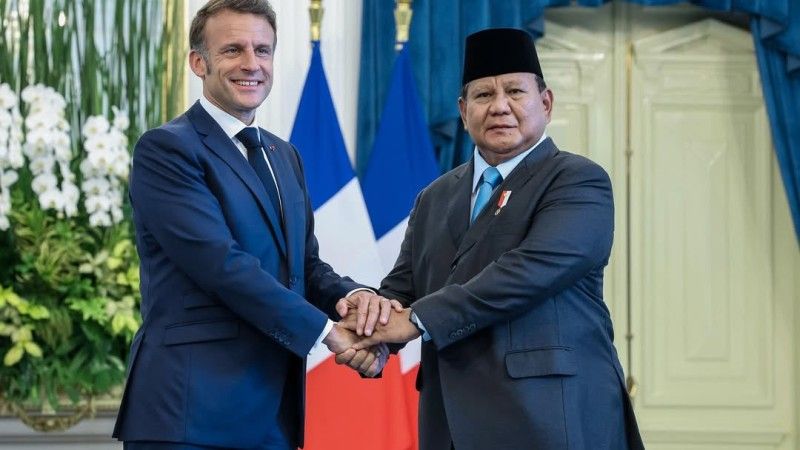
As a result of these contracts and projects, France has unequivocally become Indonesia’s most important European defence partner. A symbolic confirmation of this dynamic was President Emmanuel Macron’s visit to Indonesia at the end of May 2025 as part of his tour of the Indo-Pacific. He was the first European leader to visit Indonesia since Prabowo Subianto took office, further underlining the special significance of the strategic partnership between the two countries. During the meeting, the two leaders adopted a joint policy declaration (“Joint Vision 2050”), envisaging the further deepening of strategic cooperation in the long term. President Prabowo also paid a subsequent visit to Paris, where he attended Bastille Day celebrations as guest of honour.

What's Next?
The deepening of defence cooperation between France and Indonesia can be seen as evidence of changing geopolitical conditions in the uncertain, multipolar world of the 2020s. From the French perspective, partnership with Indonesia forms part of efforts to strengthen the European Union’s strategic autonomy by diversifying partnerships beyond the traditional transatlantic-centred model. It is therefore unsurprising that Macron’s France is emerging as the most engaged European actor in the Indo-Pacific: from the very beginning of his presidency, France has spoken openly about the need for Europe to achieve strategic defence autonomy, an important pillar of which is the cultivation of new partnerships. Indonesia – located at the crossroads of key maritime communication routes, a rising economic power and an informal leader within ASEAN – represents a partner of particular significance in this strategy. In this sense, defence cooperation between Paris and Jakarta constitutes a form of anchoring European interests in a region hitherto dominated by US–China rivalry. Particularly in an era of tensions in transatlantic relations, building Europe’s image as an independent partner has become increasingly important. Beyond the Franco–Indonesian context, recent years have witnessed growing interest among European states in a presence in the Indo-Pacific. Over the past few years, several countries – including France, Germany, Italy and Sweden – have signed bilateral defence agreements with ASEAN states. Poland has also become involved in deepening and nurturing relations with Indo-Pacific countries. For example, during his official visit to Southeast Asia in 2024, Polish Foreign Minister Radosław Sikorski visited Malaysia, where he discussed defence issues with Prime Minister Anwar Ibrahim. Malaysia constitutes an important Asian defence partner for Poland, as the main battle tank of the Malaysian armed forces is the Polish-built PT-91M Pendekar. Given that the strategic importance of constructive relations with Southeast Asian states is likely to continue to grow, further deepening of Franco–Indonesian cooperation – as well as, more broadly, cooperation between EU countries and ASEAN member states – is likely to continue.
From Indonesia’s perspective, the deepening of cooperation with France – and more broadly with the European Union – should be viewed as an element of a non-aligned diplomatic strategy. Indonesia, in a manner typical of many countries in the region, seeks to maintain positive diplomatic relations with all key sides of the geopolitical divide. As Europe emerges as an increasingly assertive and autonomous political bloc, closer partnership with it is becoming ever more important for Indonesia. It is worth noting, however, that even while nurturing cordial relations and defence cooperation with France and Europe, Indonesia simultaneously seeks to maintain positive relations with Russia and China, as evidenced, for example, by Prabowo Subianto’s visit to Moscow in December 2025.
In the longer term, however, it is difficult to offer a clear-cut forecast of the future development of Franco–Indonesian cooperation. In the short term, one should primarily expect the implementation of the contracts already signed for the delivery of further Rafale aircrafts, submarines and other contractual commitments. The question nevertheless remains open as to whether Indonesia will continue to procure additional French-made armaments. This is difficult to determine. First, Indonesia consistently pursues a policy of diversifying its arms suppliers. Beyond the French contracts discussed above, Jakarta signed significant agreements with other countries over the past year. One example is Turkey, which is to supply Indonesia with KHAN short-range ballistic missiles, making Indonesia the first operator of this type of weapon in Southeast Asia.
In the context of naval modernisation, Italy has recently attracted attention. In February 2026 it was announced that Italy’s flagship aircraft carrier Giuseppe Garibaldi is to be transferred to Indonesia free of charge for geopolitical and industrial reasons, with Jakarta bearing only the costs associated with modernisation and adaptation of the vessel.
At the same time, in the field of air force modernisation, Turkey signed a contract with Indonesia in July 2025 for the sale of 48 KAAN combat aircraft produced by Turkish Aerospace Industries. The transaction is to be implemented gradually between 2028 and 2035 and – as in the case of the Scorpène-class submarines – includes clauses on technology transfer and the establishment of a local industrial base. Furthermore, in 2025 Jakarta also held talks with China and the United States, considering the purchase of Chinese J-10 fighters or American F-15EX aircraft. Ultimately, negotiations with Washington were suspended, and in October 2025 plans were announced to acquire 42 Chinese combat aircraft. This decision may be regarded as symptomatic of Indonesia’s policy of „playing on all fronts”: Indonesia remains the only state involved in disputes in the South China Sea that has opted to purchase Chinese fighter aircraft.
For this reason, although further deepening of Indonesia’s cooperation with France appears likely, it should not be treated as a foregone conclusion. Jakarta’s foreign policy remains largely pragmatic and transactional, subordinated to current calculations of strategic interests. The future shape of the partnership with France will depend above all on the extent to which Paris remains a competitive and useful partner for Indonesia compared with alternative arms suppliers.
author: Jan Gawronski


