












- ANALIZA
- WIADOMOŚCI
France’s military standing is safe despite budgetary pressure

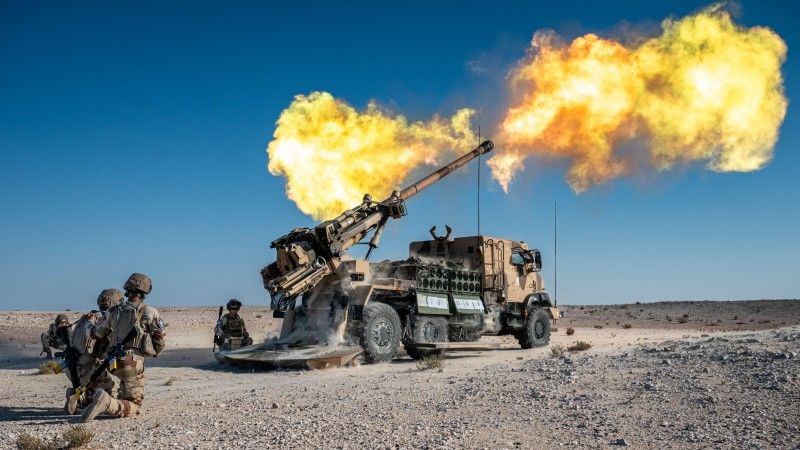
Photo. Armée de Terre/X
France will maintain its military stature, despite facing a 5.8 percent budget deficit. Given the geopolitical uncertainty, there is reason to be glad: the national defense envelope has been spared from cuts and has become something of a sacred cow. On July 13, President Emmanuel Macron announced an increase in military spending, with an additional €3.5 billion planned for 2026 and another €3 billion for 2027. This injection will raise the defense budget to €64 billion by 2027, a significant increase from the €56 billion initially projected in the Military Programming Law.
Of course, the need to modernize France’s conventional forces is clear.
In recent months, the armed forces have reported a requirement for three additional frigates and thirty more Rafale fighter jets. More than €16 billion will also be allocated to replenish an ammunition stockpile considered insufficient, despite its essential role in every dimension of warfare, including naval operations. French first-rank warships have, on several occasions, been deployed with limited munitions, even while the French Navy was engaged in high-intensity missions such as the interception of Houthi missiles and drones during Operation Aspides, aimed at securing maritime trade routes. These types of decisions should not be taken, and in light of these operational demands, the number of first-rank frigates to rise from 15 to 18 is worth noticing.
Significant attention is also being given to the next-generation SAMP/T surface-to-air defense system, particularly the Franco-Italian NG variant equipped with MBDA’s new Aster 30 B1NT missile. A minimum of eight batteries is expected by 2030, with twelve planned for 2035, addressing a key vulnerability in France’s current air defense capabilities.
At the same time, precisely, France having identified the „Very High Altitude” domain, referring to the space between 20 and 100 kilometers above the Earth’s surface, as a strategic priority is great news. With additional €2 million, the revival of French Nostradamus over-the-horizon radar program, which had been paused since the early 2000s, should help match capabilities possessed by Russia with its SPRN system and the United States with its SSPARS network, both of which are critical for detecting hypersonic missile threats.
While this initiative marks an important step, both France and its European partners must accelerate their efforts beyond this altitude range. Or they will definitely fall behind when it comes to space issues. The United States has already begun deploying satellite-based sensors through the HBTSS program, led by L3Harris and Northrop Grumman, with two demonstrator satellites launched into orbit on February 14, 2024, aboard a SpaceX Falcon 9. France, for its part, has a valuable foundation to build on: the French defense procurement agency (DGA) gained early expertise in this area with the Spirale demonstrators launched in February 2009, aboard an Ariane 5 ECA (Flight V187).
Therefore, France should be even more proactive in making the development of this strategic superiority an imperative. The issue of communications networks and Europe’s digital autonomy is fundamental. A sovereign cloud and satellite infrastructure would shield us from dependence on external providers. Europeans cannot afford the risk of having an „off” switch used as a bargaining chip at the first sign of diverging interests.
In parallel, the structuration of France’s efforts around quantum technologies, a potentially even more disruptive force than artificial intelligence, is a positive trend to be further consolidated. In early June, a national strategy on the matter was announced, including the creation of a dedicated campus at École Polytechnique, a specialized laboratory within the Defense Innovation Agency, and the integration of quantum capabilities into future combat systems. This will contribute to being better aligned with the realities of future warfare.
As such, public statements made by the French political leadership in recent days have provided a highly needed reassurance scheme. It shows that France is adapting to the rising demands imposed by growing international tensions. And it is a sigh of relief at what appears to be a moment of clarity after delays in procurement, halted orders, government-imposed restrictions, and mounting budgetary uncertainty.
Some observers will argue that the projected €64 billion budget should be put in perspective. The United Kingdom is aiming for €70 billion, and Germany is already spending €75 billion. Yet France is not starting from as far behind as its neighbor across the Rhine. Others will point out that the amount of €100 billion annually, recommended by the Ministry of the Armed Forces, remains a distant goal, and that NATO’s target of 3.5 percent of GDP by 2035 may not be secured. Even so, the signal being sent is the right one. And let’s remember that in an increasingly unstable global environment, France is offering more than financial commitment to its partners. It brings precious command capabilities, operational expertise, and an autonomous nuclear deterrent.
This is why French military development cannot be conceived in isolation. It must be carried out in close cooperation with its partners, the United Kingdom, of course, but also Germany and Poland, to define common postures in both conventional and nuclear deterrence. This should also lead to a rationalization of European military equipment, to enhance complementarity rather than duplication.
2027 is a first step. As the next should be the upcoming decade, a joint borrowing initiative should be considered. This is what France will advocate for during the negotiations over the new EU budget for the 2028-2034 period, which already plans to allocate €131 billion to European defense. Two years of negotiations ahead. The clock is ticking and history is keeping score.
Author: Adam Hsakou


