


- WIADOMOŚCI
- KOMENTARZ
- WYWIADY
“Made in NATO”: US Ambassador Whitaker on NATO 3.0, European defence and the future of American forces

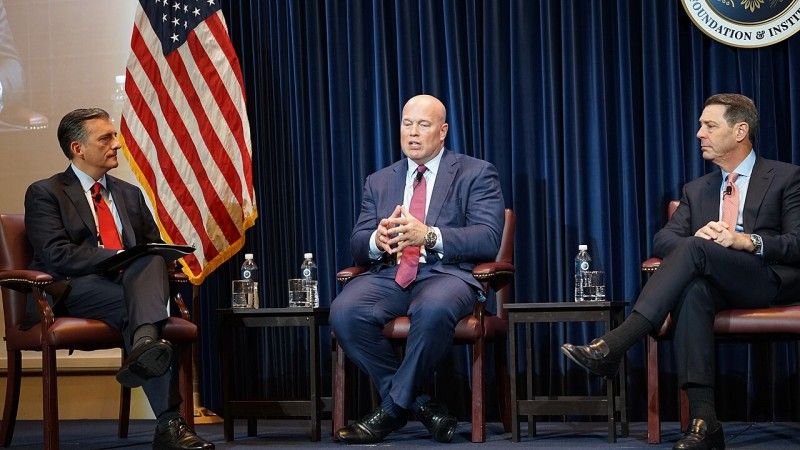
Photo. Xuthoria / Wikimedia Commons / CC BY-SA 4.0 (https://creativecommons.org/licenses/by-sa/4.0/)
The United States is pushing for a stronger NATO, increased European defence spending and expanded weapons production on both sides of the Atlantic. In an exclusive interview with Defence24, US Ambassador to NATO Matthew G. Whitaker discusses the future of the Alliance, transatlantic defence cooperation, the European Union’s €150 billion SAFE programme and opportunities for American and European defence manufacturers. He also signals further US troop deployments to Poland, with details expected following Washington’s review of its military presence in Europe.
The discussion also addresses Ukraine’s defence industry, the prospect of joint weapons production and NATO’s transformation under the concept of NATO 3.0. Calling Poland a „model ally”, Whitaker argues that Europe must translate higher military expenditure into real capabilities and that the Alliance needs more members prepared to invest at the pace demanded by today’s security threats.
Dr Aleksander Olech: Of course, we are in Poland, so Poland is at the centre of our discussion. Ambassador, I know that you are leading a major delegation of more than 80 American defence companies on a European tour, starting in Warsaw. Are they coming here to sell weapons or perhaps to manufacture them together with Polish partners?
Amb. Matthew G. Whitaker: This is a really exciting moment for the transatlantic defence industrial base. We have brought more than 90 companies from the United States to meet and collaborate with Polish companies tomorrow. We are looking at every opportunity, including joint ventures and co-production. I spoke to representatives of three companies just tonight at the opening reception, and they are considering where to establish production facilities. Naturally, I told them Poland would be a great place to do that. I think there are some real opportunities here, and I am excited that these companies are coming.
The challenge now is to turn the defence spending commitment made at The Hague, including the 5% target, which Poland is already achieving, into real military capabilities. That is what matters most. The only way we can do that is by expanding the transatlantic defence industrial base. That means production in Europe and production in the United States, but most importantly, it means „Made in NATO”.
Perfect, because we have already seen joint projects. For instance, Poland and Anduril are developing cooperation on the Barracuda missile project. We are also following the situation in Ukraine. Could Poland become a production hub for American PAC-3 missiles?
We are obviously having those conversations. We have just announced that a maintenance facility will be established in Poland, and I think that is a good first step. Germany already has a facility in Bavaria producing PAC-2 missiles. We clearly need to increase air defence production, whether we are talking about counter-drone systems or capabilities to intercept manoeuvring ballistic missiles.
There are a lot of opportunities. We have American companies of all sizes — large, medium-sized and small — that want to do business in Poland and with Poland. I think that is the most important thing, and I believe we are going to see a lot of good things come out of this visit.
Poland is dealing with drones coming from the eastern flank, and the United States could contribute its expertise and know-how. Staying with these developments, Europe has introduced the €150 billion SAFE programme, which prioritises European defence production and includes a 65% requirement. Are American defence companies concerned about losing their position in European markets?
I do not worry too much about the SAFE programme, the „Made in Europe” provisions or the 65% requirement, as long as that does not become a broader European policy. And I do not think that most EU member states that are also NATO members support a general European preference, at least judging by the conversations I have had. They know that many excellent weapons and weapons systems are manufactured in the United States, and they want access to those capabilities.
SAFE is a unique instrument. But again, we have companies here that all want to do business with Poland. They want to build facilities and expand production, so there are real opportunities. These are the kinds of opportunities that could qualify under SAFE while also creating jobs. And for me, these are good-paying jobs. They are good-paying jobs in the United States, but also good-paying jobs in a great ally like Poland.
Poland has purchased 366 Abrams tanks and is developing maintenance facilities. Could we move beyond simply servicing equipment towards manufacturing American defence components in Poland? This is something we are really counting on — developing the capacity to produce equipment here on Polish soil. How do you see that?
I was in Lima, Ohio, watching those Polish tanks roll off the production line, and they are really beautiful machines. But this is exactly what we are trying to create. Obviously, when Polish politicians are spending Polish taxpayers« money, they want that investment to deliver real results for their voters.
Nobody expects all that money to go towards American capabilities alone, although we make some unique and highly sophisticated capabilities that you can only buy in the United States. The whole purpose of bringing so many American companies to Poland this week is to have these conversations and look for those win-win opportunities that expand the transatlantic defence industrial base and make „Made in NATO” something that really means something.
Was it a deliberate decision to start this tour in Poland? Perhaps it could also encourage other European partners, such as Finland or Portugal, which is considering the F-35, to develop similar projects with American companies. Could Poland set an example for others?
We have already done this once in Germany and the Benelux countries. We started in Munich and worked our way through the Benelux countries. We learnt a lot of lessons about what companies on both sides of the Atlantic want to know when doing business together, because this is also about Polish companies doing business in the United States.
We see real opportunities on both sides and in both directions. This is our second opportunity, and we have almost twice as many American companies coming and almost twice as many Polish companies participating as we had in Germany. There are some real connections and opportunities that we can hopefully turn into genuine joint ventures and co-production projects. My fingers are crossed.
I think I am uniquely positioned to do this as the US Ambassador to NATO because I can bring companies together in Poland, Italy or elsewhere. We can organise initiatives in places where it would probably be more difficult to do so through bilateral channels alone.
It is a great learning opportunity for everybody involved. But at the same time, I want it to turn into real capabilities. Right now, there is a lot of money available that needs to be spent on equipment that is not being manufactured quickly enough or on a sufficient scale. That is what we are trying to do: expand production capacity as quickly as possible.
I see this as an invitation to Polish companies. Can we assure Polish businesses today that the United States is ready to welcome them? Could they go to Washington, DC, Cleveland, Ohio, or Colorado Springs and start building major projects with American partners? Is this an invitation to Polish companies?
Yes, that is exactly what we are trying to achieve: creating those connections. The United States is a very entrepreneurial country, with a highly entrepreneurial system. We have a lot of companies that you may never have heard of, but which have some really interesting capabilities and are looking to do business with Polish companies.
At the same time, these connections will help Polish companies find opportunities to do business in the United States. I think this is simply a win-win situation, a two-way relationship that benefits both allies.
And Poland is a model ally. I cannot say enough about how serious and clear-eyed Poland is about what we all need to be doing. I wish there were 30 other allies like Poland and the United States, investing at the speed required and addressing the threats we face today.
That gives us a quote for the headline! I have a few more questions, Ambassador. Let us turn to NATO 3.0. Are we moving towards an Alliance in which more countries primarily use American equipment, or is NATO 3.0 about allies taking greater responsibility for their own defence and becoming stronger alongside the United States? How do you see NATO 3.0 as the US Permanent Representative to NATO?
NATO 3.0 is the factory reset of NATO. It is an Alliance that deters and defends on the European continent. It does not get involved in out-of-area operations, and it does not have allies spending less than the amounts required to defend and deter the Alliance. I see it very much as a project that is progressing well.
We saw our European allies increase their defence spending by $139 billion compared with 2024. I think that is a great first step, but it is not enough. We need everybody to reach 5%. Poland has already reached that level. Our Baltic allies are also part of these efforts, and from 2027 they will join regular meetings under the NATO 3.0 framework. But we need all allies to step up.
We cannot have backsliding. We cannot have allies who think they can enjoy security without spending and investing the money needed to acquire the necessary capabilities. That is how we deter and defend every inch of the Alliance.
American soldiers have returned to Estonia after a nine-month gap. I used to live there, so I see this as a significant development. We are also seeing American forces returning to Lithuania. I have to ask about Poland: what is the future of the proposed new permanent US military base? Does Washington support this project, or is it still a long-term prospect?
President Trump has already announced that more troops are coming to Poland. That is the President’s direction, and we will execute that direction. Obviously, we need to put them somewhere, and there are a lot of details to work through.
But I think that once we have completed the force posture review, that will include announcements about how we are going to proceed in Poland. I think there are some really exciting developments coming up here in Poland.
One final question, Ambassador. We have discussed Poland, but I would also like to address the challenges surrounding Ukraine. Ukraine is also part of this impressive initiative involving American defence companies, which suggests an interest in cooperation with Ukraine. Am I right?
I have been to Ukraine a couple of times, with a particular focus on its defence industrial base. I think there are a lot of good capabilities and excellent companies there. Once the war is over, those companies are going to need markets where they can sell their products, keep their employees working and sustain their businesses. Making those connections between Ukrainian companies and American companies is an important step.
We already have American companies doing business with Ukrainians, and I think there is no better battle laboratory right now than Ukraine. You can test your equipment there and see whether it can withstand a very difficult wartime environment. That is what I am encouraging all our companies to do, and I think there is a real opportunity to build those connections as well.
Ambassador, thank you very much for this discussion. I would also like to promise our viewers that this will not be our last interview. They can leave their questions in the comments, and I will ask you next time. Can we agree on that? Ambassador, your words, not mine!
Thank you. I would love to do this again. It’s not going to be tomorrow!
Thank you very much, Ambassador.
Thank you. Good luck.


