












- ANALIZA
- WIADOMOŚCI
Marco Rubio’s visit to India and the Quad format meeting

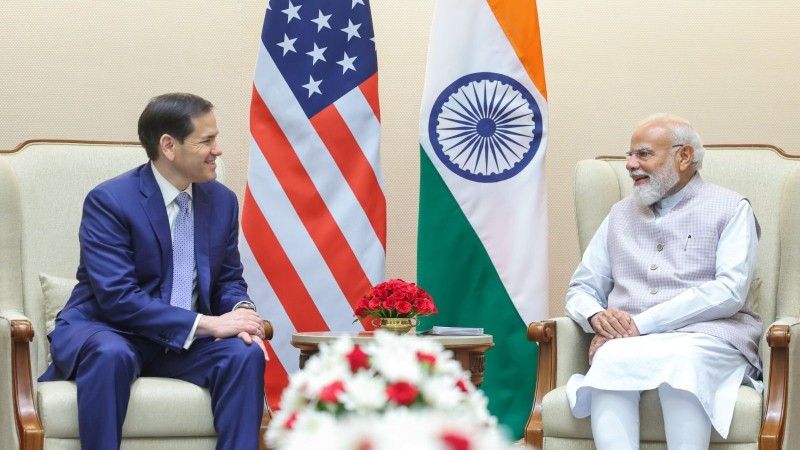
Photo. @narendramodi/X.com
In these turbulent times, the world’s major powers are using every possibility at their disposal. The United States does so, and so do India. And both sides are reaping the rewards.
We recently witnessed Donald Trump’s high-profile visit to China, complete with a large business delegation featuring some of America’s most prominent billionaires. Now, U.S. Secretary of State Marco Rubio has undertaken a lengthy, multifaceted visit to India. From New Delhi’s perspective, this comes after a series of engagements with European leaders in the first half of the year, several BRICS meetings under India’s presidency (notably without final communiqués due to disagreements between the UAE and Iran), and warm meetings with Russian Foreign Minister Sergei Lavrov. The time has now come for a warming of ties with Washington and another Quad summit – bringing together India, the United States, Australia, and Japan. Everyone, it seems, is playing all available games.
Rubio’s visit was designed to thaw relations after a prolonged period of tension. The United States had imposed steep tariffs on Indian goods (later adjusted), while India was displeased by Trump’s attempt to portray himself as the mediator who de-escalated tensions between New Delhi and Islamabad the previous year. Nor does the idea of Islamabad playing a mediating role in the current Middle East conflict sit well in New Delhi.

The primary goal, therefore, was to strengthen ties that currently rest largely – and quite successfully – on robust economic cooperation. Bilateral trade in goods stands at approximately $150 billion, rising to around $240 billion when services are included, with India enjoying a significant surplus. The United States is India’s largest export market, while India ranks as the 10th-largest trading partner for the U.S. A powerful supporting factor is the large and highly influential Indian diaspora in America – over five million strong – which constitutes the wealthiest and most highly educated group in the country, with prominent figures across business and politics. There are, in short, numerous incentives for deeper cooperation. It is even possible that Trump will soon recall the personal rapport he once enjoyed with Prime Minister Narendra Modi during his first term.
Rubio’s extended stay in India was itself a deliberate signal of goodwill and a desire to cultivate friendship. His first stop was Kolkata, where he visited the Missionaries of Charity, prayed at the tomb of Mother Teresa (as a devout Catholic), and toured an orphanage run by the Sisters. From there, he flew to Delhi for high-level bilateral meetings with Prime Minister Modi, National Security Advisor Ajit Doval, and External Affairs Minister S. Jaishankar. He then embarked on symbolic cultural visits to Agra, where he posed for the obligatory photograph at the Taj Mahal, and Jaipur, where he attended performances by local artists and immersed himself in regional traditions, before returning to Delhi for the Quad meeting.

These accompanying visits carried significant symbolic weight. In Kolkata, Rubio highlighted his religious devotion – a quality that resonates with Modi – while showing support for the Missionaries of Charity. His presence in West Bengal also came shortly after the BJP’s spectacular electoral victory in the state. In Jaipur, he demonstrated respect for local Hindu traditions, and the Taj Mahal stop was a classic diplomatic gesture.
Yet the substantive political discussions were paramount. Most notably, both sides signed the bilateral and Quad-level framework for securing supply chains in the mining and processing of critical minerals and rare earths. The agreement is clearly intended to counter China’s overwhelming dominance – Beijing controls 60–70% of global mining and over 80–90% of processing of rare earth elements. It aims to build resilient, „trusted” alternative supply chains.
Rubio also signed agreements and issued declarations on energy cooperation, with the U.S. seeking to expand exports of oil, gas, and technology to India. Discussions on a Bilateral Trade Agreement advanced, as both nations expressed a desire to broaden economic ties. India made a non-binding commitment to purchase $500 billion in U.S. goods over five years. Within the Quad framework, the four countries agreed to jointly participate in the expansion of a port in Fiji, in coordination with the Fijian government.

Overall, Rubio’s visit must be assessed as a successful one. Both India and the United States stand to gain. India strengthens its position in Washington and the broader West, with the Quad serving as a key platform in this regard. Notably, Rubio’s trip followed closely on the heels of Modi’s visits to several European capitals. One can therefore expect New Delhi to soon „balance” these engagements with high-level meetings involving more anti-Western powers – a predictable move consistent with India’s long-standing doctrine of strategic autonomy.
For the United States, the benefits are equally evident – both economic and geopolitical. Washington has a clear interest in drawing New Delhi closer. The critical minerals agreement represents a significant step in that direction while simultaneously challenging Beijing’s dominance. Not all Indian commentators would agree, but Rubio’s visit was a classic win-win scenario for both sides.


