












- ANALIZA
- KOMENTARZ
- WIADOMOŚCI
India and Russia seek new ways to deepen cooperation

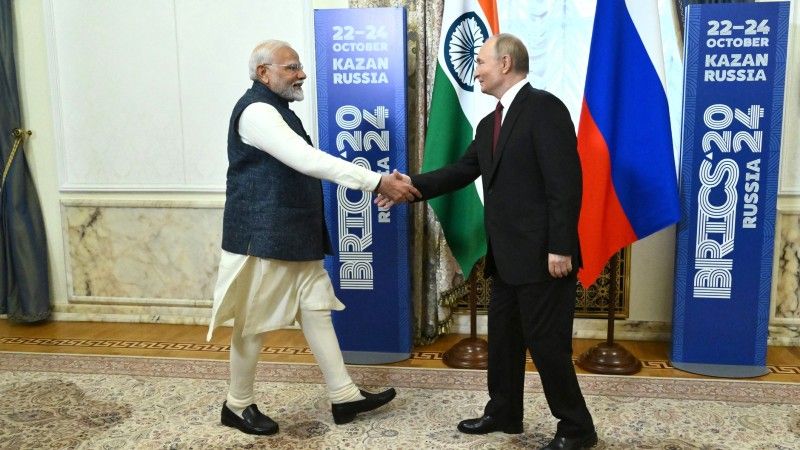
Photo. kremlin.ru / Wikipedia
Hopes in the West that India would swiftly distance itself from Russia after the 2022 invasion of Ukraine proved unfounded. Yet while the bilateral relationship has endured, both countries continue to struggle to find platforms for cooperation beyond the massive trade in oil.
When Russia launched its full-scale invasion of Ukraine in 2022, Western capitals expressed both hope and pressure for India to condemn Moscow. That was never a realistic expectation. India’s longstanding policy towards Russia has remained remarkably consistent for generations: New Delhi does not condemn Moscow, regardless of the circumstances. At the same time, India is not enthusiastic about the war and has occasionally conveyed its preference for a peaceful resolution to Russian interlocutors. India also values its growing ties with the West – most notably through the recently concluded EU free trade agreement – and maintains cordial relations with Ukraine. This balanced, multi-aligned approach has long defined Indian foreign policy: preserving constructive relationships with all sides of any conflict.
The practical consequence of this stance was a lucrative offer from Russia. Shut out of European markets, Moscow turned to India with heavily discounted crude oil. The partnership took off almost immediately and has since reached enormous scale. Since 2022, India has purchased Russian oil worth approximately $168 billion. Before the surge, bilateral trade hovered around $12–13 billion annually, with Russia enjoying a large surplus. Today, two-way trade stands at roughly $70 billion per year, of which oil accounts for about $60 billion – or roughly 85%. Both governments have set an ambitious target of $100 billion in annual trade by 2030.

Western powers, particularly the United States, have repeatedly pressed India to curb these purchases. The strongest pressure came from Washington late last year. However, the subsequent outbreak of conflict in the Gulf, which led to the closure of the Strait of Hormuz, prompted the US to issue waivers allowing countries to buy Russian oil. India seized the opportunity, rapidly scaling up imports from around 1.2 million barrels per day in February (a low point caused by American pressure) to a record 2.25 million barrels per day in March.
Given the prolongation of the Iran-related tensions, Indian purchases of Russian oil are expected to remain elevated – and potentially grow further. New Delhi sees clear advantages: securing affordable energy amid a global fuel crisis while managing domestic inflationary pressures. The only real drawback has been American diplomatic pressure, which has now eased considerably.
A critical – and perhaps most consequential – feature of this trade has been India’s payment in Indian rupees. Sanctions made dollar and SWIFT transactions impractical. Russian entities opened special Vostro accounts in Indian banks to receive rupees, creating a growing surplus of the currency on the Russian side. This imbalance has pushed Moscow to seek payments in alternative currencies and to recycle the rupees through increased investment in India.

The rupee-based mechanism, born of necessity, has also become a notable step toward de-dollarization of global trade. At one point Russia favored payments in UAE dirhams (AED), but in recent months it has increasingly pressed India to settle exclusively in Chinese renminbi (CNY). The share of yuan is rising, although rupees still dominate. This shift strengthens the Chinese currency and enhances Beijing’s influence in global energy markets.
Equally significant is Russia’s growing willingness to invest its rupee surplus back into India. During President Putin’s visit to New Delhi in December 2025, both sides pledged to identify new areas of cooperation – an effort that has been underway for several years. Russian investment in India has so far been modest: notable projects include Rosneft’s stake in Nayara Energy, Rosatom’s nuclear plants at Kudankulam, some metallurgy and chemicals ventures, and limited rail infrastructure cooperation.
The main obstacles for Russia have been the absence of a modern bilateral investment treaty (the old 1994 agreement was terminated by India in 2017), an incompatible banking system, and Western sanctions. For India, concerns included Russia’s downgraded credit rating and the simple fact that more attractive offers were coming from other partners.
Progress is now visible. Russian banks are expanding their presence in India, easing payment frictions, while Russian funds are investing in Indian startups and e-commerce. Negotiations on a new bilateral investment treaty have been prioritized; the next round is scheduled for June 2026.

At the same time, India continues to diversify its partnerships. The landmark Free Trade Agreement with the European Union, concluded in January 2026, has had its provisional text published (though tariff schedules are still pending). It is undergoing final legal scrubbing and is expected to be signed later this year, with ratification and entry into force targeted for 2027. On 27 April 2026, India will sign a similar FTA with New Zealand – concluded in a remarkably swift nine months.
This pattern reflects India’s decades-old diplomatic doctrine: maintaining constructive relations with as many major powers as possible. New Delhi keeps its options open and does not play favorites. Whether it chooses deeper ties with Moscow, Brussels, Washington, or others will ultimately depend on the quality and attractiveness of the offers presented.


