












- WIADOMOŚCI
- WAŻNE
- KOMENTARZ
New format of NATO's eastern flank

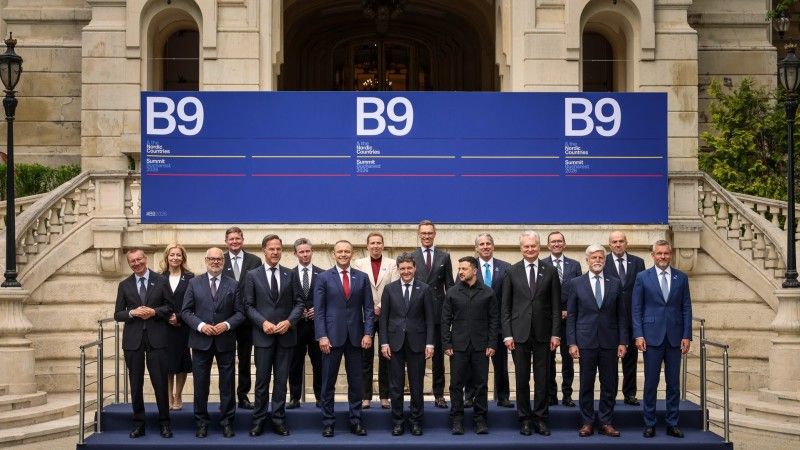
The Bucharest summit was not a standard B9 meeting. It brought together the Bucharest Nine, the Nordic Allies, NATO leadership, Ukraine, the United States as an observer, and wider allied participation, showing that the eastern flank is now understood as one strategic space from the Black Sea, through the Baltic Sea, to the Arctic.
The Bucharest summit marked a new stage in the evolution of the B9 format. It was co-hosted by Romanian President Nicușor Dan and Polish President Karol Nawrocki, and it expanded beyond the traditional eastern flank group by including Denmark, Finland, Iceland, Norway and Sweden. This matters because NATO’s eastern flank is no longer only a Central European or Baltic question. After the accession of Finland and Sweden, the security map has changed, and deterrence must now be viewed as one continuous line from the Black Sea to the Baltic Sea and further into the Nordic and Arctic regions.
The presence of the NATO Secretary General, the President of Ukraine and the United States as an observer gave the meeting additional political weight. This was also President Nawrocki’s first B9 summit, which had symbolic importance, given that Poland and Romania created this format eleven years ago under Andrzej Duda and Klaus Iohannis. Nawrocki’s message was clear: when Poland and Romania warned that Russia’s revisionism was not temporary, many considered the region too alarmist. Today nobody can say they were not warned.
The key sentence from the summit is that the region is no longer NATO’s periphery, but its strategic centre of gravity. This is not only political language. It reflects the real geography of threat. Russia remains the most significant, long-term and direct danger to the Alliance, while the eastern flank is the place where hybrid operations, military pressure, infrastructure threats and the possibility of escalation are most visible.
The declaration also focused on practical defence issues. NATO’s defence plans must be fully resourced, capability targets delivered, and military mobility strengthened. The reference to extending NATO’s fuel pipeline system to the eastern flank is particularly important, because logistics will decide whether allied forces can actually move and fight in a crisis. In this sense, the summit was not only about declarations, but about the physical ability to defend territory.

The inclusion of the Nordic Allies changes the scale of the conversation. Nordic and Central European cooperation is becoming one of the most important directions for European security. The Baltic states, Poland, Romania, Finland, Sweden and the wider Nordic region now share one strategic reality: Russia must be deterred not in separate sectors, but across a connected northern and eastern theatre. This does not replace NATO, but it strengthens the political and military coordination of those states that understand the Russian threat most directly.
The NATO Secretary General’s remarks fitted this logic. His point that the B9 is firmly anchored in NATO and the transatlantic relationship was important, especially at a time when Europe is discussing greater responsibility for its own defence. His statement that Allies from the Black Sea, to the Baltic, to the Arctic demonstrate unity and determination reflects the new reality of the Alliance. Deterrence in the High North and on the eastern flank has improved, but it is still not sufficient given the scale of the threat.

Ukraine and Moldova were also central to the discussion. The summit reaffirmed support for Ukraine and underlined the importance of deeper NATO-EU cooperation, including initiatives such as Eastern Flank Watch. Moldova was mentioned as a key partner, which is correct, because its security is directly connected with the security of the wider eastern flank. Russia uses pressure not only against NATO states, but also against vulnerable partners around them.
Hungary’s constructive abstention should also be noted. Budapest stated that it was not in a position to accept the current wording of the declaration as agreed language and left future decisions to the incoming Hungarian government. This shows that unity exists, but it is not automatic. The eastern flank is becoming more organised, but political differences inside the region remain and must be managed.
The decision that the next summit will take place in Poland is significant. It confirms Warsaw’s role as one of the main political and military centres of NATO’s eastern flank. The fact that this decision was supported by B9 countries, Nordic Allies, NATO, the United States and other participants shows that Poland is seen as a natural place for the next stage of this debate.
This format will not replace NATO and should not be presented as an alternative to the Alliance. It can, however, become a useful instrument for coordination between states that share the same threat perception and need faster practical cooperation. The value of this summit lies precisely in that: the eastern flank and the Nordic region are beginning to speak together, plan together and think about defence as one connected space. The direction is right, but at the same time, the question is how quickly it will produce real capabilities.


