












- WIADOMOŚCI
Polar power play: China, Russia and the race for the Arctic (Part II)

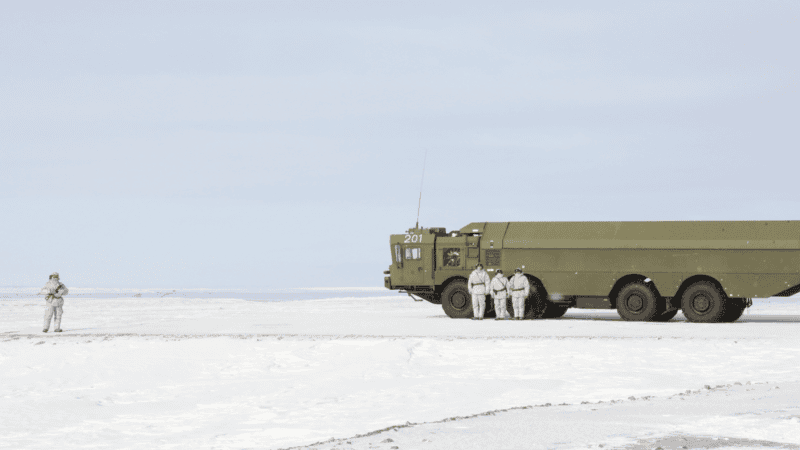
Photo. Ministry of Defence of the Russian Federation/commons.wikimedia.org/ Creative Commons Attribution 4.0 International
The People’s Republic of China’s Arctic strategy emphasizes that the Arctic’s natural conditions and the changes taking place there have a direct impact on the national climate system and the environment, and thereby on Chinese economic interests in sectors such as agriculture, forestry, fishing and the maritime industry. Although it is not the most important geographic region in which China seeks to compete with the United States, a holistic approach based on economic competition will affect the use of Arctic space as an area in which to contest U.S. superiority, forcing the United States to invest and commit forces and means much needed in competition in the Pacific.
In the future this policy may present a potential challenge to the transit routes of the United States and its allies. This issue concerns especially the areas of the Northern Arctic. The need for stabilization and peaceful governance of the region has been emphasized, indicating that the use of capital and technology will play a key role in the development of Arctic sea routes. As a result, sustainable development is crucial, using resources there while maintaining symbiosis with the environment, including exploitation of oil, gas and other mineral deposits with suitable ecological protection.
The fundamental international document regulating China’s status in this area is the United Nations Convention on the Law of the Sea of 1982; the state ratified it on 7 June 1996. Under the Convention, non-Arctic states may conduct scientific research, maritime navigation, obtain natural resources, and participate in environmental protection. China is also a party to the Svalbard Treaty (1925), which guarantees the exploitation of Svalbard’s natural resources and territorial waters, the right to fishing and marine hunting, participation in trade, maritime industry and mining, and the organization of scientific research. Under international law, non-Arctic states do not have the right to engage in extraction of oil and gas directly on the Arctic continental shelf; nor can they directly influence the governance of the Arctic. As a result, by engaging in oil extraction and cooperating with Russian firms, China obtains mutual benefits in the context of competition with Western influences and companies. At the same time it emphasizes its presence and interest in environmental protection, which aligns with Chinese policy aims to minimize the impacts of climate change.
For the Russian Federation the Arctic is above all strategic raw-material resources, crucial for its national security and supporting its image and status as a great power. In 2016, the Concept of the Foreign Policy of the Russian Federation emphasized the role of the Northern Sea Route as a maritime route of great significance and the need to preserve peace, stability and constructive international cooperation in the Arctic. This route is gradually expanding in terms of the period available for navigation and territorially stretching eastwards from Novaya Zemlya, from the Kara Sea along Siberia, ending at the Bering Strait. As a result, Russia very closely monitors all actions by non-Arctic states; initially distancing itself from Chinese engagement. Currently, however, one can observe a change in approach and closer cooperation, which is both a manifestation of Russia’s weakness and of the fear of increasing U.S. engagement. Russia remains the largest Arctic state (the Arctic coastline measures 24,150 km) and has the largest fleet of icebreakers, including nuclear-powered ones. Presently the Yamal Peninsula, the Gydan Peninsula, the Taz Peninsula and the Ob Bay are areas where oil and gas extraction is being invested in by Gazpromneft and the Novatek group.
The People’s Republic of China regards the Arctic as the so-called Polar Silk Road — a branch of the main Belt and Road project (One Belt, One Road or OBOR). Russia’s approval of the Northern Sea Route as the Polar Silk Road links that waterway to OBOR, indicating closer and prospective economic relations between the two states in the Arctic. China’s de facto acceptance of Russia’s demands to control the Northern Sea Route and to observe Moscow’s internal regulations alleviates Russian fears of excessive Chinese investments in the country. An example is the engagement of the state-owned CNPC together with the Silk Road Fund in Novatek’s Russian Yamal LNG terminal project, from which 4 million tonnes of natural gas are to be destined for China. The majority share belongs to Russian Novatek (50.1%), while CNPC holds a 20% stake and the Silk Road Fund signed an agreement to purchase 9.9% of supplies. This is an element of China’s projection of power in the economic sphere by taking over global and regional technological-economic systems, thereby economically binding other countries. This can be achieved through controlling share packages, including in the Arctic, protecting assets against risks associated with investments along the Northern Sea Route. Such risks are mitigated by influence within Russian firms — influence the Chinese seek to acquire, having the means and benefiting from a favorable timing factor in the context of Russia’s weakening political, economic and military role. Aware of this, Russia is cautious in offering such opportunities, and decisions are made choosing the lesser evil, where the alternative is cooperation or competition with Western countries and companies. Russia does not cooperate exclusively with the Chinese partner — examples include India or attempts to find investors for its projects in Japan. The latter alternative is currently very difficult given Tokyo’s determined stance against Moscow and its aggression against Ukraine. Nevertheless, maintaining a balance of political influence in the Arctic is a Russian strategic objective.
Economic factor as a real driver in the pursuit of dominance
Crude oil and natural gas are of fundamental importance to the Chinese economy. In this context, mention should be made of the oil field in the Qaidam Basin in Qinghai Province and deposits of lithium, calcium, strontium, bromine, salts, silicon and magnesium located there; additionally, deposits of copper, lead and zinc. Another area is the South China Sea, or oil deposits in the Bohai Bay. The largest oil field is in the Chongqing region, where in 2020 24.5 million tonnes of crude oil and 41.5 million tonnes of gas (oil equivalent) were produced, accounting for one-sixth of national production. China continues to increase crude oil extraction to satisfy huge economic needs that domestic resources cannot cover, hence investments in Russian companies in the Arctic are of real importance. However, Beijing does not allow full coverage of raw-material demand in the near and long term in pursuit of the „Chinese Dream.” It is therefore significant that estimates suggest undiscovered Arctic oil and gas deposits may account for about 13% and 30% respectively of the world’s total resources of these commodities. For the Middle Kingdom these are key raw materials determining national economic development, economic growth and social stability.
Especially because many Arctic deposits are on land given organic limitations in exploiting offshore fields — a consequence of Western sanctions and the lack of appropriate technologies or the ability of Russian firms to acquire them. The solution appears to be cooperation with Chinese companies that could partly provide such equipment, although not fully suitable for the Arctic. The latter, however, have limited experience in exploiting deposits under such difficult terrain and weather conditions as in the Arctic Ocean.
China also possesses economically profitable rare-earth metal resources, accounting for about 37% of global reserves. It dominates through mining complexes such as Bayan Obo (Inner Mongolia), the Ganfeng Lithium corporation (a shareholder in the Argentine Caucharí-Olaroz project) and assets in the Chilean chemical firm Sociedad Química y Minera, a lithium producer. Investments also include cobalt extraction in the Democratic Republic of the Congo (DRC), where 60% of the world’s reserves are located. Of 24 critical minerals identified by the Australian government (Critical Minerals Prospectus 2020), China is the largest producer of 11. A British risk list indicates China as the leading producer of 23 minerals. The above data evidences China’s extensive experience in exploiting resources on foreign territory, which underlines its determination to maintain a leading position in the rare-earth market while building reserves. This can influence the state’s bargaining position when the need arises. A proactive approach is demonstrated by regarding the Arctic as another source of rare earths and by maintaining a dominant future role as a strategic objective.
Conclusions
The Arctic region is certainly one of the vectors of China’s foreign policy, focused on the economy and recognizing emerging long-term options. This is a pragmatic approach, as Jakub Grygiel (Jakub Grygiel,Great Powers and Geopolitical Change, Baltimore, the John Hopkins University Press 2006, p. 22.) observed, and relates to the geostrategy of states where national interests impact the „geographic directions of foreign policy,” influencing „where the state concentrates its efforts through projection of power and targeted diplomatic actions.” This involves using diverse instruments to engage regional actors bilaterally and organizatively without employing military force. In parallel China is developing technologies necessary to operate in the Arctic, enabling competition with other »players.« This includes research and investments in the region. Natural resources and fisheries are among the factors; additionally, Arctic sea lines of communication open opportunities to shorten transit times for goods and reduce sensitivity of sea routes through the Strait of Malacca to disruptions of supply continuity.
There is a possibility that an arms race in this cold region could become the arena of a new Cold War; in such a case the role of international regional organizations like the Arctic Council would be degraded. That will not happen, however, in the next few decades, given the current war in Ukraine and other volatile regions such as the Balkans and Africa that draw in „big players” including Russia, the United States, China and the European Union. In relation to Moscow and Beijing there is a certain divergence in approach, although both are driven by the promise of future profits. China skillfully engages smaller actors, avoiding direct confrontation with larger ones; Russia does the opposite, creating enemies through aggressive actions, as exemplified by the consequences of aggression against Ukraine and its unpredictable ramifications — thereby appearing as an uncalculated state that negates the possibility of any reliable partnership or cooperation. At the same time, the Arctic is a region where lines between adversaries and allies may blur in the medium and long term. Currently, for Russia and China this is a partnership of choice, or rather a partnership born of lack of choice. Especially since the balance between the Russian Federation and China has been verified, with Beijing taking the dominant position, which allows it to dictate terms and prices, e.g., for raw materials and resources. Russia has a dominant position in the Arctic and therefore, in the face of a dominant »partner,« must be cautious to avoid losing yet another area of influence — something Moscow is fully aware of.
China’s aspirations to become a world power also concern the maritime domain. China has built its first modern icebreakers, but of small tonnage, which will doubtless become one of the shipbuilding industry’s priority tasks in the future. This is not merely about possessing an oceanic navy, but also about influence in commercial fishing, the development of marine sciences, shaping maritime infrastructure and focusing on resource extraction. The scientific and technical aspect is particularly important here, since China aims to become an innovative society by 2035 (a model rejecting copying other projects in favour of indigenous ones), and to fulfil the »Chinese Dream« (Zhongguomeng) by 2049. The Russian Federation will certainly not allow a takeover of its sphere of influence and is expanding military infrastructure and strengthening the Northern Fleet to create the capability to conduct combined operations. This will help preserve control of the region in every dimension — an objective not aligned with China’s strategy, which has limited potential in the region and must rely on internationalization in the short term to achieve long-term economic dominance. Internationalizing the Arctic is argued on grounds of caring for peace, stability and protection related to climate issues. In reality, key matters will remain access to oil, gas and other mineral deposits, and the strive to control sea lanes. Differences in interests between Russia and China may be reflected in approaches to Arctic militarization — for example, China is not invited to joint military exercises there. This contrasts with joint military exercises in Central Asia (within the Shanghai Cooperation Organization) or in the Sea of Japan. On the other hand, it should be remembered that China’s rising global economic position is supported by the military mainly in response to crises that threaten its economic or geopolitical interests. This underscores how important and sensitive Russian dominance in the Arctic is.
The competition for the Arctic began long ago and is not a new phenomenon, but the dynamics are changing with transformations in the region. Wherever benefits can be achieved, opposing interests of the USA, Russia and China appear. Today these interests clash over relatively new territory that requires foreign-policy change and the adaptation of military capabilities to create the conditions for seizing initiative and securing uninterrupted access to resources and control of sea lanes. Even if the Moscow–Beijing alliance may raise concern in the NATO context in Europe, the Arctic is a wholly separate theatre of competition where every state is opening a new chapter in building military capability and will strive for dominance.
Authors: Zdzisław Śliwa, PhD Hab., Aleksander Olech PhD, Piotr Dutkiewicz MA


