


- WIADOMOŚCI
- KOMENTARZ
Portugal's fighter jet competition intensifies. France, the US and Sweden fight for the contract

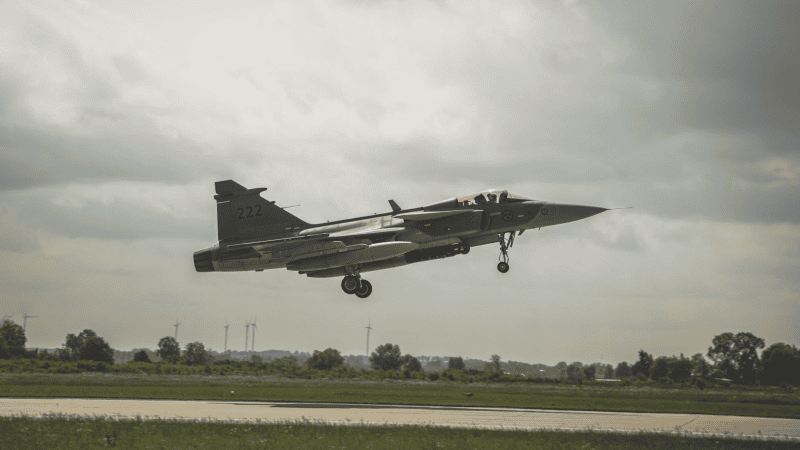
Photo. Forsvarsmakten/X
The competition to replace Portugal’s F-16 fighter jets is intensifying. France is offering the Rafale, the United States is promoting the F-35, and Sweden is expanding its industrial cooperation in Portugal to strengthen the Gripen’s position. On 11 November 2026, Saab announced that Portuguese company Vangest would manufacture eight complex components for its Gripen E/F aircraft. Meanwhile, Lockheed Martin is preparing new production opportunities for Portuguese companies, while Dassault Aviation has already signed an industrial cooperation agreement. Lisbon has yet to launch a formal procurement process, but the competition for a contract potentially worth around €5 billion is already underway.
Dassault Aviation, acting on behalf of the Rafale partners Thales and Safran, signed a memorandum of understanding with AED Cluster Portugal in September 2026 to explore industrial cooperation linked to Portugal’s future replacement of its F-16 fleet. The agreement followed the formal Rafale offer submitted to Lisbon in July. This matters because Rafale has become one of France’s greatest defence export successes, but that success has so far been concentrated largely outside Western Europe.
Dassault currently lists eight Rafale export customers: Egypt, India, Qatar, Greece, Croatia, the UAE, Indonesia and Serbia. Only Greece, Croatia and Serbia are European customers, and among EU and NATO members the list is limited to Greece and Croatia. No Western European country outside France has purchased the aircraft. Portugal would therefore represent something more than another export contract: it would break a pattern that has followed Rafale throughout its history.
This does not mean Rafale has been uncompetitive in Europe. In the Netherlands in 2002, the JSF and Rafale achieved the highest system-effectiveness scores, but the Dutch government ultimately judged the JSF to be the most effective and cheapest option over its lifecycle, describing it as the „best aircraft for the best price”. Switzerland selected the Gripen over Rafale and Eurofighter in 2011, before that purchase was rejected in a 2014 referendum. In the second Swiss competition in 2021, the F-35A scored 336 points, at least 95 more than any rival, and was assessed as offering the highest overall benefit at the lowest cost. Finland also selected 64 F-35As after concluding that the F-35 offered the best overall military system among five candidates, including Rafale. Belgium chose 34 F-35As in 2018.
There are also cases where Rafale never reached the final competition. Dassault withdrew from Canada in 2018, citing difficulties meeting security and interoperability requirements in the closely integrated Canada-US environment. It had earlier withdrawn from the Norwegian process and, in Denmark, left the competition after the first request for information in 2005. Poland selected the F-35 through the US FMS route without a classic international competition involving Rafale, while Germany bought 35 F-35As primarily to preserve its role in NATO nuclear sharing – a requirement tied to US nuclear weapons that Rafale could not fulfil.
Portugal is therefore an important test for Dassault. Rafale has already proved that it can win major contracts in the Middle East, Asia and parts of Southern and Eastern Europe. The problem has been penetrating the Western European fighter market, where cost, NATO integration, interoperability with the United States and industrial participation have repeatedly mattered as much as the aircraft itself. The agreement with AED Cluster Portugal addresses precisely this last dimension. If Lisbon eventually selects Rafale, it would be one of the most politically and industrially significant European successes in the aircraft’s export history.
Sweden enters the competition with concrete production contracts
However, France is not the only European country seeking to strengthen its position in Portugal. On 11 November 2026, Sweden’s Saab announced an expansion of its cooperation with Portuguese industrial group Vangest. The company’s facilities in Marinha Grande will manufacture eight complex components for Gripen E/F fighter jets. The agreement is intended to increase Saab’s international production capacity while giving Portuguese industry a direct role in the manufacturing of the Swedish aircraft. The contract’s value, production volumes and start date have not been disclosed.
Johan Segertoft, head of Saab’s Gripen business unit, stressed that increasing production requires strong industrial partnerships. The Swedish manufacturer also indicated that selecting the Gripen E/F as Portugal’s next fighter aircraft would create further opportunities to expand cooperation with Vangest. Importantly, this is not merely a memorandum promising future industrial benefits. The Portuguese company has been assigned specific manufacturing responsibilities within the Gripen programme.
Saab has been developing its presence in Portugal for some time. In December 2025, the Swedish manufacturer signed a memorandum of understanding with AED Cluster Portugal. In March 2026, Daniel Boestad, Vice President of Gripen Business Development, identified OGMA as a potential partner for manufacturing components in Portugal. OGMA is controlled by Brazil’s Embraer, which already cooperates closely with Saab on the Gripen programme. The Swedish company has also indicated that it would consider expanding production activities in Portugal, although no final decision on aircraft assembly has been announced.
The Gripen therefore offers Lisbon more than a new combat aircraft. Saab is attempting to establish long-term industrial cooperation, create production opportunities and integrate Portuguese companies into its international supply chain. Nevertheless, the agreement with Vangest does not mean that Portugal has decided to purchase Gripens. The country has yet to launch a formal fighter procurement process, and the Swedish manufacturer faces considerable competition.
The United States is not giving up. F-35 remains a major contender
The American position has also strengthened. On 8 October 2026, Portuguese Foreign Minister Paulo Rangel confirmed that Lisbon was seriously considering the US proposal for the F-35 alongside other options. The statement followed his meeting with US Secretary of State Marco Rubio. This is particularly significant because in March 2025 Portuguese Defence Minister Nuno Melo had publicly questioned the acquisition of the F-35, pointing to the unpredictability of American policy. The government’s latest statements indicate that Washington’s offer remains firmly under consideration.
Lockheed Martin is also seeking to involve Portuguese companies in the production of its aircraft. On 22 October, it was reported that four Portuguese businesses would be formally invited to compete for contracts to manufacture two types of structural components for the F-35. The invitations are expected to be issued by the end of November, with the companies competing against six other potential suppliers. These are not contracts already awarded to Portugal, but they demonstrate that American industrial cooperation is being developed before Lisbon has selected its next fighter.
The American manufacturer has identified 17 additional potential industrial projects involving 23 Portuguese companies and three universities if Lisbon selects the F-35. These opportunities could include production, technology transfer and participation in international supply chains. However, they remain proposals rather than confirmed investments. Lockheed Martin is therefore pursuing a strategy similar to that of its European competitors: offering access to industrial projects alongside the aircraft itself.
Portugal currently operates 28 upgraded F-16M fighter jets, which will eventually need replacing. The potential procurement has been estimated in Portuguese media at approximately €5 billion, although the final cost will depend on the number of aircraft, weapons, support arrangements and the industrial package. The F-35 is widely regarded as a strong contender because of its capabilities and integration with NATO, but Lisbon’s decision will also depend on economic and political considerations.
Four aircraft, three major national competitors and a European consortium
The competition is not limited to Rafale, F-35 and Gripen. The Eurofighter consortium, bringing together major British, German, Italian and Spanish industrial interests, is also seeking the Portuguese contract. Airbus has presented the Typhoon as a suitable replacement for Portugal’s F-16s, pointing to air policing, NATO quick-reaction alert missions and the protection of Portuguese airspace and maritime approaches. The consortium is also offering industrial cooperation and financing arrangements intended to strengthen its position against the American and other European proposals.
The industrial dimension is becoming increasingly important. Dassault Aviation has signed an agreement with AED Cluster Portugal, Saab is assigning production tasks to Vangest and exploring cooperation with OGMA, while Lockheed Martin is preparing competitive opportunities for Portuguese suppliers. The Eurofighter consortium is promoting its own long-term industrial package. All four manufacturers understand that Lisbon will assess not only the aircraft’s military capabilities but also the economic benefits that their acquisition could bring to Portugal.
The next stage will be the formal launch of the procurement process and the definition of Portugal’s military, financial and industrial requirements. Until then, none of the manufacturers can claim to have secured the contract. The F-35 has important advantages in terms of fifth-generation capabilities, while Rafale, Gripen and Eurofighter are seeking to demonstrate that their aircraft can meet Portuguese operational needs while offering substantial opportunities for domestic industry.
Three countries are now at the centre of the competition for Portugal’s future fighter aircraft: France with the Rafale, the United States with the F-35 and Sweden with the Gripen. The multinational Eurofighter consortium remains a fourth contender. The competition is no longer limited to the performance of the aircraft themselves. It increasingly concerns investment, technology, manufacturing and the future of Portugal’s defence industry. For France, winning would mean finally breaking into a Western European market that has repeatedly favoured American aircraft. For Sweden, it would represent another important export success for the Gripen. For the United States, it would further strengthen the F-35’s position in Europe.
Portugal now has to decide not only which fighter it wants to operate, but also which industrial and defence partnerships it intends to develop for the coming decades. Most of countries in Europe have choosen F-35, however, this time is about long-term partnership.


