












- ANALIZA
- WAŻNE
- WIADOMOŚCI
Southeast Europe at the crossroads: China and the United Arab Emirates in strategic rivalry

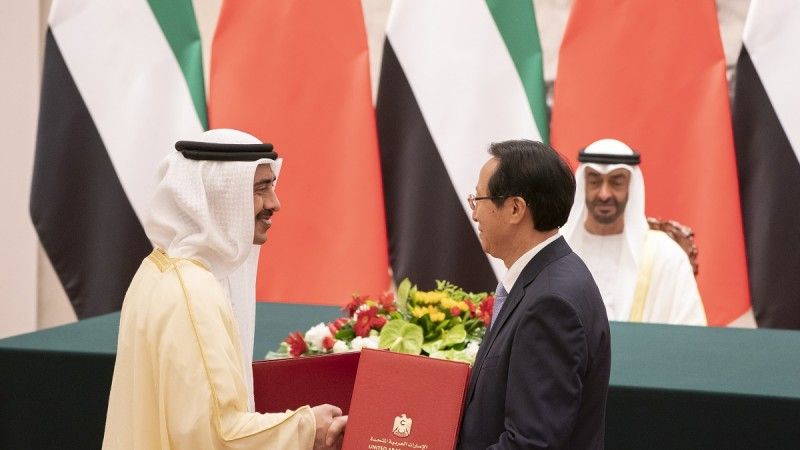
In Serbia and Montenegro, the two competitors are currently securing influence through infrastructure and energy projects, debt leverage, and strategic alignments.
China is acting with strategic loans and large-scale projects. Serbia has positioned itself as China’s most important partner in the region. Initiatives like the modernization of the Belgrade-Budapest railway line, the takeover of Smerdervo steelworks and Chinese-financed energy projects demonstrate the depth of this commitment.
In 2022, China invested EUR 1.4 billion in Serbia (approximately the total volume of all 27 EU member states). In the first half of 2024, it became the largest foreign investor with EUR 697.9 million and additionally signed a memorandum of understanding for a further EUR 2 billion for renewable energies (will undoubtedly be the most fiercely contested battleground).
Furthermore, arms deliveries from China are causing security concerns: In April 2022, six transport aircraft of the Chinese People’s Liberation Army delivered the FK-3 air defence system to Serbia, flying through the airspace of several NATO members with diplomatic clearance. The unprecedented delivery — the first of its kind in the Balkans — was closely monitored by NATO, which is watching this development with growing concern, as it signals an expanding Chinese military footprint in the region. This development underscores Serbia’s balancing act between East and West.
The United Arab Emirates is focusing on selective investments: infrastructure, energy, and high-quality real estate projects. These investments are made with political backing and diplomatic sensitivity. The aim is to secure long-term influence in the region through soft power and stable economic partnerships.
With players such as Eagle Hills (e.g., Belgrade Waterfront, >EUR 3 billion) or ADIA, they are pursuing long-term investments in urban development and logistics. For example, the Emirates acquired a 49% stake in Air Serbia. Collaboration also takes place in the military sector, particularly in the fields of drone and missile technology, but on a much smaller scale compared to China.
In Montenegro, tourism and maritime assets continue to attract attention following the development of Porto Montenegro, while energy projects such as the Krnovo Wind Farm, a successful investment by the Masdar Group (Abu Dhabi Future Energy Company), demonstrate the country’s growing role in regional sustainability. By contrast, China sought to draw Montenegro into debt dependency through the Bar Boljare motorway project, prompting the European Union once again to step in and support the country. Once again, the European Union stepped in to support the country.
And the real gem of the region, Croatia? Why are both players hardly active in the country? Although it is an EU member, with a stronger economy and purchasing power, as well as greater legal certainty for investments, neither country has managed to gain a serious foothold. Croatia’s ports (Rijeka and Ploče) and its geographical location in the heart of Europe are virtually predestined for China’s Belt and Road Initiative and the UAE’s trade policy.
Despite having one of the most attractive tourism sectors in Europe, both China and the UAE remain on the sidelines. The passivity of the UAE, with tourism giant Dubai as an investor, is particularly irritating. Where are Jumeirah or Emaar? Although Croatia has a highly coveted strategic LNG terminal, neither the UAE nor China have made any serious attempts to secure their position. It is likely that they simply could not find a way in?
The right network and the right strategy make all the difference
Author: Eduard Vasilj holds degrees in Political Science and International Law from the Goethe University of Frankfurt and in Political Science and Organisation from the University of Zagreb. Following his advisory work for governments, he transitioned into the private sector, serving for almost 20 years in executive and board positions within major multinational corporations across the German-speaking region and Southeast Europe. He advises governments, multinational corporations, and family offices on geopolitical risk - and geoeconomics — with a particular focus on East and Southeast Europe.


