- ANALIZA
- WIADOMOŚCI
- WAŻNE
The historical context of security in the Black Sea region

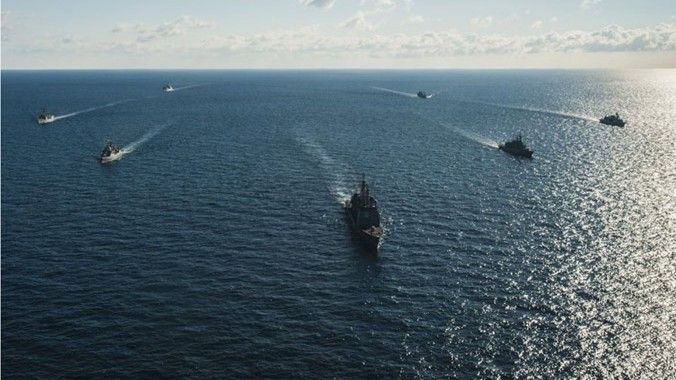
Photo. www.nato.int
Few regions in the world are as tightly controlled — and as strategically explosive — as the Black Sea. Locked behind two narrow straits and governed by a nearly 90-year-old convention, this maritime basin has become one of the most decisive arenas of the Russian–Ukrainian war. At the centre of it all stands Turkey, armed not with fleets or missiles, but with legal authority that can determine who sails, who fights, and who is locked out. To understand today’s balance of power in the Black Sea, one must look far beyond the battlefield — and deep into history.
For geographical reasons, the Ottoman Empire (1299–1922) was decisive in the Black Sea region. The Empire controlled two major straits: the Dardanelles, connecting the Aegean Sea to the Sea of Marmara, and the Bosphorus, connecting the Sea of Marmara to the Black Sea. The role of these straits, dubbed the Turkish Straits, is fundamental to the reason that they constitute the only entrance to the Black Sea from the Mediterranean. Confirmation of Ottoman dominance in the Black Sea region came with the conquest of Crimea in 1475.
Foreign ships were then excluded from sailing the Black Sea, creating Ottoman domination of the area for three centuries. This domination lasted until 1774, when the Ottomans decided to support Poland in the war against Russia. Empress Catherine the Great then placed Crimea under a Russian protectorate, guaranteeing its merchant shipping free passage through the straits. Over the following years, the issue of the Black Sea straits remained the subject of international rivalry. An agreement was not reached until 1923 in Lausanne.
The treaty adopted at that time stipulated that all ships, even warships, had the right of free passage through the straits, but only in peacetime. The International Straits Commission was to supervise the provisions of the treaty by overseeing the implementation of its various provisions, including demilitarisation. Changes in this regard came in the 1930s when Turkey claimed that the demilitarisation clause of the Lausanne Treaty was contrary to Turkey’s right to self-defence.
The change to the previous provisions was driven by developments in international politics: the remilitarisation of Germany accelerated the erosion of the post-war collective security system established by the League of Nations. Turkey therefore returned to the subject of the straits at another conference, this time in Montreux, Switzerland.
Russia was also a power vitally interested in regulating access to the Black Sea straits. Its demands included that the Black Sea be closed to all but the littoral states. These conditions were a consequence of the fact that Ukraine and Georgia were then part of the USSR, while Romania and Bulgaria were Soviet allies.
However, Russian ideas for shaping order in the Black Sea region did not meet with the approval of the Western powers. Britain and other European states took steps to limit the ability of Russian warships to operate in the Black Sea unfettered in the event of a naval war and to seek refuge there. Western states also sought to limit Turkey’s ability to block the Turkish Straits. Faced with the impossibility of reaching a compromise, a compromise solution was eventually adopted by the states concerned with the Black Sea Straits issue.
The provisions of the 1936 Montreux Convention allowed Turkey to remilitarise the zone of the straits, granting it some control over them. At the same time, the agreement regulating the passage of ships increased Soviet influence in the Black Sea.
In the ongoing Russian–Ukrainian war, the Montreux Convention provides the legal basis for regulating traffic in the Black Sea. At the beginning of hostilities, Ukraine asked Turkey to close the straits to Russian warships, pointing to Turkey’s crucial importance in maintaining peace in the Black Sea region.
The Turkish government agreed to the proposal on 28 February 2022. However, this did not stop Russia from placing several warships in the Black Sea. In response, Turkey stated that it would not prevent Russian warships from entering the Black Sea if Russia claimed that they were returning to their home ports.
The key provisions of the Montreux Convention governing the entry of ships into the Black Sea during wartime read: 1) Turkey may close the straits to warships of belligerent parties in time of war or when Turkey itself is a party to the war or is threatened with aggression by another state; 2) Turkey may close the straits to merchant ships belonging to states at war with Turkey; 3) any state with a coastline on the Black Sea — Romania, Bulgaria, Georgia, Russia or Ukraine — must give Turkey eight days« notice of its intention to send warships through the straits. Other countries, those that do not border the Black Sea, must give Turkey 15 days« notice.
Only Black Sea states may send submarines through the straits, but only after prior notification and only if the submarines were built or purchased outside the Black Sea; 4) only nine warships may pass through the straits at any one time, and there are restrictions on the size of the ships, either individually or in groups. No group of ships can exceed 15,000 metric tonnes. Modern warships are heavy, with frigates around 3,000 metric tonnes and destroyers and cruisers around 10,000 metric tonnes. Modern aircraft carriers are too large to pass through, and under Turkish regulations are not allowed anyway.
Dominion of the Black Sea entails many advantages. Ships of coastal countries sailing on it have much greater rights than vessels from outside the Black Sea. Ships of coastal countries sailing there have much more rights than non-Black Sea vessels. Foreign warships, for example, cannot stay in the basin for more than 21 days; Black Sea navies are exempt from such restrictions.
In addition, non-Black Sea navies have a permissible total tonnage of 45,000 tonnes, with no non-Black Sea power having more than two-thirds of this figure. Ships of countries involved in hostilities are not allowed to enter the Black Sea, making it impossible, for example, to replace the sunken cruiser „Moskva”. Turkey’s situation in the ongoing Russian–Ukrainian war is difficult. Both sides in the conflict are important partners in key energy and military trade agreements.
Turkey is a member of NATO and seeks to strengthen its ties with the West; at the same time, the Russian Federation is one of its key partners. Turkish control of the key straits may prove decisive for its future relations with both partners.