












- ANALIZA
- WIADOMOŚCI
US and India to jointly produce Javelins? Hegseth presents vision for Indo-Pacific

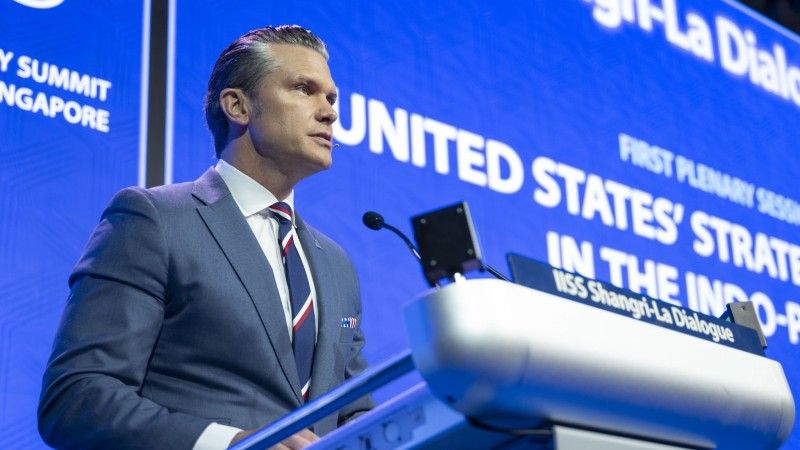
Photo. SecWar/X
U.S. Secretary of Defense Pete Hegseth presented a strategy intended to enable the United States and its Indo-Pacific allies to preserve peace in the region. He also spoke about the possibility of producing Javelins in India.
On 29th–31st May, Singapore hosted another International Institute for Strategic Studies (IISS) Shangri-La conference. During the event, U.S. Secretary of Defense Pete Hegseth delivered a speech in which he outlined a plan for U.S. engagement in the Indo-Pacific region.
Secretary Hegseth’s twenty-five-minute address consisted, to a large extent, of reiterating the priorities of U.S. foreign policy, although it also included several statements that can be regarded as new.
"We need partners, not protectorates"
Speaking about U.S. policy in the Indo-Pacific, Pete Hegseth announced the beginning of a new era, one that ends American subsidizing of the defense of other wealthy countries. He said US needs partners, not protectorates. He underlined DC seeks alliances based on shared responsibility, not dependency, adding that the days of „free riders” attempting to base their security on support from others while contributing little themselves were over. As the politician emphasized, the United States will help those countries that „also help themselves.” In doing so, he was referring to the principle of burden sharing promoted by the current administration, particularly by Under Secretary E. Colby.
Hegseth stressed that aliances are a two-way street. He reiterated that, saying alliances work only when they are based on partnership. He added that strong alliance exists when everyone has a stake in it. He also noted that those allies who follow U.S. guidance — including defense spending at no less than 3.5 percent of GDP — can count on special treatment from the current administration. According to Pete Hegseth, this includes accelerated arms sales, deep industrial cooperation, and expanded intelligence sharing.
In addition to greater allied involvement, the United States also wants to be more active itself. Hegseth noted that Department of Defense is leading a historic national mobilization of the defense industrial base. He made a bold declaration, claiming the US will produce the best weapons in the world — at scale, at speed, and at a reasonable price, indicating that this year the Trump administration is set to allocate one trillion dollars to defense development, with spending in 2027 expected to reach as much as 1.5 trillion dollars.
The Monroe Doctrine, "Big Stick" policy, and "Peace through strength"
The speech repeatedly featured slogans frequently cited by individual members of the current U.S. administration. These include, among others, the policy of Peace Through Strength. Hegseth noted the US force posture will be resilient, distributed, and designed to defeat an attack at its inception. He underlined that this will prevent an adversary from achieving rapid and decisive military gains, mentioning the recent capture of Nicolas Maduro and the change of power in Venezuela, as well as Operation „Epic Fury” in Iran. Secretary Hegseth also referred to deterrence by denial in the Pacific itself, specifically along the so-called First Island Chain.
Hegseth’s remarks also included references to older doctrines and their updated, global versions. This concerns the Monroe Doctrine of 1823 and the „big stick” policy formulated at the beginning of the 20th century by then-U.S. President Theodore Roosevelt. The latter, serving as an offensive supplement to the Roosevelt Corollary — a doctrine originally limited to the Western Hemisphere — in today’s interpretation casts the United States as a global policeman disciplining states that violate its interests.
Hegseth noted that US allies in Asia are not looking for constant escalation or spaces defined by public confrontations. They want, he said, noting the United States provides that, disciplined strength. Hegseth said that the demand is for leadership confident enough to speak softly and act prudently while carrying a »big stick,«”, ending with the words: ”Big stick speaks softly” — in the original, Roosevelt said: ”Speak softly and carry a big stick.”
The above considerations also included remarks devoted to China. Secretary Hegseth stated that the hegemony of a single power in the Pacific — implicitly Beijing — would upset the regional balance there. Hegseth noted US seeks, and what President Trump speaks about, for a stable balance that works for Americans and for the allies. He added that this is a favorable and enduring balance of power in which no state, including China, can impose hegemony.
Praise for allies and joint arms production with India?
Returning to the subject of allies, it is worth mentioning the countries Hegseth named as the United States« closest allies in Asia. South Korea received praise for its government’s declaration regarding defense spending at 3.5 percent of GDP, while the Philippines was commended not only for significantly increasing defense expenditure but also for improving interoperability and conducting joint exercises with the United States. The group of allied states in the Indo-Pacific region also included Japan, Australia, Vietnam, Thailand, and Malaysia.
A separate part of the speech was devoted to India, including cooperation within the QUAD format, which consists of the United States, Japan, Australia, and India. One noteworthy piece of information concerned joint work on the development of heavy industry, which would enable, as Hegseth said, the ability to repair and sustain common platforms. According to Hegseth, India would be expected in particular to support the U.S. Navy. Moreover, the country would be interested in co-producing advanced systems, including anti-tank guided munitions successfully used in Ukraine — namely, Javelins.


