












- KOMENTARZ
- WAŻNE
- WIADOMOŚCI
U.S. strikes Caracas regime, Venezuela at center of global crisis

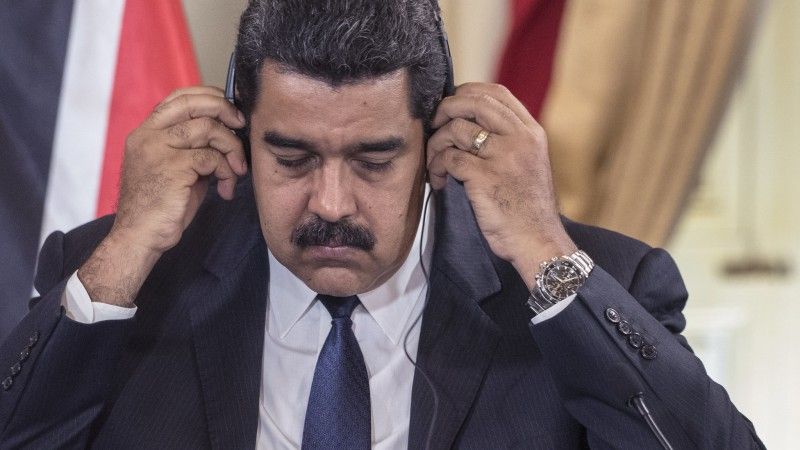
An unprecedented U.S. military operation against Venezuela’s authoritarian authorities, the capture of Nicolás Maduro, and the first direct U.S. intervention in Latin America since 1989 are calling into question the existing regional security architecture and generating far-reaching consequences for the international order.
During the night of 2-3 January 2026, Venezuela experienced a sharp military escalation whose scale and execution point to a state-level operation with clearly defined strategic objectives. In Caracas and across the northern part of the country, multiple explosions were reported alongside intense military air activity and widespread power outages affecting key districts of the capital and critical infrastructure. The disruptions appeared selective and synchronized, suggesting prior reconnaissance of energy and communications systems. Several hours after the operation began, President Donald Trump announced that forces of the United States had successfully captured President Nicolás Maduro and removed him from Venezuelan territory. If fully confirmed, this would mark the first time since the 1989 intervention in Panama that the United States has directly used military force to remove a sitting Latin American head of state, signaling a significant shift in Washington’s posture toward the region.
A blow to an authoritarian system of power.
The operation was directed against a political system widely characterized as authoritarian, marked by the concentration of power within a narrow political-military elite. Over the years, Venezuela’s state institutions were subordinated to the executive branch, while electoral processes, the judiciary, and the media remained under tight governmental control. The ruling system was responsible for systematic human-rights violations, repression of the opposition, and the dismantling of institutional checks and balances. The consequences of Nicolás Maduro’s rule extended well beyond domestic politics. Years of economic mismanagement, hyperinflation, the collapse of public services, and the degradation of infrastructure resulted in one of the world’s largest displacement crises. Over the past decade, more than seven million Venezuelans have left the country, placing immense pressure on neighboring states and turning Venezuela into a persistent source of regional instability with direct security implications.
Operational profile: precision force and special operations
Available information indicates that the action followed a multi-phase concept designed as a short-duration, high-precision operation with limited geographic scope. Initial strikes targeted selected military facilities, command centers, and elements of critical infrastructure, temporarily degrading decision-making, communications, and energy supply. This phase was intended to create favorable conditions for the operation’s core task. At the center of the mission were U.S. special operations forces, including the elite Delta Force, operating with intelligence, aviation, and logistical support. The operational design focused on achieving a decisive strategic effect by capturing the regime’s leader physically, rather than through territorial occupation or prolonged combat. This approach aligns with U.S. doctrine, which emphasizes limited exposure, reduced escalation risk, and maximal political impact.
Institutional disruption and the succession question
The nighttime operation caused significant disruption within Venezuela’s state apparatus. Although authorities declared a state of external threat and called for mobilization, no clear picture emerged regarding the actual center of decision-making. The absence of consistent official communication highlighted the fragility of institutions that depend heavily on a single leader. Particular attention has focused on reports suggesting that Vice President Delcy Rodríguez may have left the country and could be in Russia. If confirmed, this would represent a serious breach in constitutional succession and increase the likelihood of a political vacuum. In this context, the stance of the armed forces, long regarded as the regime’s main pillar, remains the decisive factor in either stabilizing or further fragmenting the regime.
Regional security: a shift in Latin America’s strategic balance
The direct U.S. military intervention in Venezuela represents a qualitative change in Latin America’s security environment. Since the end of the Cold War, the region had largely avoided overt military interventions by global powers. The current events may therefore be interpreted as the end of an informal restraint that shaped regional security for decades. For neighboring countries, the situation entails short-term risks of destabilization, including renewed migration flows and potential spillover of internal unrest. In the longer term, however, the removal of a chronically destabilizing authoritarian regime could reduce pressures on regional security, provided that a controlled transition and institutional rebuilding can be achieved.
Global consequences and challenges to the international order
The Venezuelan operation has clear global implications. The use of force without an international mandate has intensified debate over the erosion of collective security mechanisms and the selective application of sovereignty norms. For strategic competitors of the United States, including Russia and China, the events reinforce narratives portraying Western interventionism as driven by power rather than law. Over time, such precedents risk further militarizing international relations, weakening diplomatic mechanisms, and increasing the likelihood of unilateral actions elsewhere. Venezuela thus becomes another test case for the resilience of the rules-based international order.
A dynamic and unfolding situation
The U.S. operation against the authoritarian regime in Caracas has opened a new and highly uncertain chapter for Venezuela and the wider region. While the action directly targeted a system responsible for a prolonged humanitarian and migration crisis, its long-term consequences remain unclear. The situation remains dynamic and fluid, with the future of Venezuela, regional stability, and the credibility of the global security architecture now closely intertwined.


