- WIADOMOŚCI
Violation of Turkish airspace: Turkey shoots down an unidentified UAV

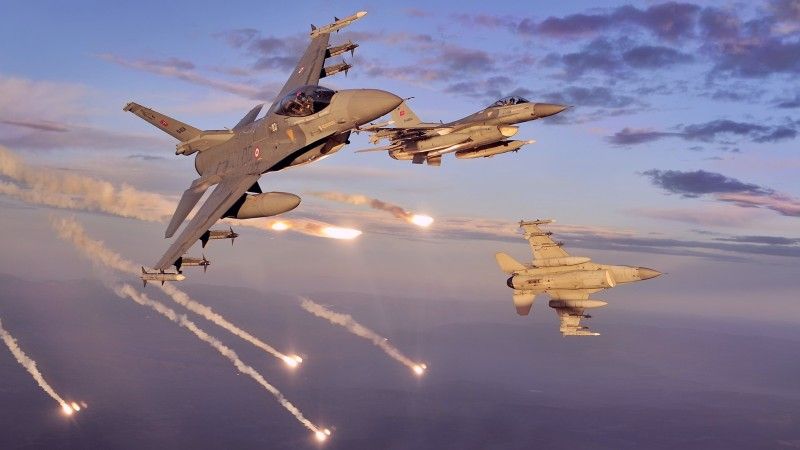
Photo. NATO
On 15 December, F-16 fighter jets of the Turkish Air Force intercepted and shot down an unidentified unmanned aerial vehicle (UAV) that had intruded into Turkish airspace from over the Black Sea. Prior to being neutralized, the object managed to fly over parts of central Anatolia. The drone was destroyed over a sparsely populated area, avoiding any threat to the civilian population.
Operational context
According to information released by the Turkish Ministry of Defence and subsequent media reports, Turkish radar systems detected an unidentified object approaching national airspace from the Black Sea via the Kastamonu corridor. The object was intermittently visible on radar—its track appearing and disappearing—suggesting a very small radar cross-section combined with meteorological interference. This created uncertainty as to the nature of the threat faced by the air defence system.
See also 
Such identification ambiguity is not unusual. Weather balloons, hobbyist drones, commercial UAVs, military reconnaissance platforms, and loitering munitions often operate at overlapping altitudes and similar speeds. Distinguishing among them in real time poses both cognitive and technical challenges.
The incident highlights a broader reality in which modern airspace is becoming increasingly congested with objects whose detectability falls below traditional radar thresholds. This is particularly true of platforms with a small metallic wing surface area, capable of exploiting radar blind spots in systems originally designed to detect manned aircraft and ballistic missiles.
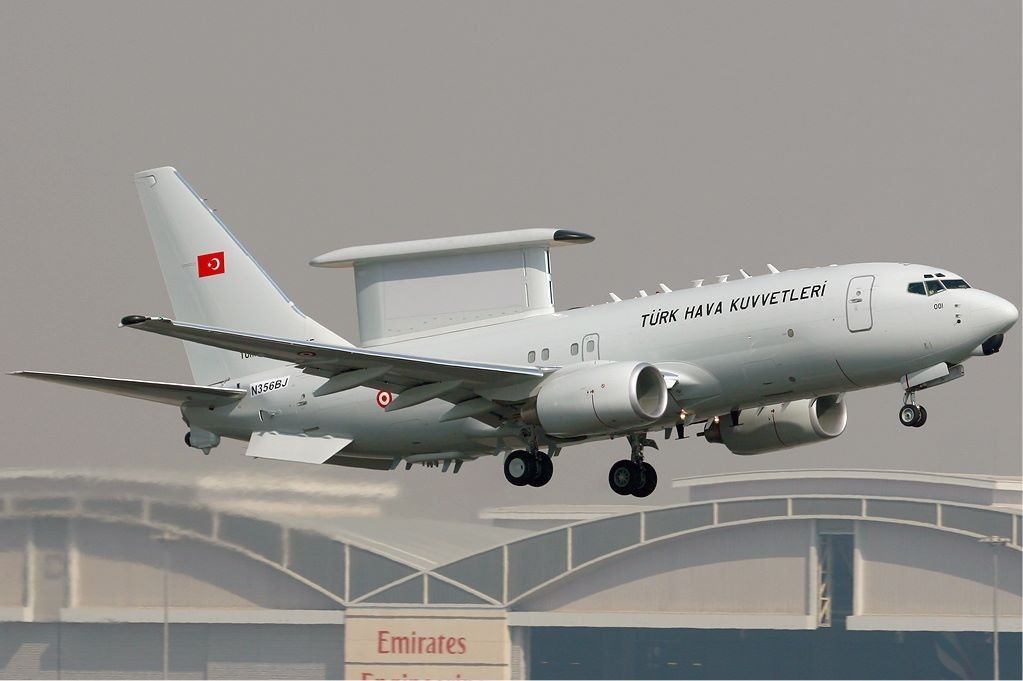
Despite the uncertainty, tracking data were transmitted in real time to the Air Operations Centre in Eskişehir, operating within both national and NATO command structures.
As the object approached Turkish airspace, F-16 fighters were scrambled in a Quick Reaction Alert (QRA) posture. Visual identification confirmed that the target was a UAV that had lost command-and-control connectivity and was flying along a constant, linear trajectory. Rather than engaging immediately, Turkish authorities allowed the aircraft to continue inland until it reached an area deemed safe for interception. The UAV was ultimately destroyed by an AIM-9X Sidewinder missile in the Çankırı–Elmadağ area, approximately 200 km from the coast.
Turkey maintains a layered ground-based air defence system, including domestically developed HİSAR-A and HİSAR-O systems. Nevertheless, the decision was made to employ an AIM-9X Sidewinder launched from an F-16. While using a manned combat aircraft armed with a relatively expensive air-to-air missile against a small UAV may initially appear disproportionate, the decision was fully deliberate.
At first glance, the measures taken may seem excessive. The rationale, however, lies in geography, proportionality, and risk management. The AIM-9X is a highly capable short-range missile equipped with an infrared seeker, off-boresight engagement capability, and exceptional manoeuvrability. This makes it particularly effective against low-signature targets that might evade older weapons systems. In air defence—especially over national territory—the cost of failure outweighs the cost of the interceptor. Fighter aircraft, in turn, provide mobility, visual identification, and precise control over the timing of engagement. In this case, the F-16s served not only as strike platforms but also as airborne sensors, confirming the UAV’s nature, behaviour, and flight path. This was critical before undertaking lethal action.
The neutralization of the object also constituted a demonstration of readiness. Employing a frontline missile system signalled that Turkey treats violations of its airspace—whether deliberate or inadvertent—with the utmost seriousness.
A key aspect of the incident was the functioning of Turkey’s command-and-control architecture. Radar data were shared with NATO structures, and the interception was conducted under both national and allied procedures. This reflects the practical operation of NATO’s Integrated Air and Missile Defence (IAMD) system.
Signature of the lost drone
One of the most distinctive operational features was the drone’s in-flight behaviour. Following visual identification, Turkish pilots and controllers observed that the object maintained a steady, unchanging course toward central Anatolia. This linear trajectory strongly suggested that the UAV—likely satellite-linked—had lost command-and-control connectivity.
Such behaviour is well documented in modern conflicts. When data links are severed—whether due to electronic warfare, satellite interference, or technical failure—many UAVs automatically revert to preprogrammed routes or continue along their last vector until fuel exhaustion or impact. This characteristic played a key role in the Turkish decision-making process.
Unknown origin
The most politically sensitive aspect of the incident remains the UAV’s origin. Defence analysts quickly ruled out large NATO platforms such as the U.S. RQ-4 Global Hawk or MQ-9 Reaper, which regularly operate over international waters of the Black Sea. Neither the size, radar signature, nor flight profile matched these systems.
Attention instead turned to smaller fixed-wing UAVs widely used in the Russia–Ukraine war, including Shahed-136–type loitering munitions. These systems are inexpensive, numerous, and difficult to detect, and heavy use of electronic warfare frequently disrupts their navigation.
No immediate accusations were made, nor did the incident trigger diplomatic escalation. Turkish officials emphasized safety considerations, technical assessment, and an ongoing investigation, reflecting Ankara’s delicate political balance. As a NATO member, a Black Sea littoral state, and an actor maintaining complex relations with both Russia and Ukraine, Turkey seeks to avoid overreaction that could upset the existing regional „equilibrium.”
Nevertheless, the continued uncertainty surrounding the drone’s origin presents a strategic dilemma. If the UAV originated from the conflict zone, its intrusion into Turkish airspace could be interpreted as an unintended „spillover” of the war into neighbouring states. Shooting it down reinforces Ankara’s longstanding position that the war must not spread beyond Ukraine’s borders.

The "Steel Dome" concept in practice
Turkish officials presented the incident as evidence of the functioning of the evolving air defence concept known as the „Steel Dome”—a networked architecture integrating radars, command-and-control systems, electronic warfare assets, fighter aircraft, and missile-based weapons.
Importantly, the Steel Dome is not a single system but a process encompassing detection, classification, decision-making, and interception. The recent incident demonstrated that the key element of this architecture is not any individual hardware component, but the integration of all subsystems. Sensors detected the object; command centres consolidated data and coordinated the response; fighter aircraft conducted the interception; and civil aviation authorities reportedly rerouted passenger traffic as a precaution. Each stage operated within a coherent civil–military ecosystem.
Implications for Black Sea Security and NATO's Eastern Flank
Turkey’s case illustrates how inexpensive UAVs can penetrate deep into a state’s airspace without clear hostile intent, forcing defenders to make rapid decisions under uncertainty. UAVs blur the line between accident, reconnaissance, and provocation, complicating deterrence signalling and increasing the risk of miscalculation.
For NATO, the incident underscores the need to adapt air defence not only to high-end threats—such as ballistic and cruise missiles or combat aircraft—but also to low-altitude intrusions that can gradually erode allied airspace sovereignty.
The episode offers an important lesson for the Alliance in airspace protection, the resilience of command-and-control systems, and civil–military coordination under ambiguous conditions. It also highlights Turkey’s strategic importance as a NATO frontline state, whose responses to emerging threats have a direct impact on security stability in the Black Sea region.