












- ANALIZA
- WYWIADY
- WIADOMOŚCI
Will China effectively hamper NATO’s arms procurement? [ANALYSIS]

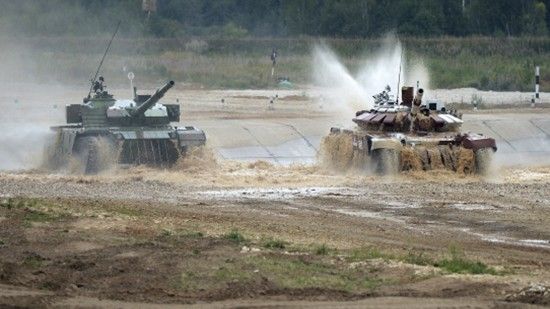
Photo. mil.ru
In the shadow of discussion about a potential kinetic world war, a very interesting game is playing out over rare-earth metals. Why can China’s decision to drastically limit their exports be considered a breakthrough? Will Chinese policy affect the European defense industry?
The 9th October decision by China to significantly restrict exports of rare-earth metals is a move of strategic importance that forces the United States to react immediately. President Donald Trump’s recent tour of Asia shows that Washington took the gauntlet thrown down by Beijing seriously. The awareness of the consequences of a possible Chinese blockade — which has resulted in attempts to secure supplies of critical raw materials from partners such as Malaysia, Japan, Thailand, Cambodia and Australia — demonstrates that „the United States belatedly understood that relying on supplies of key raw materials from its main strategic rival is not a good solution” (quoting Tomasz Jóźwik, „Magazyn na Weekend” no. 212, „Dziennik Gazeta Prawna”).
For the time being, the escalating trade conflict between the U.S. and China has been temporarily frozen. Donald Trump told the media about an agreement with Xi Jinping under which the Americans committed, among other things, to lower tariffs on Chinese products from 57% to 47%, and China (which holds a 90% share of global rare-earth production) suspended for one year the introduction of tightened regulations related to control of REE (rare-earth element) exports.
Rare-earth elements and NATO arms procurement
One should not be under any illusion that the „calming” on the Washington-Beijing line described above is the final note in the American-Chinese systemic war. It is therefore worth looking at the latest „exchange of blows” from a broader perspective. Why is China’s decision to limit exports of rare-earth elements so important? Could it have a real impact on the pace of NATO countries« rearmament? Paulina Uznańska, an analyst on the China team at the Centre for Eastern Studies, answered these and other questions for us a few days before Donald Trump’s recent visit to Asia.\*
Michał Górski, Defence24: Is it correct that some experts regard the recent decision by the PRC’s Ministry of Commerce — to require foreign entities to apply for licenses to trade products that use Chinese rare-earth metals — as a breakthrough decision that substantially worsens the U.S. position in the trade war with China?
Paulina Uznańska, OSW: Yes, it is a breakthrough decision. For the first time Beijing is using an extraterritorial instrument in the rare-earth sector: the measures concern products that contain even trace amounts of Chinese rare-earth metals or that were produced using Chinese technologies. In practice this means that, for example, if a Japanese company invested in a battery factory in Europe using Chinese rare-earth metals, Beijing would have a legal basis to interfere in that investment.
This legal construct resembles the American Foreign Direct Product Rule — a mechanism the U.S. developed as early as 1959 and has applied to China several times, e.g., against Huawei and later in restrictions on advanced semiconductors and the equipment used to manufacture them. In other words, an instrument that until now was Washington’s domain in the technological space — and which the PRC fiercely criticized — Beijing has started to use in the resource domain itself.
The consequences for the U.S. position in economic competition with China are significant for several reasons. First, the discretionary nature of the licensing mechanism allows China to calibrate pressure by sector and geography, which translates into business uncertainty and supply disruptions. For example, after the introduction of the „first round” of export restrictions in April this year, the number of license applications approved was reportedly higher for European firms than for American ones. Second, China’s toolkit for industrial espionage expands. The export licensing system enables the acquisition of sensitive commercial data from foreign companies: from technical details and photographs of production facilities to information about end customers. In the long term Beijing’s decision will accelerate diversification and the development of alternative sources by the U.S., but in the coming quarters it strengthens Beijing’s bargaining advantage and may lead to disruptions in supply chains.
Does this decision also apply to countries such as Russia?
The export restrictions are global in scope: they cover all states, including Russia. As is often the case in the Chinese legal–political model, enforcement will be selective and inconsistent. For some companies certain license applications will be processed efficiently, others will get stuck, and still others will be rejected without explanation. The company’s country of origin will certainly matter in this process. This year we have already observed cycles of tightening and loosening the policy in China’s dealings with the European Union. After the introduction of the „first round” of export restrictions on rare-earth metals and permanent magnets made from them in April this year, exports of magnets fell unprecedentedly within a month. In March 2025, the volume of exports of permanent magnets manufactured from rare-earth metals from China to the EU was 1,843 tonnes; in April — after Beijing introduced restrictions — it fell by almost half (44%) to 1,035 tonnes, then in May decreased to 395 tonnes (–62% compared with April). That was a period of slowed license issuance, explained by Beijing on procedural grounds — „we don’t have your coat, what will you do to us?” \[Polish saying, derived from a movie quote, meaning - »we cannot do anything about this«\]. In reality it was a show of Beijing’s strength. There was a rebound in June (+245% month-on-month, +32% vs. April), and in July foreign sales returned to levels seen at the start of the year, only to fall again in September. Such steering of the pace of administrative decisions is itself an instrument of economic policy and will maintain elevated unpredictability in supply chains.
Could China’s decision significantly delay the development of NATO’s military potential? Which capabilities (equipment) could this decision affect?
China’s implementing documents explicitly state that if the ultimate recipient is a defence entity, export licenses for rare-earth metals and permanent magnets made from them will not be issued. The justification is „national security” and „international non-proliferation commitments,” which de facto directs the measure against the Western defence sector.
This is not surprising: already in 2010 China used rare-earths as „leverage” informally against Japan, restricting exports to that country after the territorial dispute over the Senkaku/Diaoyu islands escalated. Those were informal restrictions then, ostensibly justified on environmental grounds. Since 2021 China has had a law on export controls and administrative regulations that give these instruments a solid legal foundation. Since 2023 Beijing has been gradually expanding and specifying the control regime, adding additional raw materials such as gallium, germanium, antimony, graphite and tungsten. The direction of Beijing’s actions has therefore been clear.
The scale of the real impact on NATO’s potential depends on how prepared industry is for a scenario of being cut off from Chinese rare-earth metals: inventory levels, the number of non-Chinese suppliers, the pace of development of alternative technologies and supply chains. According to decisions by the U.S. Congress, from January 1, 2027 components containing rare-earth metals or magnets of Chinese origin should not be used in weapon systems ordered by the Pentagon. The new Chinese licensing regime will, however, force schedule adjustments and accelerate the qualification of supply chains outside China. That will be more difficult because transfers of know-how between China and the West are also being limited. Although from 2023 there was already a ban on exporting selected rare-earths processing technologies, the current control regime expands MOFCOM’s licensing requirements also to cooperation and the provision of services by Chinese specialists to foreign entities. In practice every form of professional contact (consultations, training, technical support) will require obtaining a license, and in this area China has an advantage not only in raw materials but also in technology and expertise.
Has China faced any repercussions so far because of the new law?
Beijing continues to talk with the U.S. and the EU from a position of strength, partly because reactions to the new law have been limited and largely cautionary rather than binding.
After the Chinese restrictions were announced, President Trump threatened to impose 100% tariffs on products from China, to cancel a meeting with Chairman Xi at the APEC summit in South Korea, and to introduce additional U.S. export restrictions on global supplies of goods produced using U.S. software or containing such software. Despite the tough rhetoric, talks took place last week, which suggests that U.S. pressure at this stage is primarily of a negotiating nature rather than an immediate retaliatory response.
Brussels maintains a dialogue with Beijing. After the July summit the launch of a special EU–China channel of communication on rare-earth exports was announced. Working talks on its operation were underway last week. However, one should assume that the mechanism itself will not bring a stable improvement in conditions for EU business, because it will be largely dependent on the Chinese side’s goodwill. At the same time the use of the EU’s instrument to counter economic coercion is being considered. Since 2023 the European Union has had this important tool, under which it can, in retaliation for economic blackmail, impose import tariffs, restrictions on services, export restrictions, suspend intellectual property rights, limit access to financing and public procurement, and place restrictions on foreign investors. It can apply these measures to entire sectors, specific companies, or even individuals. Launching them does not require unanimity but a qualified majority in the Council of the EU. The EU is currently considering using this tool — it would be a way to „buy time” for diversification and a deterrent signal to Beijing to discourage it from using and further extending export controls. Beijing’s current actions meet all the criteria of economic coercion as defined by the EU. The key question, however, is whether there is sufficient political will to use it.
*Conversation dates back to 28th October, prior to Donald Trump and Xi Jinping meeting in Pusan, ROK.


