












- WIADOMOŚCI
- WAŻNE
- KOMENTARZ
Divorce or myth? German-NATO sky under US-made sea shield

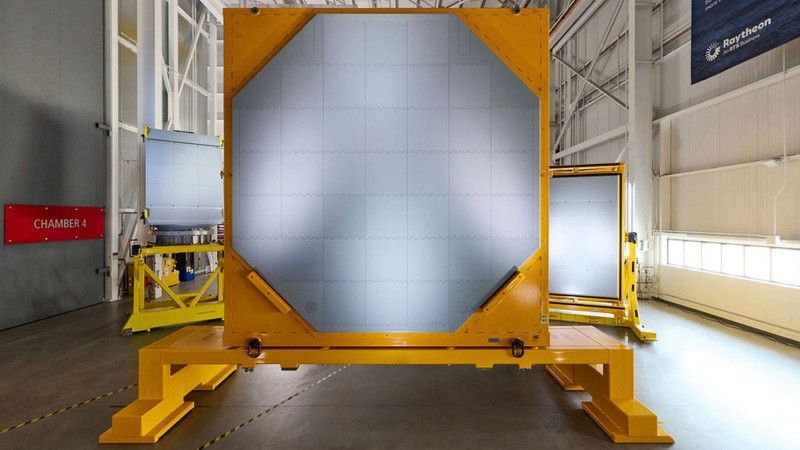
Photo. RTX
Raytheon Technologies has just announced that its SPY-6(V)1 radar has been chosen by the German government to equip F127 frigates. Thus, the US-Germany defence industrial relationship stays strong, particularly in the area of air and missile defence.
Recently, there has been a lot of discussion on decoupling between US and Germany in defence sector in addition to other sectors. In particular, an article by Politico with a list of planned German defence procurements for this and next year was titled „Germany EUR 80B rearmament sidelines US weapons”. The authors note than less than 10 percent of the planned procurements for this and next year are planned for US-made systems,
The truth is more complex, however. It is true that currently the government in Berlin may be less inclined to buy American weapons, also for political reasons. However, stating any divorce between US and German defence industries is premature to say the least, though certainly many, including France, would like to see it.
One area that requires particular attention is the Integrated Air and Missile Defence, both ground-based and sea-based. While Germany is developing many of its own technologies in the short range air defence (e.g. IRIS-T SLM missile system, combat proven in Ukraine, and the Skyranger system), and the currently emerging counter-UAS field (e.g. interceptor drones made by Argus Interceptor and Tytan Technologies, the latter company to develop a comprehensive system for Bundeswehr in 2026), the defence against the high end threat: ballistic and supersonic missiles as well as advanced aircraft relies almost exclusively on systems that are either US-made or are dependent on the decision of the US Government… and, in one case, Israel.
Germany has been using US-made Patriot system since the end of Cold War, and has many industrial facilities adapted to support and upgrade the system, and soon some of the PAC-2 GEM-T missiles will be co-produced by RTX and MBDA Deutschland in newly built facility in Germany. Several procurements related to Patriot were already mentioned on the Politico list.

Photo. File photo, Polish MOD
Also, the largest purchase of the list gained by Politico, amounting to approx. 26 billion euro, are the F127 Air Defence frigates. Just recently, an American company RTX confirmed, that those will be equipped with SPY-6(V)1 radars, a type of radar used on American Arleigh Burke destroyers that are equipped with Aegis Ballistic Missile Defence system. A notable feature of SPY-6(V)1 is the capability to fulfill both the Ballistic Missile Defence and the defence against aerodynamic targets (cruise missile, aircraft) simultaneously.
It also means (or basically confirms) that besides Patriot, another high-end Air and Missile Defence system of Germany, this time – maritime based – will use key US systems. And it also obviously means a huge stake in the project for US companies, even if German shipyards – TKMS (leader) and NVL – are the industrial partners of the project.

Photo. Bundeswehr
One should then ask the question, why Germany maintains „dependence” on the US? Simply put, as current (June 2025) Strategic Defence Review of UK MOD says: „Capable and effective IAMD (Integrated Air and Missile Defence) for the UK can only be accomplished as part of a NATO endeavour” (p. 114). The same could be told of Germany, and the authorities in Berlin are well aware of that. Without integration with NATO, creating a missile defence system providing a fair (not close to 100% but sufficient for basic operational security) effectiveness would simply be not feasible due to cost and schedules. There are some experts opinions stating that Germany would need 50 to 60 Patriot (or similar systems) instead of 16-18 it is procuring now, should it act alone, without deep NATO integration. So, NATO or… nothing. And if we act in NATO framework, then US is involved anyway.
While some European systems, interoperable with NATO are being developed, such as the French-Italian SAMP/T NG, US systems are used more often and in some areas are more capable. This is particularly true for the defence against long range ballistic missiles outside the atmosphere, where – for now – only US-made system including Standard SM-3 and THAAD are capable of, and the Israeli Arrow 3 (purchased by Germany in 2023, due to be deployed this year).
In addition, Germany is actively considering further development of those systems – namely integrating Patriot with IBCS Integrated Battle Command System, something Poland has already done, and purchasing Arrow 4, a next-generation of Israeli-American missile defence system which is even more capable. So, it seems that announcing a divorce of German and American defence industries is premature to say the least. Germany, while developing its own capabilities in many areas, is still engaged in deep cooperation with US in such a strategic sector as Air and Missile Defence. This needs to be remembered, as it also highlights the significance of NATO and Transatlantic cooperation for Germany - today and tomorrow.


