












- ANALIZA
- WIADOMOŚCI
Does Ukraine need immigrants from Africa to rebuild?

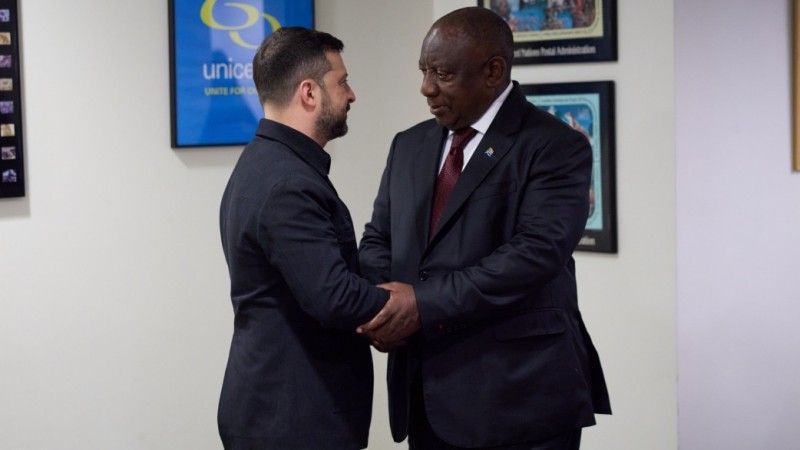
Ukraine may win battles against Russia and still lose the future if it fails to solve its demographic crisis. Reconstruction will not depend only on weapons, financial support and Western security guarantees. It will depend on whether Ukraine has enough people to rebuild cities, work in factories, defend borders, produce food, serve in the army and compete with Russia for the next generations.
Kyrylo Budanov said openly what many in Kyiv preferred not to say directly. “We will have to bring our citizens back and attract specialists from different parts of the world. There will be no other option.” This is not a technical comment about the labour market. It is a strategic warning about the future of the Ukrainian state.
The problem is already visible. Since Russia’s full-scale invasion in 2022, more than 5.7 million Ukrainians have left the country. Some will return, but many will not. Children are already in schools in Poland, Germany, France, Czechia and other European countries. Adults have found jobs, flats and a safer daily life, without the immediate threat of another Russian strike. Every additional month abroad reduces the chances of return. Kyiv cannot build its post-war economy only on patriotic appeals and interviews for domestic media.
Ukraine will need engineers, construction workers, drivers, technicians, farmers, medical staff, logisticians and, crucially, cheap labour. It will need specialists in new technologies, AI and pharmaceuticals, but also workers for roads, housing, energy infrastructure, ports, farms and industrial plants. Western money will not be enough without labour. Even the largest reconstruction fund will not lay bricks, repair railways or restart production lines. Ukraine will have to convince thousands, and perhaps millions, of people either to return or to come to a country emerging from war.
Africa is not only diplomacy
Ukraine’s policy towards Africa should therefore not be treated only as diplomacy. Before February 2022, Ukraine had ten embassies in Africa: Algeria, Angola, Egypt, Ethiopia, Kenya, Morocco, Nigeria, Senegal, South Africa and Tunisia. It also maintained a formal diplomatic presence for Libya from Tunis because of the security situation. This distinction matters, because with Libya counted as a formal embassy, the number rises to eleven.
The direction is clear. Ukraine entered the war with a limited African network and then decided to expand it. Today, Kyiv can speak of 18 missions and embassies in Africa after opening eight new posts. The current list includes Algeria, Angola, Botswana, the Democratic Republic of the Congo, Egypt, Ethiopia, Ghana, Kenya, Morocco, Mauritania, Mozambique, Nigeria, Rwanda, Senegal, South Africa, Tanzania, Tunisia and Côte d’Ivoire. The next stage is already planned. Embassies in Zambia, Sudan and Cameroon would bring the total to 21 posts, effectively doubling Ukraine’s African diplomatic presence compared with the pre-war period.
Ukrainian missions in Africa are already working at high intensity. More diplomats and officials are being sent to the continent because Kyiv understands that Africa is no longer a secondary direction. Ukraine wants to counter Russian disinformation, protect grain diplomacy, build trade routes, win votes in international organisations and reduce Moscow’s influence. It also wants partners outside Europe, including in defence technology and arms sales. Cooperation with states of the Arabian Peninsula on drones shows that Kyiv is looking for wider strategic networks beyond the Euro-Atlantic space.
After the war, Africa may also become a labour reservoir for Ukraine. This is not a slogan. It is a demographic calculation. Africa is the youngest continent in the world. In the Sahel, the median age is around 25. Millions of young people live in regions marked by poverty, coups, jihadist violence, weak state institutions and a lack of prospects. For many of them, post-war Ukraine may be difficult, but still more stable than the country they are leaving.
Kyiv must not pretend that this will be easy. Bringing workers from Africa or Asia is one thing. Integrating them into a wounded, militarised and traumatised society is another. Ukraine will have to define rules for employment contracts, residence permits, labour controls, security screening, local and national integration, schools, housing, healthcare and the work of security services. The examples of France, Italy and the United Kingdom show what happens when a state needs labour but avoids the political cost of serious and firm migration management.
See also 

Borders
Large-scale migration from Africa and Asia to Ukraine would also become a European issue. If Ukraine brings in even three million foreign workers, not six million, the consequences will not stop at the Ukrainian border. Some will stay and work. Some will move inside Ukraine. Some will try to pass through Poland and continue towards Germany, France, Italy or Spain. Schengen, Polish border policy and EU migration rules would therefore become directly connected to Ukraine’s post-war labour strategy.
Russia will use this immediately. It will tell Ukrainians that they are being replaced. It will tell Europeans that Ukraine has become a migration corridor. It will tell Africans that Ukraine and the West only want cheap labour. It will tell Ukrainian workers that foreigners are taking jobs, flats and wages. A smaller version of this campaign has already appeared in Ukraine around workers from India and Bangladesh, with false claims about salaries and content amplified by pro-Russian Telegram channels.
Ukraine needs a migration policy before mass immigration begins. It needs agreements with countries of origin, mainly in Africa and Asia, employment controls, border cooperation with Poland and the European Union, public communication and structures to counter disinformation. Kyiv must also decide which workers it needs, in which sectors, under which contracts and with what legal pathway to residence. Doing this during an ongoing war will be extremely difficult, but postponing the issue would be worse.
Russia wants Ukraine exhausted, depopulated and economically dependent. That is why the post-war struggle will not concern only territory, Western security guarantees and reconstruction money. It will also concern demography, the labour market, borders and Kyiv’s ability to control the social consequences of its own recovery, including recovery supported by immigrants. Poland, as Ukraine’s neighbour and the main gateway to the European Union, has to watch this process very carefully.


