


- WIADOMOŚCI
- ANALIZA
Taiwan receives US Support for drone technologies

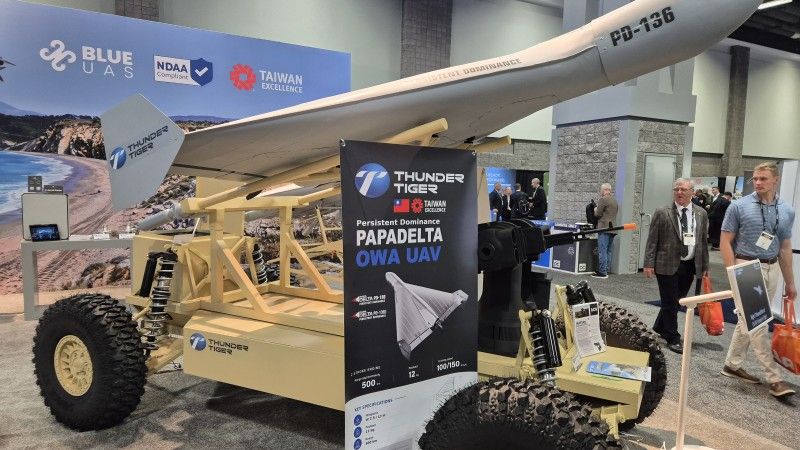
Photo. Robert Czulda/Defence24.pl
Despite opposition from Beijing, the Americans are seriously exploring opportunities to cooperate with Taiwan on unmanned systems. This could result in intelligent Taiwanese ‘Shaheds’ and unmanned surface vessels equipped with American loitering munitions.
US company AeroVironment and Taiwan’s Thunder Tiger signed a memorandum of understanding (MoU) at the AUSA 2026 exhibition in Washington on 16 October 2026. Under the agreement, the companies will explore the possible details of future cooperation ‘on the integration of unmanned systems, potential localisation of production and joint manufacturing of uncrewed aerial vehicles, as well as the joint development of future technological capabilities in Taiwan’.
The newly signed MoU is significant because it could lead to the first transfer of drone technology between Taiwan and the United States — in both directions. Both AeroVironment and Thunder Tiger have their own solutions, and integrating them could create synergies.
While American drones are well known, not least because they continue to be used effectively in Ukraine, Taiwanese unmanned systems face considerable difficulties gaining a foothold in the market, primarily because of Beijing’s hostile stance. Thunder Tiger nevertheless offers an entire range of drones, extending beyond aerial platforms. Its portfolio includes the SeaShark family of aluminium-alloy uncrewed surface vessels, advertised as having stealth characteristics.

Photo. Robert Czulda/Defence24.pl
The six-metre SeaShark 600 unmanned surface vessel displayed in the United States can operate within a radius of 350 km while carrying a 400 kg combat payload, at a maximum speed of approximately 43 knots (80 km/h). Interestingly, at AUSA 2026 it was shown with American equipment: a Bullfrog M2 remotely operated counter-drone weapon station, developed by US company Allen Control Systems and fitted with a 12.7 mm (.50-cal.) machine gun, together with four stern-mounted canisters for AeroVironment’s Switchblade 300 loitering munitions.
The MoU signed during AUSA 2026 also envisages integrating American Switchblade drones with Taiwanese uncrewed surface and ground vehicles. This combination will give Taiwan’s uncrewed boats a self-defence capability through the Bullfrog weapon station, which can engage Group 1–3 drones at distances of up to 1,500 m. It will also enable precision strikes in high-threat littoral waters using Switchblade 300 Block 20 drones, which have an endurance of more than 20 minutes and a range of up to 30 km.
Earlier work on the extensive incorporation of artificial intelligence into SeaShark vessels should also be noted. This resulted in maritime exercises in July 2026 involving these uncrewed vessels equipped with Hivemind autonomy software from US company Shield AI. Among other functions, the system enabled autonomous navigation, allocated tasks among cooperating drones and coordinated their movements during an escort mission.

Photo. Robert Czulda/Defence24.pl
Taiwan’s offering also includes ground drones. One example displayed at AUSA 2026 in Washington was the four-wheeled Ultrabuggy uncrewed vehicle. Measuring 2.4 m in length, it can carry a half-tonne payload within a radius of 100 km at speeds exceeding 30 km/h. It can serve as either a logistics or a combat platform. The vehicle was displayed with a model of the Bullfrog M2 machine-gun weapon station, while visualisations also showed it carrying launch modules for aerial interceptor drones.
See also 

Taiwanese UAVs
Taiwanese aerial drones may also have attracted American interest, particularly the Papadelta PD-136 and Papadelta PD-136J, counterparts to Iran’s Shaheds. These delta-wing drones, with a wingspan of 2.5 m and a length of 3 m, differ in their propulsion systems. The Papadelta PD-136 is a piston-engined ‘Shahed’ capable of carrying a 12 kg payload over a distance of 500 km at a speed of 100–150 km/h. The Papadelta PD-136J uses a CS-80 micro-turbojet engine, developed by Taiwan’s National Chung-Shan Institute of Science and Technology (NCSIST). This increases its speed to 500 km/h, with a 12 kg combat payload and a range of 300 km.

Photo. Robert Czulda/Defence24.pl
These systems remain under development and are not yet ready for series production. Thunder Tiger only completed flight tests of the Papadelta PD-136 in Taiwan’s Yunlin County on 5 October 2026. The drone was launched using a pneumatic catapult and flew its programmed route without any problems.
A distinguishing feature of the Papadelta drones is the material used for their fuselages. Rather than composites, the Taiwanese use aluminium sheets formed by stamping with an industrial press exerting a force of 1,700 tonnes. The press was previously used by a Thunder Tiger subsidiary to manufacture aluminium yachts. This material slightly increases the drone’s weight but also simplifies and accelerates production, making it easier to assemble large numbers of drones at once.
This capacity for mass production will be much needed, as Taiwan already regards Papadelta drones as an important means of deterring China. The Taiwan Strait is approximately 130 km wide at its narrowest point, meaning these ‘Shaheds’ could potentially strike military targets along a substantial stretch of China’s coastline, particularly in Fujian Province. This increases the risks facing the Chinese armed forces should Beijing decide to attack the island. Moreover, Papadelta production is entirely independent of foreign supplies.
Thunder Tiger’s portfolio also includes other kamikaze drones, encompassing both vertical take-off aircraft and small fixed-wing platforms. An interesting example in the latter category is the Overkill Striker 230 uncrewed aircraft, with a wingspan of 2.3 m and a take-off weight of approximately 13 kg. It stands out from other solutions of this kind by offering a choice of two propulsion systems, resulting in different performance characteristics.
With an electric motor, the drone has a range of up to 30 km, a stated endurance of 30 minutes and a maximum speed of no more than 100 km/h, while carrying a 3 kg combat payload. With a diesel engine, its range increases to 70 km, endurance to 60 minutes, maximum speed to 150 km/h and combat payload to 5 kg.
Thunder Tiger also offers a family of quadcopters designated Overkill FPV. Using a visually similar carbon-fibre frame design, they are available in several sizes. The 5-inch models have an arm span of 248 mm, weigh 0.5 kg and can carry a 0.5 kg combat payload. For the 7-inch models, the span increases to 30 cm, weight to 1 kg and payload capacity to 1.5 kg. The corresponding figures for the 10-inch models are 45 cm, 2 kg and 2.5 kg, and for the 15-inch models, 70 cm, 5 kg and 5 kg. These quadcopters can operate for more than half an hour, with a range exceeding 8 km and a maximum speed of 120 km/h.

The Taiwanese company also offers the Overkill FPV 30-inch drone, a six-armed multicopter with a span of 160 cm, a weight of 20 kg and a payload capacity of 10 kg. The Americans may be interested in developing some of these solutions.


