- WIADOMOŚCI
Germany funds 50,000 strike drones for Ukraine

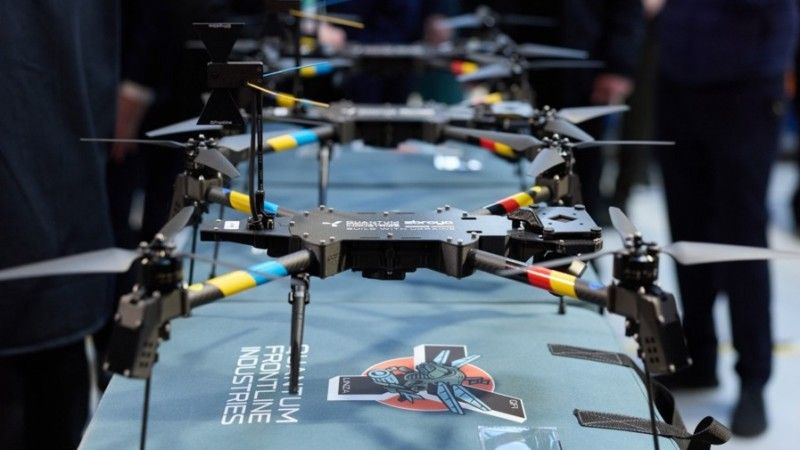
Photo. president.gov.ua
Germany is reportedly funding a roughly €90 million contract for 50,000 Ukrainian-made Shrike FPV attack drones equipped with terminal-autonomy software from US firm Auterion.
Reuters first reported the agreement on 12 July. Lorenz Meier, the chief executive of Auterion, confirmed the size and approximate value of the order while noting it was financed by a European nation. The drone manufacturer SkyFall later identified Germany as the financial sponsor. A portion of the fleet has already arrived in Ukraine, and the remainder is scheduled for delivery before the end of 2026.
Neither Berlin nor Kyiv has officially announced the deal. Citing operational security, the German Defence Ministry declined to comment on the matter, as did its Ukrainian counterpart. Because of this official silence, key details remain unknown. These include the specific contracting authority, the exact Shrike configuration, the type of warhead and the full contents of the €90 million package.
Ukrainian forces have been flying SkyFall’s low-cost Shrike drones since 2023. Reuters notes that the newly ordered systems feature Auterion software capable of autonomously tracking and striking moving targets during their final descent. This capability is known as terminal autonomy. It does not mean the drone can independently select targets or execute an entire mission without human oversight. The technology does, however, reduce the need for a constant control link, which proves highly valuable when electronic jamming, difficult terrain or sudden target movements disrupt manual steering.
The exact drone variant included in the purchase remains unclear. A fibre-optic model called the Shrike 10-F, jointly developed by SkyFall and the British firm Skycutter, recently placed first in the initial phase of the Pentagon’s Drone Dominance competition. While this success highlights the technological maturity of the broader Shrike family, it does not confirm whether Germany is funding this specific configuration.

Dividing the €90 million budget by 50,000 drones suggests an average cost of roughly €1,800 per unit. This figure should not be taken as a definitive price tag because the overall package likely covers software, integration, munitions, logistics and ongoing support. Even so, the calculation highlights the underlying logic of the procurement strategy. First-person view drone capabilities rely heavily on massive volume and rapid replacement. In a conflict where Ukraine manufactures millions of drones and carries out thousands of strikes every day, an order of 50,000 systems serves as a significant short-term resupply rather than a permanent stockpile.
This reported order aligns with Berlin’s broader shift away from simply donating existing equipment and toward actively financing Ukraine’s domestic defence industry. In April, Germany and Ukraine established a joint venture to manufacture thousands of medium and long-range drones. The Shrike purchase seems to apply this same collaborative model to short-range, expendable weapons, though no official source has explicitly linked the two initiatives. Accounting for less than one percent of Germany’s planned €11.5 billion support budget for Ukraine in 2026, the contract nonetheless guarantees a vital influx of 50,000 strike systems before the end of that year.