












- WIADOMOŚCI
- POLECANE
- ANALIZA
Bombing the shadow fleet: French aircraft carrier shows its teeth [REPORT]

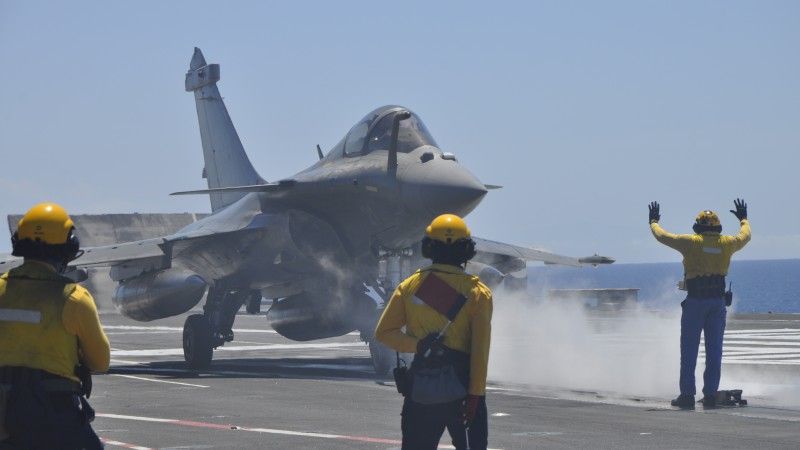
Photo. Mariusz Marszałkowski/Defence24.pl
The French aircraft carrier Charles de Gaulle, the only nuclear-powered aircraft carrier in NATO outside the United States Navy, has been training to support NATO’s eastern flank. Defence24.pl was the only Polish media outlet to witness the operation, up close and personal.
The author would like to thank the entire crew of Charles de Gaulle and NATO Joint Force Command Naples for making the visit possible.
France's one and only
R91 Charles de Gaulle is an exceptional warship. It is France’s sole aircraft carrier and the only nuclear-powered surface vessel in NATO outside the US Navy. The ship was launched in 1994 and entered service in 2001. It is the flagship of the French Navy, the Marine Nationale, and one of the few aircraft carriers in the world equipped with a CATOBAR system (Catapult-Assisted Take-Off But Arrested Recovery). Its catapults and arresting wires enable the operation of heavier aircraft carrying full weapons loads, as well as carrier-borne airborne early warning aircraft such as the E-2 Hawkeye. The ship has a conventional aircraft-carrier configuration with an angled flight deck.
The flight deck covers approximately 12,000 square metres and is fitted with two C13-3 steam catapults, shortened versions of the American catapults used aboard Nimitz-class aircraft carriers. Recoveries are conducted using an arresting-gear system. The hangar, covering approximately 4,070 square metres and measuring 6.1 metres in height, can accommodate up to 40 aircraft, primarily Rafale fighters. The ship is powered by two K15 pressurised-water reactors manufactured by Areva/Framatome, each generating 150 MW of thermal power. The reactors supply two Alstom steam turbines with a combined shaft output of approximately 61 MW, or 82,000 horsepower. Four diesel-electric generator sets provide supplementary electrical power.
A typical embarked air wing comprises approximately 40 aircraft, including 30–35 Rafale fighters, two E-2 Hawkeye airborne early warning and command aircraft, two to four NH90 helicopters, and up to two AS365 Dauphin support and search-and-rescue helicopters.
The ship carries approximately 2,000 personnel. Around 1,300 form the ship’s company, while another 500–600 belong to the aviation component. Up to 500 additional personnel, such as marines, can also be embarked.
Charles de Gaulle is to be succeeded by a new aircraft carrier named France Libre. The future vessel is expected to be larger than its predecessor and enter service in the late 2030s.

La Fayette and the aborted Baltic show of force
The current deployment of the French carrier strike group, or Groupe Aéronaval, is named La Fayette. The name refers to a French naval tradition of naming major carrier deployments after historic figures. Previous deployments have included Clemenceau 25. The operation was originally intended to focus primarily on northern and eastern Europe, partly as a signal to Russia. Accompanied by a group comprising three frigates, support vessels and a submarine, Charles de Gaulle entered the North Sea and the Baltic Sea, which had not hosted an aircraft carrier for a considerable period. Unfortunately, the mission was not completed as planned. The entire group was rapidly withdrawn from this part of Europe following the launch of the US-Israeli military campaign against Iran.

Photo. Mariusz Marszałkowski/Defence24.pl
Despite the interruption of its Baltic mission, Charles de Gaulle did not remain idle. In late April, the carrier and its strike group played an active role in another iteration of NATO’s Neptune Strike exercise. Defence24.pl had previously visited the Italian aircraft carrier Cavour, which also participated in an earlier edition of the exercise.
Neptune Strike and tanker engagements
Neptune Strike is one of NATO’s most important recurring military exercises. It focuses on maritime and air operations, including long-range strike missions conducted by NATO carrier-based aviation. The principal participants are naturally those countries possessing such capabilities: the United States, the United Kingdom, France and Italy, as well as Spain and Türkiye to a more limited extent. Another important element is countering the latest threats, including uncrewed systems. The author observed this part of the exercise at close quarters from aboard the frigate Alsace.

Photo. Mariusz Marszałkowski/Defence24.pl
The French incorporated another element into their operations: vessels belonging to the so-called shadow fleet. The shadow fleet consists of ships involved in transporting commodities subject to international sanctions. These vessels are often obsolete, inadequately insured and operated with their Automatic Identification System transponders switched off. As a result, they may pose a serious threat to international shipping and the environment, particularly in the event of an accident or ecological disaster.

Iran and Russia have both assembled large shadow fleets of tankers. The Russian shadow fleet is estimated to include approximately 1,000 tankers transporting Russian commodities to refineries in India and China, among other destinations, as well as to countries in South America. The commodities themselves are subject to sanctions imposed by organisations including the G7. Under these measures, international shipping companies may not accept contracts to transport Russian oil when its price exceeds a specified ceiling, calculated as a fixed discount to the price of Brent crude.
The author reached Charles de Gaulle aboard an AS365F Dauphin multirole helicopter. Following the landing, the visitors received a safety briefing covering the rules for remaining aboard the ship. After this short orientation, we met the carrier’s commanding officer, Captain Thomas Puga, and the commander of the French carrier strike group, Rear Admiral Thibault de Possesse. The commanders of both the ship and the wider task group explained the formation’s role and the missions assigned to it. They emphasised the importance of its strike capability, which—when employed in cooperation with other allies—makes it possible to operate far from the location at which a mission begins. The scenarios being rehearsed included flights over NATO’s eastern flank in support of units participating in exercises there. This is a critical capability because a potential adversary must factor into its operational risk calculations the possible arrival of additional air forces that are not physically based in the prospective theatre of operations.

Photo. Mariusz Marszałkowski/Defence24.pl
The group’s principal mission during the exercise, however, involved monitoring shipping and maritime traffic, as well as conducting air strikes against the naval vessels of a potential adversary. This is where an especially interesting element emerged: Russian shadow-fleet tankers served as simulated targets for French Rafale fighters launching from Charles de Gaulle.
France has quite literally placed Russian vessels sailing under the flags of foreign countries, frequently false flags, in its sights. Since the autumn of 2025, the French Navy has boarded and seized five tankers. The vessels were intercepted in international waters in the Atlantic Ocean and the Mediterranean Sea.

During Neptune Strike, the tankers became simulated targets for air attacks. In the scenario observed by the author, two Rafale fighters conducted a simulated attack against a tanker using two precision-guided aerial bombs released from a distance of four nautical miles. One of the fighters was responsible for designating the target with a pod-mounted targeting system. The French emphasise that such operations are conducted in compliance with international law and with full transparency.
The crews of the tankers, as well as the Russian naval vessels operating nearby, including signals-intelligence ships, are intended to understand precisely what is being targeted. This constitutes a form of strategic communication: should Russia engage in aggressive action beyond Ukraine, the assets that help keep the Russian state financially afloat may also become military targets. In this case, French pilots are not expected to conceal their „intentions.”
A total of 12 Rafale fighters participated in the operation, launching from the deck of Charles de Gaulle in less than ten minutes. They were accompanied by an E-2C Hawkeye airborne early warning and command aircraft. The target was located 45 nautical miles from the French carrier group. For security reasons, I will not disclose the name of the tanker used as the target.
Flight-deck operations
During the visit, the author had the opportunity to see the Combat Information Centre, the „brain” of the ship from which combat operations are commanded and directed. It is here that the air, surface and subsurface environments are monitored, weapons systems are controlled, and aviation operations are coordinated. The author also visited the Poste de Commandement de la Flotte, the command centre responsible for directing the operations of the entire Groupe Aéronaval. All vessels in the formation are controlled from this relatively small compartment, including through the allocation of specific missions to individual ships.

Photo. Mariusz Marszałkowski/Defence24.pl
Characteristic slogans can frequently be seen aboard the ship, including the French Navy’s official values: Discipline, Honneur, Patrie, Valeur—Discipline, Honour, Fatherland and Valour.
When the fighters are brought up from the hangars by the ship’s two aircraft elevators (supplemented by two additional weapons elevators) the flight deck becomes relatively crowded. Aircraft are parked both forward and aft. Helicopters and one of the two E-2C airborne command-and-control and surveillance aircraft are generally stationed in the forward section. Launch operations are relatively standard for a carrier equipped with a CATOBAR system. Much initially depends on the strength and direction of the wind, according to which the ship is positioned. As on land, aircraft at sea take off into the wind. The ship’s speed is also increased to produce a target wind-over-deck speed of between 20 and 30 knots. The arrangement of aircraft on the flight deck, known as spotting, is conducted according to the deck plan and flight schedule. In general terms, this means arranging the aircraft according to the missions assigned to each machine and the times at which those missions are to be performed. The arrangement is planned in advance on a special board, where miniature models represent the actual aircraft.
Flight-deck personnel work intensively while wearing differently coloured jerseys. Yellow jerseys are worn by personnel responsible for aircraft movement and catapult launches. Green jerseys are worn by those preparing aircraft for take-off and connecting them to the catapult. White jerseys identify supervisory personnel and safety officers. Brown and red jerseys are worn by mechanics, firefighters, weapons crews and aircraft-refuelling personnel.
Once the order to prepare for flight operations has been given, aircraft are directed to the appropriate catapult by the chiens jaunes, or „yellow shirts,” who serve as flight-deck directors. After the aircraft has stopped, a jet-blast deflector is raised behind it. This is intended to redirect the aircraft’s exhaust and protect personnel and aircraft positioned farther aft from the jet blast. The pilot lowers the launch bar attached to the aircraft’s nose landing gear. It is then connected to the catapult shuttle. The „élingueur”, a member of the green-shirted crew, installs the holdback bar connecting the aircraft to the catapult system. This component releases or breaks when the aircraft is launched at the end of the take-off sequence. Once everything has been connected, the pilot increases engine power to maximum, performs the final pre-launch system checks and waits for a signal from the flight-deck crew. The „officier de lancement”, or launch officer, wears a distinctive yellow uniform and raises a green flag, signalling to the pilot that the flight deck is ready.

Photo. Mariusz Marszałkowski/Defence24.pl
When the pilot responds with a salute, the launch officer lowers the flag towards the deck. This signals the catapult crew to initiate the launch. The pilot does not hold the flight controls during the catapult stroke. Acceleration exceeding 4–5 g could otherwise cause an unintended control input. The Rafale leaves the deck with its nose pitched upwards.
Aircraft can be launched from both catapults almost simultaneously. During the launches witnessed by the author, the intervals between aircraft were less than 30 seconds.
The landing procedure is more complicated. Pilots recover onto an angled flight deck measuring approximately 200 metres in length. Three arresting wires are laid across the deck, one of which must be caught by the aircraft’s arresting hook. The wires have individual names. The first is Athéna, Athena, the goddess of wisdom and courage, and the most difficult wire to catch. The second is Aphrodite, the goddess of love, desired by every naval aviator. The third is Andromède, rescued by Perseus from death in the depths of the sea, symbolising the pilot’s final chance.

Photo. Mariusz Marszałkowski/Defence24.pl
On a dedicated platform on the port side of the carrier are the stations of the Officiers d’Appontage. Colloquially known in French as raquettes, or „paddles” in English, they are the landing signal officers responsible for recovery safety. Their „weapons” are special joysticks used to transmit signals to the approaching pilot. The pilot sees those signals through the so-called „meatball,” an optical landing system that uses coloured lights to show whether the aircraft is correctly aligned, on the proper glide path and at the correct altitude for landing. The officers also issue instructions by radio, directing the pilot either to correct the approach or to abort the landing procedure. An abort may be ordered, for example, if an aircraft or another object remains on the flight deck. Should the aircraft fail to catch an arresting wire, the pilot keeps the engines at full throttle, flies off the deck and returns for another attempt.

Photo. Mariusz Marszałkowski/Defence24.pl
Despite its age (Charles de Gaulle is the oldest aircraft carrier visited by the author) the French carrier remains fully capable of carrying out its assigned missions. Following the tour of the ship and its flight deck, the visitors were flown ashore aboard an NH90 helicopter configured for anti-submarine warfare.

Photo. Mariusz Marszałkowski/Defence24.pl
The author would like to thank the entire crew of Charles de Gaulle and NATO Joint Force Command Naples for making the visit possible.


