












- WIADOMOŚCI
- POLECANE
A visit to the newest American aircraft carrier [REPORT]

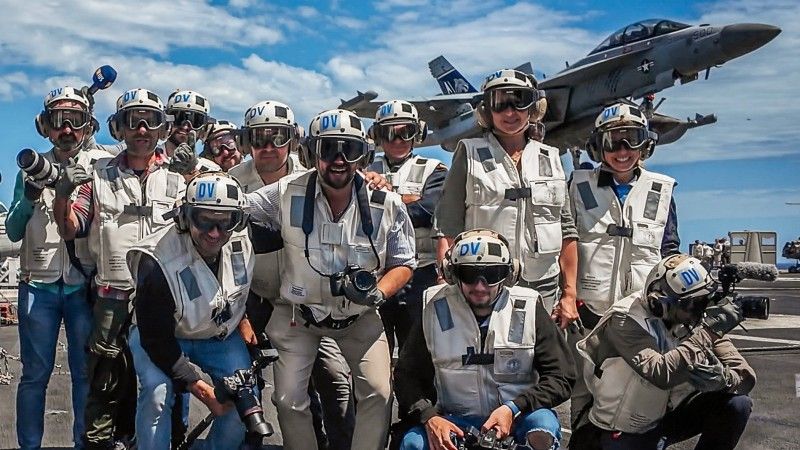
Photo. Orlando Perez/JFC Naples
It’s rare to see an American aircraft carrier up close in Europe. Even rarer is the chance to go aboard to observe the crew’s daily life and watch the takeoffs and landings of the aircraft stationed there. The editorial team of Defence24.pl had the opportunity to take part in this exceptional event. Here is the first part of our report from a visit to the aircraft carrier USS Gerald R. Ford (CVN-78).
The author would like to extend heartfelt thanks to Lieutenant Commander Piotr Adamczak of NATO Allied Joint Force Command Brunssum for invaluable assistance in organizing the trip, and to the entire team of NATO Allied Joint Force Command Naples (especially Sven Kasimirov) as well as the GRF press team for the invitation and for organizing the event.
A Colossus on the Ionian Sea
At the end of July there was a media day as part of the Neptune Strike 25-2 exercises. Defence24.pl was one of several European — and the only Polish — media outlets participating in the event organized by Joint Force Command Naples (JFC Naples). As part of the event, journalists were able to tour the newest American aircraft carrier USS Gerald R. Ford (CVN-78), which, along with the accompanying Carrier Strike Group 16, was taking part in NATO exercises. Our trip to the carrier began at the U.S. Navy base at Capodichino in Naples.
We reached the ship aboard a Grumman C-2A Greyhound, a twin-engine carrier-based aircraft whose primary role is Carrier Onboard Delivery (COD) — transporting cargo, personnel and supplies to the carrier. Despite its advanced age as a design — the lineage of these aircraft goes back to the 1960s, although the airframes still in service were built between 1985 and 1989 — the aircraft is considered reliable and relatively easy to fly. Unfortunately, its service life in naval aviation is drawing to a close.
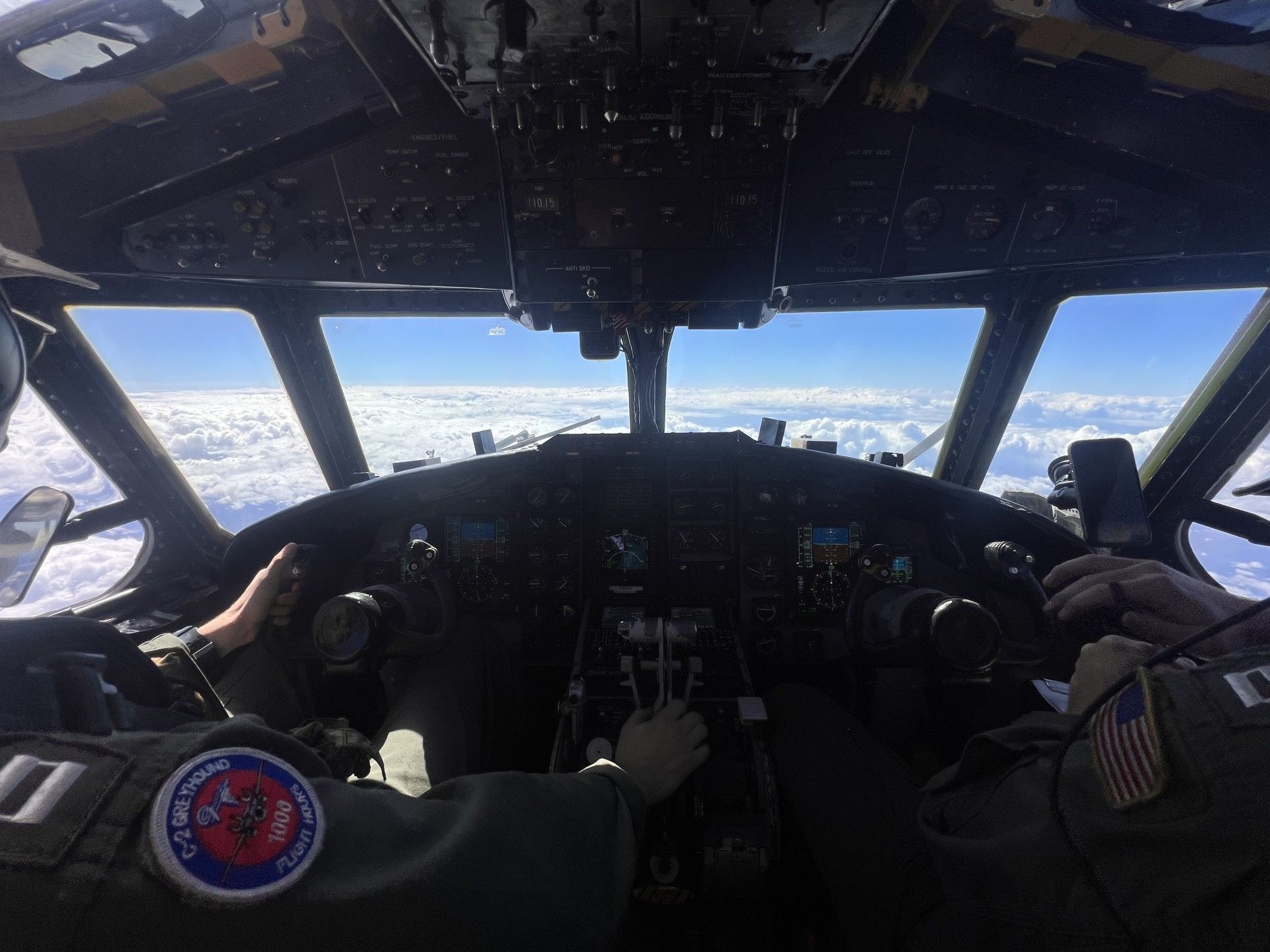
Photo. Mariusz Marszałkowski/Defence24
For USS Gerald R. Ford (GRF) our trip was the last one for civilian guests before the planned retirement of the C-2A in October of this year. All C-2s in the U.S. Navy are to be written off by the end of next year and replaced by the vertical/short takeoff and landing Bell-Boeing V-22 Osprey.
The aircraft is not a comfortable limousine. The interior is dim — light comes only through two small, porthole-like windows in the rear of the fuselage. The cargo area is lit only by weak, yellowish artificial lights mounted on the ceiling. The seats face backward relative to the direction of flight. This seat configuration is dictated by the specifics of carrier takeoffs and landings, where passenger comfort is secondary to safety.

Photo. Mariusz Marszałkowski/Defence24
The greatest inconvenience is the very poor soundproofing. With the engines running, it is unbearable without hearing protection and conversation is impossible. The crew communicates exclusively via special wired intercoms connected to headsets.
A postage-stamp in the Middle of the Sea
After the rear ramp was closed, the aircraft taxied to the runway at the international airport in Naples, which is shared with the U.S. base. After a short takeoff roll, the aircraft set course south — toward the USS Gerald R. Ford, located in the Ionian Sea about 100 km off the coast of Sicily. The flight lasted approximately 1.5 hours and was uneventful.

Photo. Mariusz Marszałkowski/Defence24
The final 20 minutes of the flight were spent preparing for the landing. There were several sharp turns and a gradual descent until the aircraft finally “sat” on the carrier’s deck. The touchdown was not too rough — civilian airliners sometimes land more sharply at standard airports.
A typical carrier landing is characterized by a strong jolt and a very short roll, braked by arresting wires (arresting gear). On CVN-78, a modern Advanced Arresting Gear (AAG) system has been installed — an electro-hydraulic system (rather than the purely hydraulic Mk 7 used on Nimitz-class ships). Thanks to AAG, stopping landing aircraft is safer; the system absorbs more kinetic energy, which reduces airframe wear, and is adaptable to a variety of aircraft — both heavier and lighter types, including unmanned systems.

Photo. Mariusz Marszałkowski/Defence24.pl
Thanks to AAG, Gerald R. Ford requires only three arresting wires (instead of four on previous carriers). Aircraft are fitted with a special tailhook, extended when the landing gear is lowered, which is intended to catch one of the arresting wires. If the pilot misses all the wires, a so-called “bolter” occurs — the aircraft throttles up and goes around.
Two U.S. Navy captains landed our Greyhound without problems. After disembarking onto the flight deck, we headed for the island superstructure rising above the deck. There you will find the navigation bridge, and the superstructure houses sensors, radars, navigation elements and communications systems. After a short briefing on life aboard the ship and safety rules, we were invited by the commander for refreshments and a conversation. We then went down to the lower deck where the hangars for planes and helicopters are located.

Photo. Mariusz Marszałkowski/Defence24.pl
The carrier can host nearly 80 aircraft. Typically these are four squadrons of F/A-18E/F Super Hornet multirole fighters and EA-18G Growlers (used for electronic warfare and support in breaking enemy air defenses). Each squadron consists of 12–14 aircraft. Additionally, 3–4 E-2D Advanced Hawkeye early warning aircraft usually operate from the carrier, serving as the airborne “eyes” for the ship and its strike group.
Helicopters are also based on the carrier, usually around 12 aircraft, including six MH-60S Knighthawks (for search-and-rescue, transport and boarding operations) and six MH-60R Seahawks (for anti-submarine warfare). The ship’s log also lists 3–4 COD aircraft — the aforementioned C-2A Greyhounds — which are typically based ashore, for example at Sigonella in Sicily.
After touring the hangar we went up to the fourth deck of the island where the bridge is located. In addition to ship navigation, air traffic is controlled from there. The view from the bridge allows a precise observation of takeoffs and landings.
To enter the flight deck you must put on a special suit that, in the event of going overboard, triggers an alarm and aids a rescue — for example, by releasing green dye into the water. Mandatory equipment includes double hearing protection, a helmet, goggles and gloves. Crew members pay particular attention to securing personal items — losing even a small object, like a pen, triggers an alarm and a search of the deck to prevent damage to aircraft engines.

Photo. Mariusz Marszałkowski/Defence24
During our visit several dozen launch and recovery operations were conducted, mainly by F/A-18 Super Hornet and EA-18G Growler aircraft. That day a total of 97 air operations involving fixed- and rotary-wing aircraft were scheduled. Aircraft launched from two catapults: one on the bow and the other on the flight deck. I will describe flight deck operations and the crew’s tasks in the next part of this report.
After an intensive day we prepared to leave the ship. The return, like the arrival, was aboard a C-2A Greyhound. The aircraft was moved to the launch position and attached to the catapult. The Jet Blast Deflector — a shield protecting the crew and other aircraft from the hot exhaust blast — was raised behind the plane. Before launch the wings of the aircraft were raised (they are folded down after landing to occupy less space on deck).

Photo. Orlando Perez/JCFNaples
A catapult launch consists of running the engines at full power with the wheels locked to prevent uncontrolled movement. The deck crew checks the aircraft’s readiness and the “shooter” — the sailor responsible for the catapult — kneels and gives the launch signal with an extended hand. The catapult accelerates the aircraft over roughly 80 meters to speeds in excess of 250 km/h, enabling it to climb out.
The acceleration during launch is so strong that despite the harnesses a passenger lifts off the seat. The crew instructs that on the command “Go Go Go” passengers should cross their hands over their chest while holding the straps, lower their heads toward their knees and wait. The wait is stressful — it’s hot, noisy and smells of fumes. Recording the launch in such conditions is impossible.

Photo. Mariusz Marszałkowski/Defence24
The Newest American Aircraft Carrier
USS Gerald R. Ford replaced USS Enterprise (CVN-65) in the U.S. Navy. Construction of CVN-78 began in August 2005; the keel was laid in 2009 at Huntington Ingalls Industries shipyard in Newport News, Virginia. The ship was christened in November 2013 and the flag was raised on 22 July 2017.

Photo. Mariusz Marszałkowski/Defence24
Subsequent Gerald R. Ford–class carriers will gradually replace Nimitz-class units. The new carriers stand out for their length (337 m versus 332 m), their electromagnetic launch system (EMALS) instead of steam catapults, more efficient nuclear reactors, a reduced crew size, improved habitability and greater upgradeability. Gerald R. Ford is more efficient and less costly to operate than the Nimitz-class ships.


