












- WIADOMOŚCI
25 years of NATO Days in Ostrava: Germany takes centre stage
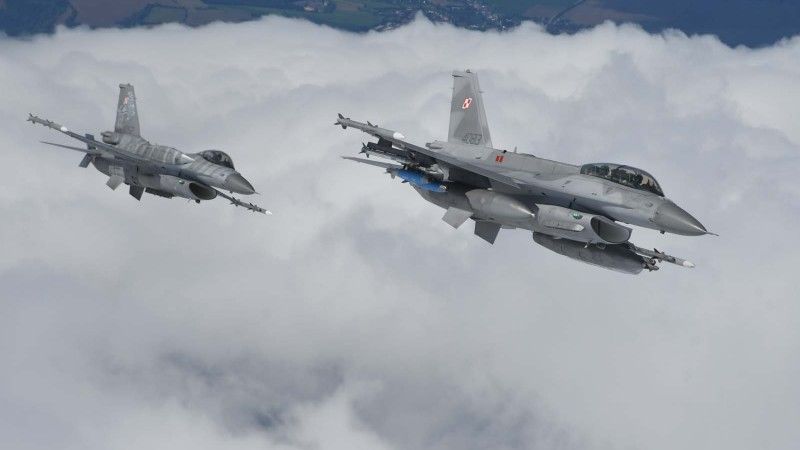
NATO Days in Ostrava, traditionally held together with the Czech Air Force Days, will take place on 19–20 September. The event is held at Leoš Janáček Ostrava Airport in Mošnov, less than 50 kilometres from the Polish border.
It is far more than an air show: one of the largest events of its kind in Europe combines flying displays with presentations by land forces, special operations units, police, firefighters, emergency services and other security agencies. Visitors can see heavy military equipment up close and watch hours of dynamic demonstrations. Unusually for an event of this scale, NATO Days is not ticketed and admission remains free.
Despite what the name might suggest, NATO Days in Ostrava is not organised by the North Atlantic Alliance itself. The event is run by Czech institutions and security services, led by the Jagello 2000 association in cooperation with the General Staff of the Czech Armed Forces, emergency and security services of the Moravian-Silesian Region, and Ostrava Airport. NATO member states, as well as the Alliance itself, have long been present at the event, but its origins and organisational roots are distinctly Czech and Central European.
From NATO enlargement to a regional security showcase
This year marks 25 years since the first NATO Day was held in Ostrava in 2001. The event emerged at a pivotal moment for Central European security. Just two years earlier, on 12 March 1999, the Czech Republic, Poland and Hungary had joined NATO together. It was the Alliance’s first post-Cold War enlargement into Central Europe and one of the key milestones in overcoming the continent’s former East-West divide.
What began as a relatively modest initiative has grown into a mass public event whose significance extends far beyond that of a traditional air show. The organisers describe NATO Days as the largest security show in Europe. Attendance regularly reaches six figures, placing Ostrava among the continent’s biggest public military and aviation events. What sets it apart, however, is the combination of major flying displays with presentations covering the full spectrum of capabilities provided by the armed forces, police, emergency services and other security agencies.
A key part of the event’s philosophy is its open character. Despite rising organisational costs, the organisers insist that admission should remain free. They also argue that taxpayers should be able to see at close range the equipment and capabilities funded with public money. In practice, NATO Days is therefore not only a showcase for military hardware, but also a major public diplomacy event: an opportunity to explain to society how defence, military modernisation, inter-agency cooperation and allied interoperability work in practice. Over the years, the event has also become an important platform for promoting careers in the Czech Armed Forces and other uniformed services. Recruitment centres, military schools and training institutions use the event to engage directly with potential candidates, helping to raise the profile of military service and attract the next generation of soldiers and other security professionals.

Poland in the spotlight
Zbyněk Pavlačík, founder of NATO Days and president of Jagello 2000, points out that Poland played an important role in the event’s development. As early as 2001, Poland became the first foreign country to take part. When the Special Partner Nation format was introduced in 2014, Poland was the first country to assume that role. Nine years later, the organisers invited Poland to return as the event’s special partner once again.
In 2023, Poland mounted one of the most extensive presentations ever staged by a Special Partner Nation. It also offered a striking illustration of the accelerated modernisation of the Polish Armed Forces following Russia’s full-scale invasion of Ukraine. Visitors could see, among other systems, HIMARS launchers, K2 Black Panther tanks, the Borsuk infantry fighting vehicle, a Bayraktar TB2 unmanned aerial vehicle and a South Korean-built FA-50 light combat aircraft, making its first foreign appearance in Polish Air Force colours. Rosomak wheeled armoured personnel carriers were also on display. Numerous units of the Polish Armed Forces took part in both static and dynamic demonstrations, with a particularly strong showing by Poland’s Special Forces.
A joint dynamic demonstration by operators from Poland’s GROM special forces unit and the Czech police proved particularly popular with the crowd. The Polish zone was also visited by Czech Prime Minister Petr Fiala and Defence Minister Jana Černochová. The 2023 edition attracted around 185,000 visitors, and according to organisers’ estimates, roughly one third of them came from Poland. This highlights Ostrava’s distinctive character: a Czech event that has also evolved into one of Central Europe’s largest cross-border security gatherings.

Ostrava’s significance, however, extends well beyond the Polish-Czech dimension of the event. Over the course of a single weekend, visitors can observe not only the capabilities of the Czech Armed Forces, but also the direction of military modernisation across Central Europe and among the region’s key allies. NATO Days has repeatedly served as a venue for important regional premieres. In 2023, NATO Days in Ostrava became the first event in Central and Eastern Europe to feature a dynamic display by the U.S. Air Force F-35A Lightning II Demonstration Team. Five F-35s took part in that year’s edition.
The F-35 has since become an even more tangible symbol of the region’s military transformation. Poland has ordered 32 F-35As, with the first three arriving at Łask Air Base in May 2026. The Czech Republic is acquiring 24 aircraft of its own, with the first F-35s currently scheduled to arrive in the country in 2031.
In recent years, Mošnov has showcased both equipment entering service and systems still being ordered or planned. Alongside events such as Defence24 Days in Warsaw, NATO Days in Ostrava has become one of the best places to see Central Europe’s rearmament and military transformation unfold in real time. From K2 tanks, HIMARS launchers and Borsuk IFVs in Polish service, through the modernisation of the Czech Armed Forces, to the Bundeswehr’s growing presence, the strategic shift taking place across the region is visible on the tarmac.

Germany takes centre stage
After Poland’s extensive presentation in 2023, Germany had been due to take on the Special Partner Nation role in 2024, but the event was cancelled after catastrophic flooding hit the Ostrava region. Italy became the Special Partner Nation in 2025, while Germany will take centre stage for the anniversary edition in 2026.
Germany’s presentation this year will be among the largest ever seen at NATO Days. On the ground, the Bundeswehr is set to bring a Leopard 2A7V main battle tank, a PzH 2000 self-propelled howitzer, a Puma infantry fighting vehicle and a Boxer wheeled armoured personnel carrier. The Fennek reconnaissance vehicle will make its NATO Days debut. The Bundeswehr Joint Support Command, established in 2024, will also take part, showcasing capabilities including logistical and medical support. Germany’s military police will present Enok and Dingo 2 vehicles, while the German contingent will be complemented by the Federal Agency for Technical Relief (THW) and the German Red Cross, displaying equipment used in disaster response and humanitarian operations.

Marking its 70th anniversary this year, the Luftwaffe is preparing its largest-ever presence at NATO Days, with 11 aircraft and helicopters taking part. One of the highlights of the entire event is expected to be the first-ever dynamic display by a Luftwaffe Tornado IDS at NATO Days. A Eurofighter Typhoon and an A400M Atlas heavy transport aircraft will also take to the air. All three types are due to appear in special anniversary liveries. The static display will also include, among others, CH-53 Sea Stallion and AS532 Cougar helicopters, neither of which has previously appeared at Mošnov.
Altogether, the German presentation is currently expected to include 15 aircraft and helicopters. In addition to the Luftwaffe contingent, this will include NH90 and Tiger helicopters operated by the German Army, appearing in both static and dynamic displays. The scale of Germany’s participation reflects not only its role as Special Partner Nation, but also a broader shift in European security. After years of criticism over underinvestment and limited readiness, the Bundeswehr is now seeking to play a significantly greater role in the defence of Europe and on NATO’s eastern flank.

A wider allied showcase
Germany will not be the only attraction of the anniversary edition. Participants from more than a dozen countries have already confirmed their attendance. The organisers have announced, among other highlights, the return of the legendary British Red Arrows aerobatic team. A further potential highlight is the Czech Air Force’s newly delivered Embraer C-390 Millennium transport aircraft, which could be presented to the public at NATO Days for the first time. The detailed programme for the weekend is due to be announced no later than 16 September.
NATO Days in Ostrava is therefore far more than a spectacular air show. It is a free, open public gathering that brings together the armed forces, security services and society, while also offering a particularly clear view of the transformation underway in Central European security. In a region that, after 1989, moved from the Warsaw Pact into NATO and today once again finds itself in the immediate vicinity of a major war on the European continent, that dimension of the event has acquired renewed significance.
Further information on participating nations and the programme is published at natodays.cz. Defence24, as a media partner of the event, will also be covering the key developments and highlights of this year’s anniversary edition.


