












- KOMENTARZ
- WIADOMOŚCI
Royal Navy 2029: First Sea Lord’s vision unveiled

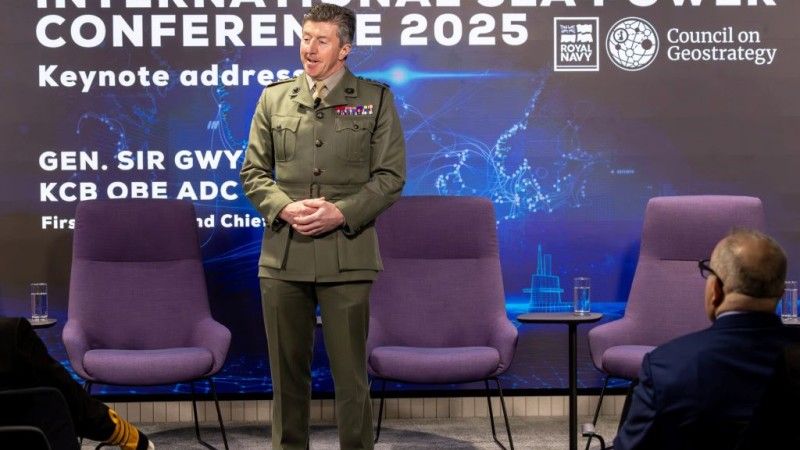
First Sea Lord drives Royal Navy overhaul: hybrid fleet, cutting-edge innovation and a 2029 goal for complete warfighting capability.
The new First Sea Lord and Chief of the Naval Staff was Appointed on 15 May 2025. General Sir Gwyn Jenkins KCB OBE ADC RM became the first Royal Marine to serve in this high command role. This itself is a historic first, as he comes from a Royal Marines Special Forces background rather than the traditional route of a career Royal Naval officer. He therefore brings a fresh perspective as how to shape the future integration of the maritime warfare domain within the wider defence ecosystem.
Sir Gwyn formally took up his role at a ceremony aboard Admiral Nelson’s historic ship, HMS Victory on the 27th May 2025. He has been a Royal Marine Commando since 1990 with a career spanning such distinguished roles as front‑line command of the elite Special Forces- Special Boat Service (SBS), command leadership of the 3rd Commando Brigade, senior policy roles advising government ministers in the Cabinet Office and lastly in service as the Vice‑Chief of the Defence Staff. In addition to his current role, he also continues as the Commandant‑General of Royal Marines Corps.
This varied and wide-reaching mix of operational credibility and wider strategic experience gives him the authority from the ground up, to deliver on his new vision which aims for a 2029 warfighting‑ readiness goal for the whole of the Royal Navy.
Making waves: The First Sea Lord's bold vision for transformation
This vision was encapsulated by General Jenkins across two milestone speeches in London. The first one was at DSEI (9th September 2025) and was followed by the second speech which was the highlight of the International Sea Power Conference (8th December 2025). General Jenkins set out both the why and the how of what must happen. He envisions several key dimensions such as a hybrid fleet blending both manned and autonomous systems, a full NATO allied integration in the North Atlantic and both a transformative reform of all levels of naval leadership in conjunction with a rational streamlining of all critical operating processes. All these elements are to have the intended effect of moving the Royal Navy forward at the pace of relevance so it can face down the whole spectrum of the threats the UK and its allies and partners are facing.
His main point which he underlined in both presentations is the absolute priority of maritime security for the UK. He states that for an island nation, the UK’s survival lifelines such as food, energy, goods and all the traffic through data cables—all run above the sea, on the sea surface and under the sea and therefore the protection of those critical arteries must be of necessity an existential priority. The events unfolding in the wider global geopolitical sphere underline how the strategic balance is rapidly shifting. Russia is investing very intensively in its Northern Fleet, hostile undersea activity threatening critical infrastructure is intensifying and the Atlantic advantage enjoyed since 1945 is now being put at very grave risk due to the slow pace of transformation in response to the challenges being posed by adversaries.
His conclusion to the overall situation is very blunt. He states that there is no room anymore for „Peace-Dividend” era complacency and neglect. The Royal Navy must build for speed and adaptability, reorganizing itself to fully integrate into its operating structure all new emerging capabilities such as AI, autonomous systems, sensors and networks whilst all the while keeping ahead of the rapid speed of technological development.

How will this warfighting transformation look in each domain of maritime warfare?
At the centre of the programme is a hybrid fleet guided by a simple principle that Jenkins defined as „uncrewed wherever possible; crewed only where necessary.”
In the air domain this would translate as the deployment of hybrid carrier wings which will fuse jets, helicopters and uncrewed platforms along with a jet‑powered collaborative drone demonstrator which is planned to launch from a Queen Elizabeth‑class carrier on an accelerated timeline soon.
On the open sea, uncrewed escorts will operate alongside high‑end capabilities such as Type 26 frigates, adding sensors, decoys and weapons capacity while increasing task‑group mass, all at lower cost and shorter build times. General Jenkins set out publicly an ambitious near‑term goal to have the first of these escorts in the water within two years. It was not lost on many commentators, that finally a decision maker is not talking of vague future intentions but setting measurable targets for which he is prepared to be accountable.
Beneath the waves, the Atlantic Bastion concept will link crewed and autonomous host platforms with dispersed, networked sensors from the Mid‑Atlantic Ridge to the Norwegian Sea, delivering persistent awareness and responsiveness on an as‑a‑service procurement model designed to stimulate industry co‑investment.
Atlantic Bastion—what is it?
Atlantic Bastion is the Royal Navy’s undersea defence concept, unveiled in the 2025 Strategic Defence Review and detailed at the International Sea Power Conference, that creates a layered, AI‑enabled detection and targeting web across the North Atlantic. The aim is to protect NATO’s Sea lines and critical seabed infrastructure such as cables and pipelines. It is achieved by integrating autonomous surface and underwater vehicles, crewed ships and submarines, RAF P‑8 Poseidon maritime patrol aircraft and advanced acoustic underwater sensors into a single digital network.

The Defence Industry- an integral partner and enabler
In the context of the Atlantic Bastion concept, at DSEI, Jenkins praised industry for its tremendous example when compared to other key players. He said,”For every pound we have invested, industry has invested four”, which amounts to approximately £500 million in research and development investment. He linked this directly to the commercial potential of maritime autonomy, projecting a global market of £350 billion and presenting Bastion as an engine of national growth.
Instead of over‑specifying requirements up‑front, the Navy has issued what it wants specific capabilities to be able to do and then has left the rest for industry innovators to realise. In this way it has adopted a commercial as‑a‑service approach, so industry can iterate and innovate solutions quickly by working with the Navy’s test and experimentation ecosystem. This is a shift in approach in order to deliver capability at the pace of technology development and by not entangling industry in the all too familiar bureaucratic inertia of the past.
Early „seed corn” funding of roughly £14 million has already unlocked strong private match funding (around 4:1), with 26 firms submitting sensor proposals and 20 companies demonstrating prototypes. In this way initial systems are planned to be in the water in 2026 and scaling thereafter. Conceptually, Bastion revives the idea of persistent undersea coverage, something akin to a mobile, distributed successor to Cold War SOSUS, but with unmanned endurance, AI classification and multi‑domain integration that enables faster, coordinated responses when threats are detected.
At the International Sea Power Conference, Jenkins framed Bastion as the first pillar in a three‑part Atlantic defence construct which is framed according to three key components:
Atlantic Bastion to protect sensitive waters and NATO sea lines.
Atlantic Shield to strengthen air defence across the UK’s northern approaches, with uncrewed escorts contributing to layered protection
Atlantic Strike to guarantee credible maritime strike options, including a carrier‑borne uncrewed fast‑jet demonstrator developed with the RAF.
Each strand is designed for full allied integration. Norway has signalled intent to connect future Type 26 activity in the High North to Bastion’s network, while deeper programmes such as AUKUS cooperation on nuclear‑powered submarine will extend deterrence and reach wherever possible.
The whole program of Transformation is more than just simply about sophisticated hardware acquisition. At DSEI, General Jenkins announced a mission to achieve full warfighting readiness by 2029, anchored on four immediate priorities: nuclear, innovation, leadership, and agility. He committed to overhauling leadership assessment within 100 days, reforming training for modern maritime warfare and stripping out bureaucratic bottlenecks that slow up delivery of much needed critical projects. By December, these ideas crystallised into the Warfighting Ready Plan 2029, launched across the Navy and built on extensive wargaming and early process reforms that have already saved nearly 200,000 staff hours within a year which will free up essential and limited time for training, integration and general preparedness to face any multi-domain threat in the future.
Jenkins’s leadership philosophy underpins the whole programme. He places leadership excellence as the key to delivering results by inspiring people. He is clear that technology, highly critical though it be, is not a panacea that will solve all operational problems by itself. He stresses that the true advantage comes from an investment in those who are on the ground and who will be enabled in their mission by a focus on culture, training and empowerment. He essentially says they are the ones who hold the answers, and he is listening to them.
Hence the renewed focus on selecting and developing future warfighting leaders who can effectively lead by example and motivate teams, adapt under pressure and translate new capabilities into operational effect. This is also reflective of his experience as it is an ethos embodied by the Commando Force’s transformation into small, highly trained teams that are enabled by autonomy and long‑range effects and tailored for the High North operations.
Why is the High-North so prominent in the overall strategy?
The High-North is of critical importance for the following areas:
Strategic importance: Melting Arctic ice is now opening new routes whilst Russia’s Northern Fleet expands its submarine and missile reach across the Barents and Norwegian Seas. Undersea cables and energy routes raise the obvious risk of hybrid disruption in both peace and war.
Alliance integration: UK Commando Forces are re‑rolling for Arctic operations alongside Norwegian and Dutch partners, building on the many valuable lessons from Ukraine for effectively mastering dispersed and digitally connected warfare.
Operational response: Atlantic Bastion sensors extend surveillance deeper into the High North. Future Carrier Strike Group cycles will incorporate Arctic training as a key capability. Commando Force modernisation enabling rapid, resilient operations in extreme environments.
A key feature that General Jenkins announced is an especially close United Kingdom partnership with Norway since with the UK the two countries have the greatest exposure on the Atlantic flank so need to fully integrate as a unified force in all operational tasks. This was realised by the signing on the 4th of December 2025 of a joint agreement known as the ”Lunna House Agreement”. In it the two countries will closely intertwine and combine both their operational and industrial capabilities to secure the High North.

The Nuclear dimension as ultimate force deterrence
The ultimate force constant stressed by General Jenkins is the Strategic Nuclear Deterrent, reaffirmed as the bedrock of UK and NATO security. Jenkins lists nuclear deterrence as the Navy’s top priority which resolutely demands a whole‑force effort across submarines, infrastructure and protective forces and underscores the UK’s NATO‑first commitment. In his view this capability is safeguarding not just 67 million Britons but one billion across the whole alliance. This clear signal of resolve complements the hybrid fleet’s pursuit of mass, resilience and lethality, making deterrence credible across the whole operational spectrum from undersea competition all the way through to carrier strike.
What could this all result in?
If delivered according to the timelines set out, early milestones could potentially bring the vision to life very quickly. These will be Bastion sensors in the Atlantic, a carrier‑launched uncrewed jet demonstrator and the first uncrewed escorts sailing alongside Royal Navy warships. By the time the Carrier Strike Group next deploys to the Indo‑Pacific, its air wing could be almost unrecognisable from what it is today in the way it will enable fusing of crewed and uncrewed platforms for speed, survivability and combat power.
The broader reward for the United Kingdom will be strategic as it will result in a Royal Navy that will have the ability to generate mass at speed through autonomous capability which will in turn cause its enemies targeting difficulties through the coordinated applied use of dispersion, integration with allies through shared concepts and by preserving the all-important human edge through intensive leadership and training reform. With the combination of combat experience, national‑security leadership and reformist zeal that General Jenkins brings to the role, the path to 2029 warfighting readiness is credible. The test now will be to deliver on everything at speed and in close step with industry partners and NATO allies.
Sources
1. GOV.UK (10 Sep 2025): First Sea Lord speech at DSEI 2025 – https://www.gov.uk/government/speeches/first-sea-lord-general-sir-gwyn-jenkins-speech-at-dsei-2025
2. GOV.UK (8 Dec 2025): First Sea Lord’s speech to the International Sea Power Conference – <https://www.gov.uk/government/speeches/first-sea-lords-speech-to-the-international-sea-power-conference>
3. GOV.UK (8 Dec 2025): UK unveils new undersea warfare technology to counter threat from Russia – https://www.gov.uk/government/news/uk-unveils-new-undersea-warfare-technology-to-counter-threat-from-russia
4. Navy Lookout (9 Sep 2025): First Sea Lord sets very ambitious targets for Royal Navy transformation – https://www.navylookout.com/first-sea-lord-sets-very-ambitious-targets-for-royal-navy-transformation/
5. Royal Navy News (27 May 2025): New First Sea Lord officially takes up role after ceremony on HMS Victory – https://www.royalnavy.mod.uk/news/2025/may/27/20250527-1sl-supersession
6. Royal Navy (11 Sep 2025): Head of the Royal Navy outlines bold vision for the Service – https://www.royalnavy.mod.uk/news/2025/september/11/20250911-first-sea-lord-outlines-future-of-the-royal-navy-at-dsei
7. Royal Navy (8 Dec 2025): New Royal Navy undersea warfare technology unveiled to counter threat from Russia – https://www.royalnavy.mod.uk/news/2025/december/08/20241208-atlantic-bastion
8. Naval News (11 Dec 2025): UK Royal Navy Details Multi-layered, All-Domain Approach to Building North Atlantic Deterrence – https://www.navalnews.com/naval-news/2025/12/uk-royal-navy-details-multi-layered-all-domain-approach-to-building-north-atlantic-deterrence/
9. Janes OSINT (11 Dec 2025): UK’s Atlantic Bastion programme seeks hybrid answer to submarine threat – https://www.janes.com/osint-insights/defence-news/sea/uks-atlantic-bastion-programme-seeks-hybrid-answer-to-submarine-threat


