












- WIADOMOŚCI
- ANALIZA
Russia: Two new aircraft in Baltic Fleet Aviation

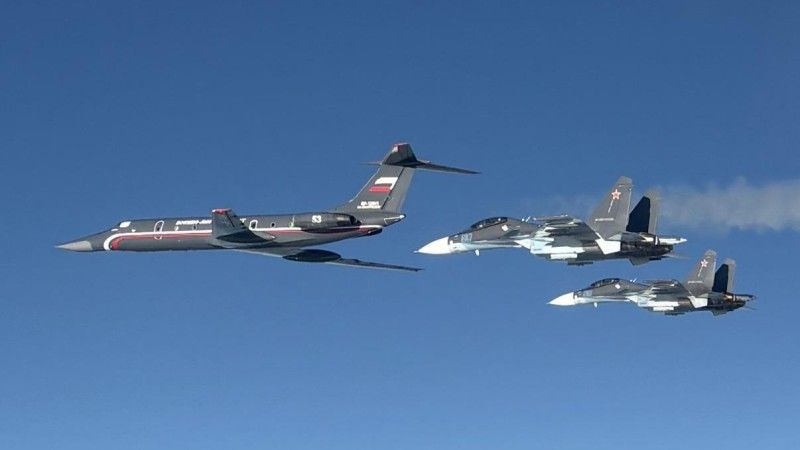
Photo. NATO
Contemporary aviation of the Baltic Fleet is only a shadow of what it was in Soviet times, but it is receiving new aircraft. In 2025 — two airframes have been added.
Aircraft of the Baltic Fleet occasionally appear in international airspace over the Baltic. Sometimes they fly alone, sometimes as an escort for bomber or reconnaissance aircraft of the Russian Aerospace Forces. They are often intercepted by NATO quick-reaction aircraft stationed in Poland or the Baltic states.

A bit of history
The Baltic Fleet in Soviet times was the smallest of the Soviet Fleets. This followed both from the size of the Baltic Sea and from the fleet’s smaller set of tasks compared with other theaters. Its primary mission was to force and seize the Danish Straits, combined with conducting an amphibious operation against Denmark. NATO’s task at the time was to prevent this and to effectively contain that fleet in the Baltic.

Photo. UAC
The Baltic Fleet’s aviation was also the smallest among the Soviet fleets, but not nearly as small as it is today. In mid-1989 it consisted of:
- Headquarters and support units;
- 57th Naval Missile Aviation Division (which included the 170th Naval Missile Aviation Regiment and the 240th Naval Missile Aviation Regiment);
- 12th Independent Missile Aviation Regiment;
- 342nd Independent Regiment of Radio-Electronic Warfare Aviation;
- 15th Independent Long-Range Reconnaissance Regiment;
- 846th Independent Naval Attack Aviation Regiment;
- 263rd Independent Transport Aviation Regiment;
- 745th Independent Anti-Submarine Warfare Helicopter Regiment;
- 49th Independent Anti-Submarine Warfare Squadron;
- 145th Independent Anti-Submarine Warfare Squadron.

In the second half of 1989, to bypass limits arising from the CFE arms control treaty, the following units were attached to the Baltic Fleet aviation:
- 132nd Bomber Aviation Division (Su-24 bombers) from the 4th Air Army of the Supreme High Command;
- 66th Independent Fighter-Bomber Aviation Regiment (Su-17 fighter-bombers) from the 76th Air Army.
It is worth mentioning that most of the 4th Air Army was then stationed on the territory of Poland and had its headquarters in Legnica. From its structure only the 132nd Division was located within the USSR, specifically in the Baltic republics. The division included three bomber aviation regiments numbered 4, 321, and 668. All four of these regiments immediately had their names changed to naval assault aviation regiments, which was intended to remove their aircraft from the CFE limit. A similar step was taken in Poland with the 34th Fighter Aviation Regiment of the Air Defense Forces, transferring it from the Air Defense Forces to the Navy.

At the same time, cuts began in the Baltic Fleet’s aviation. First to go were the 12th Independent Missile Aviation Regiment and the 342nd Independent Regiment of Radio-Electronic Combat Aviation, which were disbanded. The independence of Lithuania, Latvia and Estonia and the withdrawal of Russian troops from their territories led to further organizational and personnel reductions, and above all to a division of the Northern Fleet into two groups.
The northern group with its base in Kronstadt, and the southern group with its base in Baltiysk. The Kaliningrad exclave was cut off from the rest of Russia’s territory. Communication with it is possible only by sea and by air over the Baltic. In this situation, in early 1995 the Kaliningrad Defensive Region was formed, later renamed the Kaliningrad Special Region. The Baltic Fleet’s aviation was concentrated entirely on its territory.
See also 

Modern times
At the beginning of the current decade, the Baltic Fleet Headquarters in Kaliningrad included the Office of the Chief of Naval Aviation and Air Defense. Two divisions reported to it:
- 44th Air Defense Division;
- 34th Mixed Air Division.
The air division included:
- 4th Mixed Aviation Regiment (a squadron of Su-24M bombers, a squadron of multirole Su-30SMs, a transport flight of Tu-134A and An-26);
- 689th Fighter Aviation Regiment (two squadrons of Su-27P fighters);
- 396th Mixed Helicopter Regiment (a squadron of shipborne Ka-27s, a squadron of transport Mi-8s, a squadron of attack Mi-24s).
That force represented the entirety of the Baltic Fleet’s then-aviation. At that time the Baltic Fleet was still subordinated to the Western Military District in St. Petersburg. In 2024 a radical reorganization of the entire command system of the Armed Forces of the Russian Federation took place. The Western Military District was divided into the Leningrad Military District and the Moscow Military District, and the Baltic Fleet itself was again subordinated to the Main Naval Command.

Photo. Russian MoD
This reform also caused the separation of the forces under the Office of the Chief of Naval Aviation and Air Defense of the Baltic Fleet. The office itself was reformed into the Office of the Chief of Naval Aviation. Meanwhile, the air defense forces — i.e., the entire 44th Air Defense Division and the 689th Fighter Aviation Regiment — were transferred under the command of the 6th Air and Air Defense Army in St. Petersburg.
Thus, the Russian naval aviation was reduced to the two-regiment 34th Mixed Air Division and is probably at its weakest in its postwar history. True, in recent years the aircraft fleets of the regiments stationed in the Kaliningrad Oblast were strengthened with new equipment, but this was done drop by drop. The number of new aircraft was practically symbolic.
In 2016–2018 the 4th Mixed Aviation Regiment received eight Su-30SM aircraft with side numbers from 70 to 77. This was not even a full squadron, which should number 12 aircraft. Subsequent new Su-30s delivered to the regiment were already in the newer Su-30SM2 version. Around the turn of 2021 and 2022 four such aircraft entered service, with side numbers 78 to 81, and in November 2022 another four Su-30SM2s with side numbers 82 to 85. In 2023, more precisely in July, the 4th Regiment received only one batch this time comprising three aircraft with numbers 86 to 88. Deliveries were then interrupted for over two years. Only on 21 November 2025 were two more Su-30SM2s delivered with numbers 89 and 90.
Altogether the 4th Mixed Aviation Regiment received eight Su-30SM aircraft and 13 more modern Su-30SM2 aircraft. These 21 machines do not even make up two full operational squadrons, and operation of the Su-24M is being gradually phased out. It can be expected that more Su-30SMs will be delivered to the oblast, but one should not expect colossal deliveries — rather arrivals in batches of 2, 3, or 4 aircraft. Lately the entire Russian military aviation has been fed new equipment in this way.

Photo. UAC
In addition to the Baltic Fleet, in 2023–2024 the Aerospace Forces also received two batches of Su-30SM2 aircraft. Each batch numbered three aircraft, giving a total of six new aircraft. The second trio went to the 689th Fighter Aviation Regiment, once part of the naval aviation.
Belarus, meanwhile, bought more Su-30s. In 2019 and 2024 it received from the manufacturer four aircraft in the Su-30SM version each (a total of eight), in 2025 six more modern Su-30SM2s, and in early January 2026 another two Su-30SM2s. Belarusian Su-30s have side numbers from 01 to probably 17, skipping number 13.
Summing up...
The aviation stationed in the Kaliningrad Oblast, belonging both to the Navy and to the Aerospace Forces, is relatively small in number and mostly equipped with aircraft that are already several decades old (Su-24M, Su-27P, Tu-134A, An-26). The newer machines are only eight Su-30SMs and 13 Su-30SM2s of the Baltic Fleet, and three Su-30SM2s of the Aerospace Forces.
War in Ukraine is inflicting heavy losses on Russian aviation. The Russian aircraft industry continues serial production of the Su-57, Su-35, Su-34 and Su-30, but in very small numbers. New deliveries only roughly offset Russia’s frontline losses and practically do not renew the equipment inventory, which is growing older.
However, the military forces amassed by the Russians in the Kaliningrad Oblast are of such importance to them that further aircraft deliveries to the region should be expected this year and in the coming years.


