












- WIADOMOŚCI
- ANALIZA
New Russian submarine in the Baltic

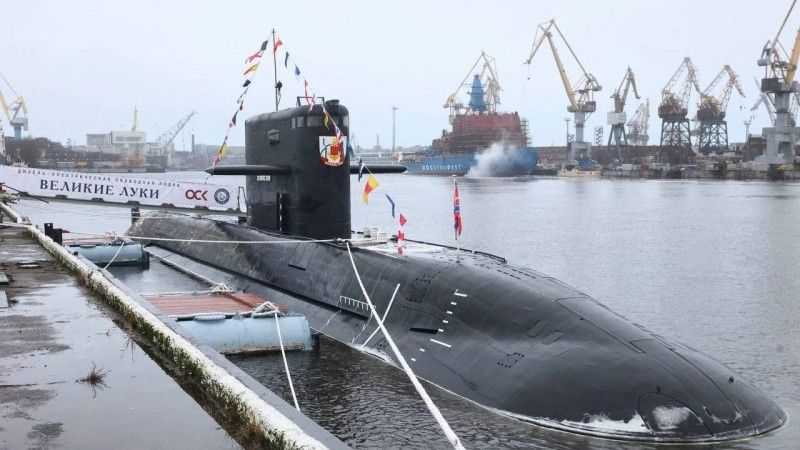
Photo. Russian MoD
Recently, the regular submarine forces of the Russian Baltic Fleet were increased by 100 percent. Instead of one, they now have two submarines.
Over the last three decades, the number of Russian submarines belonging to the Baltic Fleet steadily declined, eventually reaching just one vessel. This is the Dmitrov (487), a Project 877 Paltus submarine. It is the oldest conventional submarine under the Russian naval flag. It was commissioned on 25th September 1986, during the USSR era. After transferring to the Baltic, it served for many years to train foreign crews from countries that purchased Project 877 vessels. At that time, the project also acquired the name Warszawianka, and in NATO terminology, it is known as Kilo. The name Warszawianka originally referred to export versions but became so popular that today it is commonly used to refer to both older Project 877 units and the newer Project 636.
The sole Russian Dmitrov is stationed in Kronstadt and belongs to the 3rd Independent Submarine Division, under the Leningrad Naval Base. In recent years, its deployments at sea have been infrequent. It is a contemporary of Poland’s unique submarine, ORP Orzeł (291).

Photo. Russian MoD
After the collapse of the USSR, conventional submarine production remained only at one shipyard: the Admiralty Shipyards in St. Petersburg. This yard focused on export orders. For several years, the Russian Navy did not have the funds to build new submarines of this class. As a result, the initial plans for a new generation of conventional submarines were delayed. On 26 December 1997, in St. Petersburg, keels were officially laid for prototype Project 677 Lada submarines for Russia and Project 677E Amur for an unspecified export customer. The Lada prototype was launched on 28 October 2004, while construction of the Amur prototype was quickly halted. Its stern sections remain visible in shipyard photos to this day. It quickly became clear that Project 677 was underdeveloped, and its construction caused significant difficulties for the shipyard.
Project 677 submarines were initially intended for the Northern Fleet and later for other fleets. The total collapse of the prototype and series schedule forced Russian command to simultaneously strengthen—or rather rebuild—conventional forces in the remaining fleets using a proven design. The direct successor to Project 877 was Project 636. It was produced in various export variants for China, Algeria, and Vietnam. For Russian needs, a variant 06363 was developed.
The Russian Admiralty planned to build six such submarines each for the Black Sea Fleet, the Pacific Fleet, and the Baltic Fleet. For the Northern Fleet, serial production of Project 677 submarines was to continue, but only after resolving prototype issues.
Six Warszawiankas for the Black Sea Fleet were commissioned between 2014–2016, and six for the Pacific Fleet between 2019–2025.
Of the six „Black Sea” submarines, on 24 February 2022, two were outside their home waters. Due to Turkey closing the Bosporus and Dardanelles Straits, Russia faced a dilemma: either return them to their Black Sea bases (as they had once transited the straits) or leave them to operate in the Mediterranean. They chose the second option. The two submarines, Novorossiysk (555) and Krasnodar (562), operated for several years from the Syrian port of Tartus and from Baltic bases. After the evacuation of Russian vessels from Syria, both now operate mainly from Kronstadt and sail to the Mediterranean using ports of friendly nations, such as Algeria.
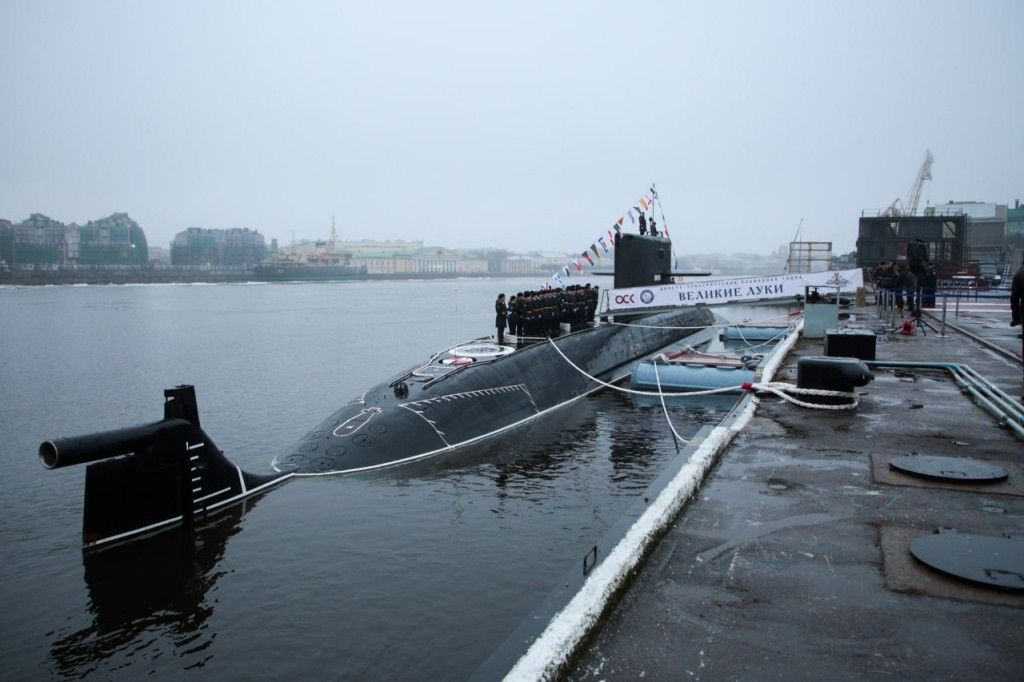
Photo. Russian MoD
The two submarines Novorossiysk (555) and Krasnodar (562), Project 06363, spend much of their time in the Baltic, but still officially belong to the Black Sea Fleet.
Of the six „Pacific” submarines, at least the first four have already been deployed to the Pacific after construction. In the Baltic, the submarine Yakutsk, commissioned on 11 June 2025, is still present, as well as probably Mozhaysk (451), whose flag was raised on 28 November 2023. „Probably,” because in January 2025 it attempted to transit to the Pacific Fleet but, for still unknown reasons, returned through the Danish Straits. In mid-2025, it participated in naval exercises in the Baltic.
Although Mozhaysk (451) and Yakutsk are in the Baltic, they are organizationally part of the Pacific Fleet and will eventually operate in its areas of responsibility.
Simultaneously with the construction and commissioning of the twelve Project 06363 submarines described above, shipyard and design struggles continued with Project 677 Lada. On the prototype St. Petersburg (477), the flag was raised on 22 April 2010, but it was not combat-ready. Officially, it was incorporated into the Northern Fleet, but completion work continued for over a decade. Only around September 2021 did it reach combat readiness, but only briefly. It was soon deemed non-viable and left non-operational. So far, there has been no reliable information on its official decommissioning or last lowering of the flag. It should be noted that Russians often do not report such events. The second submarine (and the first serial unit) of Project 677 is Kronstadt, commissioned into the Northern Fleet on 31 January 2024.

Photo. Russian MoD
Submarines: the non-operational St. Petersburg (477) and the operational Kronstadt formally belong to the Northern Fleet, but both remain berthed at Kronstadt. The prototype St. Petersburg will likely never leave under its own power.
In summary, at the beginning of December last year, the Baltic Fleet had only one submarine of its own, though five other submarines from other fleets were present in the Baltic.
According to announcements in previous years, after six Warszawiankas were built for the Black Sea and Pacific, the next six were to be built for the Baltic. However, these plans became obsolete when the Russian Admiralty gained confidence that Project 677 Lada was finally refined and could be built both for the Northern and Baltic Fleets.
Consequently, the third (and second serial) Lada, named Velikie Luki (454), instead of the Northern Fleet, officially went to the Baltic—or rather remained there, as it was built there. The first flag-raising ceremony took place on 16 December 2025. It was assigned to the 3rd Independent Submarine Division.
This increased the number of Baltic Fleet submarines from one to two, a 100 percent increase.

Photo. Russian MoD
Submarines of the 877/636 family, to current knowledge, will no longer be built. Yakutsk is the 75th vessel of this family, built since 1984, making it one of the largest post-WWII submarine series. In the USSR, only one larger series existed: Project 613 (NATO Whiskey), consisting of about 215 submarines.
Currently, at the Admiralty Shipyards in St. Petersburg, construction continues on two more Project 677 Lada submarines. Keels for the future Vologda and Yaroslavl were laid on 16 June 2022, but they have not yet been launched. Keels for two additional submarines of this type are planned for 2026. Originally, all were to be built for the Northern Fleet, but some may possibly go to the Baltic Fleet. Russian plans in this regard are not yet fully known.


