












- WIADOMOŚCI
- KOMENTARZ
France increases its military presence in the Middle East

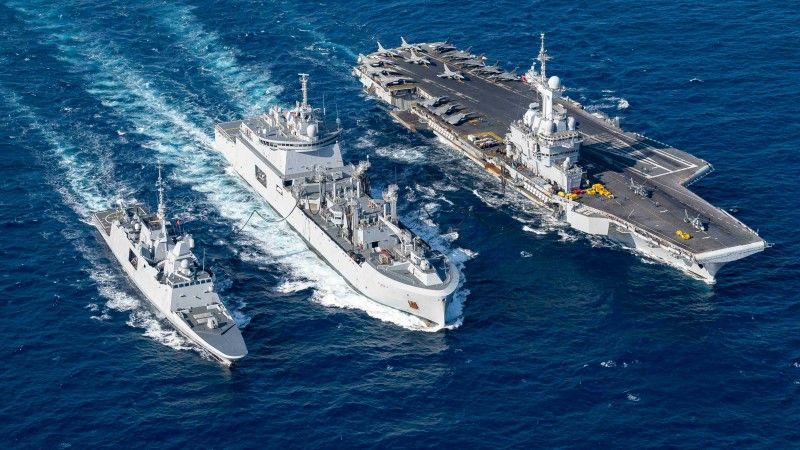
France continues to strengthen its military presence in the Middle East, while consistently maintaining a defensive stance regarding the U.S.–Iran confrontation. Rising operational costs, limited weapon stockpiles, and President Macron’s political considerations mean that Paris avoids offensive actions, while aiming to protect its own forces and support regional stability.
French armed forces currently maintain around 8,000 troops in the Middle East, supported by nearly 50 Rafale fighter jets and several naval assets. The core of the maritime presence is the aircraft carrierCharles de Gaulle, equipped with approximately 26 Rafale fighters and E-2D early warning aircraft, alongside two amphibious ships and several destroyers.

Simultaneously, France maintains permanent contingents in Djibouti (approx. 1,500 troops), the UAE (900), Iraq (1,200), Lebanon (800), and Jordan (300). The scale of engagement is therefore significant, but its character remains defensive. This is reflected in Macron’s statements as well as official government communications.
As General Marc Le Bouil, commander of French air operations (CDAOA), noted, „the level of engagement of the French air force is unprecedented,” with Rafale jets having „destroyed dozens of Iranian drones and missiles.” French aviation is indeed operating on the front line of Gulf air defence, but its activities remain focused on interception rather than offensive strikes.
At the same time, these operations reveal clear limitations. The intensive use of MICA air-to-air missiles is rapidly depleting French stockpiles, while production delays—reaching up to two years—complicate replenishment. This is particularly significant in France, where around 90% of military equipment is sourced domestically. Even such an advanced industrial base is not capable of quickly meeting the demands of a high-intensity conflict. This raises an obvious question: what would happen if a similar war were to erupt in Europe?
Despite increasing military activity, France has not altered its overall strategy. Paris has refused to participate in the U.S.-led operation to secure the Strait of Hormuz, while its main offensive capabilities remain concentrated in the eastern Mediterranean.
France continues to prioritise its own regional interests, particularly in Lebanon, where it is engaged in diplomatic efforts aimed at de-escalation. Macron has criticised Israeli actions, while simultaneously avoiding direct involvement in the conflict.

Costs remain a key factor. France is closely observing how the confrontation with Iran is becoming increasingly burdensome for the United States and is unwilling to replicate that scenario. With a military presence across multiple countries, rising expenditures, and growing casualties, Paris is balancing between maintaining influence and avoiding escalation.
All indications suggest that France will continue its strategy of maximum defensive engagement—without joining an „offensive coalition.” Washington has called on Paris, and Paris has chosen not to respond.


