












- WYWIADY
- WIADOMOŚCI
Stryker for the Polish Armed Forces? Gen. Sokołowski on an armored leap [INTERVIEW]

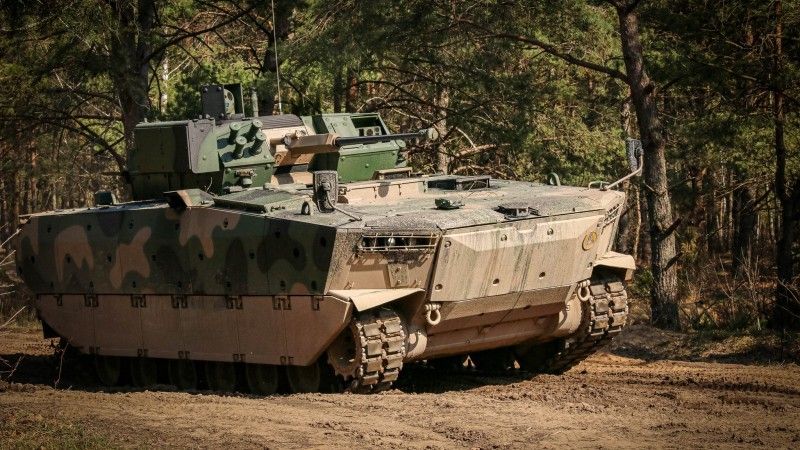
We are already drawing lessons from operational use and identifying additional areas worth implementing. We remain in constant contact with the manufacturer of the Borsuk and will introduce further changes and improvements resulting from user experience, Lieutenant General Marek Sokołowski, General Commander of the Armed Forces, emphasizes in an interview with Defence24.pl. In the interview, he also discusses the General Command’s planned participation in the Defence24 Days conference and the accompanying Exhibition of the Armed Forces and the Polish Defence Industry.
Jędrzej Graf: General, we are approaching the Defence24 Days 2026 conference, whose partner is the General Command of the Branches of the Armed Forces. The Armed Forces exhibition will also be held during the conference. What new items will be presented?
Lt. Gen. Marek Sokołowski, General Commander of the Armed Forces: I am pleased that the General Command of the Branches of the Armed Forces is a partner of the Defence24 Days 2026 conference. This event is a key forum for discussion on issues related to the security and defence of Poland and its allies. Representatives of the General Command of the Branches of the Armed Forces will take part in large numbers in the discussion panels. In addition, officers of the General Command will present assumptions for the development of the Armed Forces in key areas as part of the presentation blocks.
At the Armed Forces exhibition during Defence24 Days 2026, we will present a broad spectrum of the most modern equipment currently in service with the Polish Armed Forces or being introduced. This will include armored, artillery, anti-aircraft, reconnaissance, and logistics equipment — of American, Korean, and domestic defence-industry production.
One of the most important elements of this year’s exhibition will be the Borsuk infantry fighting vehicle, developed and produced by Huta Stalowa Wola together with national partners. This platform is crucial for the transformation of the mechanized forces and for replacing post-Soviet equipment. Also presented will be, among others, M1A2 SEPv3 Abrams, K2 GF, and Leopard 2PLM1 tanks; Krab and K9 self-propelled howitzers; Rak mortars; Homar-A, Homar-K, and Langusta launchers; Rosomak wheeled armored personnel carriers with the ZSSW-30 turret; the Pilica anti-aircraft system; the FT-5 unmanned system with launcher; as well as Żmija and Legwan reconnaissance vehicles.
There will also be no shortage of technical support and logistics equipment — Hercules recovery vehicles, Cougar and M-ATV MRAP vehicles, and the Rosomak in the medical evacuation variant. In this way, we will show that the modernization of the Polish Armed Forces does not concern only combat systems, but covers the full spectrum of capabilities — from reconnaissance, through fires, to combat support and logistics.

Photo. Marek Pawlak / General Command of the Armed Forces
Units subordinated to the General Commander are receiving a great deal of new equipment: in the land domain alone, Abrams, K2, K9, new aircraft and helicopters, but also Polish Borsuks or Rosomaks with ZSSW-30 turrets. How is the process of introducing this equipment progressing? Let us focus on the land domain, because that is what we will see at Defence24 Days.
The process of introducing modern weapon systems into the Polish Armed Forces is a complex and multi-stage undertaking that goes far beyond the moment of equipment delivery itself. In practice, this means the need for full integration of new platforms with existing organizational structures, logistics systems, training systems, and operational systems.
A good example is the parallel introduction of K2 and M1 Abrams tanks. In 2022–2025, deliveries of 180 K2 GF tanks were carried out; they went mainly to units of the 16th Mechanized Division. Further deliveries are planned for 2026–2027, followed by the introduction of the K2PL version, whose configuration is being developed on the basis of operational experience and conclusions reported by users — our soldiers. I emphasize that in 2022–2024, future instructors for K2GF tank crews, as well as technical instructors for the tank at levels I–III of technical support, were trained in South Korea and Poland. Thanks to this, we are already able to conduct the training process independently. Another advantage of the K2 tank is the Embedded Training System installed inside the tank, which enables comprehensive crew training, taking into account different combat environments and tactical scenarios. The system allows for realistic training of the commander, gunner, and driver because it uses the tank’s interface and systems. This makes it possible to reduce training costs associated with tank operation, particularly ammunition consumption.

Photo. senior staff chor. Mariusz Kraśnicki/ 15th "Giżycka" Mechanized Brigade
The K2 is a very modern platform and, at the same time, is characterized by a high level of operational readiness already at the current stage of introduction. I would like to emphasize that we have very good contact with the Korean side — both at the technical and operational levels. This cooperation allows for a rapid response to the comments and suggestions we submit. The Korean side not only supports the operation of the tanks already delivered, but also continuously introduces changes to the K2GF tank design on the basis of our experience.
In parallel, the Abrams program is being implemented. In 2023–2024, 116 M1A1 tanks were delivered, and deliveries of 250 M1A2 SEPv3 tanks are now underway; these are to be completed this year. The equipment is going primarily to the 18th Mechanized Division and training centers. A key element of this process is the training system and the development of a complete logistics base, including spare parts, workshops, diagnostic systems, and technical support.
What does this look like for the Abrams?
As for the training system, in 2022–2026, tank crews, technical personnel, and future Abrams tank instructors were trained at the Abrams Academy. From 2027, the plan is for Polish instructors to assume responsibility for conducting the training. Logistics support, meanwhile, is based to a large extent on cooperation with the American side.
This is an important difference compared with the K2 tanks, where technology transfer and the development of industrial capabilities in Poland are of particular importance, including the eventual production of the K2PL version, as well as support vehicles. I would stress, however, that the logistics package also included the acquisition of M88A2 Hercules recovery vehicles, HMMWV SECT technical assistance vehicles, and various types of workshops and diagnostic systems, which provide significant capabilities for supporting the operation of these tanks.
How do soldiers assess the new armored equipment?
The assessment of users — crews and technical personnel — is a key element of the entire process. Experience to date indicates that soldiers assess the platforms being introduced very positively.
In the case of the Abrams tanks, the maturity of the design and its verification in combat conditions are emphasized. The K2, in turn, is assessed as a modern system, while also being flexible, forward-looking, and offering major growth potential, especially in the context of the future K2PL version. The common denominator is a clear qualitative leap compared with post-Soviet equipment — both in terms of ballistic protection and fire-control systems, situational awareness, and crew ergonomics.
What are the greatest challenges in introducing the new platforms?
At the same time, users point to challenges that are natural with modernization on such a large scale. These primarily concern logistics support, the availability of spare parts in the initial phase, the need to build maintenance and repair competencies, and infrastructure adaptation. Soldiers also draw attention to the pace and intensity of training, as well as the need to work with advanced technical documentation, often in English.
I would like to thank all soldiers involved in this process for their professionalism, diligence, and initiative. Their attitude is clearly noticed and appreciated by our foreign partners, which confirms the high level of competence of the Polish Armed Forces in the process of introducing modern weapon systems.
And how is the introduction of the Borsuk IFV progressing?
The Borsuk program is of special importance because it concerns the basic combat asset of the mechanized forces. In February 2023, a framework agreement was signed for 1,014 vehicles, while in March 2025 the first executive contract was concluded for 111 units. The Armament Agency is currently negotiating another executive contract for 146 Borsuk IFVs.
The first 15 vehicles were delivered to the 15th Mechanized Brigade in Giżycko, where operational-military trials began. These cover a very broad range of issues — from the organizational structures of subunits, through specialist and live-fire training, to the assessment of infrastructure and logistics-support capabilities.
It is important that the soldiers currently operating the Borsuk previously took part in its design and testing, which enables very conscious and effective introduction of the system. In the first instance, Borsuks are going to units of the 16th Mechanized Division.
We are already drawing lessons from operational use and identifying additional areas worth implementing. We remain in constant contact with the manufacturer and will introduce further changes and improvements resulting from user experience. At the same time, negotiations are ongoing regarding the next executive contract for Borsuks. This is a program that, over the next several years, will completely change the capabilities of the mechanized forces and significantly increase their combat effectiveness.
Analyses are underway regarding the possible introduction of Stryker APC as an interim solution. Under what conditions would such equipment be useful?
Stryker APCs could be a valuable supplement to the capabilities of motorized subunits, particularly in the context of rapid response and high operational mobility. This is a platform proven in combat operations, offering configuration flexibility and the ability to carry out a variety of tasks.
Their potential introduction would increase interoperability with allied forces, especially American forces, and could strengthen capabilities for rapid deployment and support for operations on NATO’s eastern flank.
However, the acquisition conditions are of key importance — the technical condition of the equipment, the availability of spare parts, operating costs, and the possibility of integration with the Polish logistics and training system. If these conditions are met, the Stryker could be an effective interim solution.
Of course, the priority remains the acquisition of armaments produced by the Polish industry. We are continuously implementing this process, and its effects — including the Borsuk IFV and the Rosomak APC with the ZSSW-30 turret — will also be visible during the exhibition accompanying the Defence24 Days conference. At the same time, however, the scale and urgency of the security challenges mean that, as General Commander, I must also look at a timeline appropriate to the threats and available solutions. I want to state clearly that, at this stage, no final decisions have been made on this matter. Analyses and checks of various options are ongoing, and any decisions will be communicated by the leadership of the Ministry of Defence.

Photo. Platoon Leader Anna Wolska / 1. "Pomorska" Logistics Brigade
The military is forming new divisions, combined-arms and specialist brigades, while at the same time some soldiers remain engaged on the border. What are the greatest challenges?
The greatest challenge is the scale and simultaneity of the activities being carried out. The Polish Armed Forces are simultaneously developing new structures, modernizing equipment, and carrying out current operational tasks, including protection of the eastern border. Let me recall that we are implementing the process of forming new divisions — the 1st Legions Infantry Division and the 8th Home Army Infantry Division — as well as strengthening existing tactical formations, including the 16th and 18th Mechanized Divisions. Missile and artillery forces are being developed, as are air-defence capabilities.
The greatest challenge is creating new units from the ground up — essentially from zero. This means the need to build organizational structures, acquire personnel, and prepare barracks, garage-maintenance, and training infrastructure. These are multi-year processes, which is why interim solutions are being used — container infrastructure, tent halls, and modular facilities.
A very important element is the National Deterrence and Defence Program „Shield East” which integrates military activities and strengthens defence capabilities on NATO’s eastern flank. This is an initiative much broader than the mission to support the Border Guard, which has been ongoing since 2021. It is currently being carried out primarily by the 18th Mechanized Division, supported by other units. I would add that newly formed units, as a rule, do not take part in border missions. The exception is the 1st Legions Infantry Division, which assigns several dozen soldiers to protective tasks and to the 18th Mechanized Division staff in order to better prepare for anticipated tasks. During subsequent rotations, the participation of the 1st Legions Infantry Division will increase.
Thank you for the conversation.
In the second part of the interview, we will speak with the General Commander about the introduction of new combat aircraft and helicopters into the Polish Armed Forces.


