












- WIADOMOŚCI
- OPINIA
- KOMENTARZ
There's no room for error in the urban warfare. How is modern counterterrorism changing?

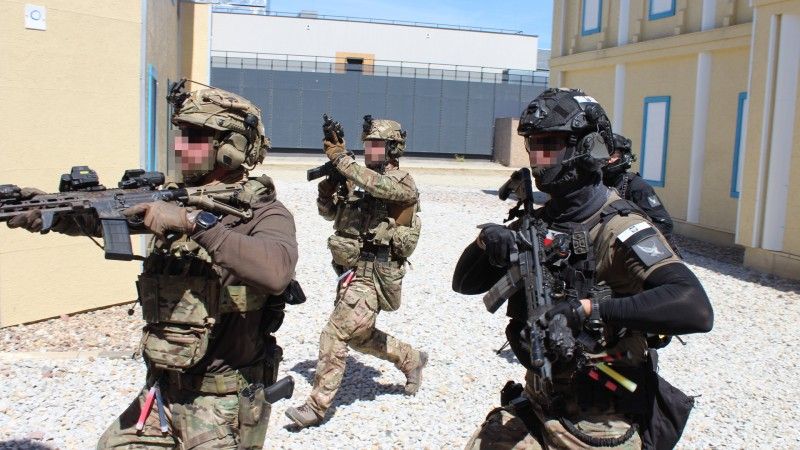
Photo. Jacek Raubo/Defence24
Forces Cooperation 2 Urban Combat is the latest iteration of exercises aimed at developing cooperation and interoperability between various counter-terrorism units from Poland and around the world. In the Wielkopolska region, it became clear how vital operators are and how strategic the mission of investing in their training and skill development truly is.
From June 22 to 25, 2026, the exercise codenamed „Forces Cooperation 2 Urban Combat” took place at the Adam Mickiewicz University (UAM) in Poznań and at the Wielkopolska-based facilities of the European Security Academy (ESA). It was a series of tactical-medical workshops organized jointly by the National Police Headquarters, the Military Institute of Medicine, and the Independent Counter-Terrorist Sub-unit of the Police (SPKP) in Poznań. This marked the second edition of the event, which blends information exchange with practical training among operators from independent police counter-terrorism sub-units, as well as other law enforcement and military structures involved in counter-terrorism operations.

Photo. Jacek Raubo/Defence24

Photo. Jacek Raubo/Defence24

The first day was dedicated to a seminar phase held at the Faculty of Political Science and Journalism at UAM in Poznań. Attendees had the opportunity to hear lectures covering the full spectrum of counter- and anti-terrorism topics. This included an analysis of how military technologies bleed into the criminal underworld—a trend that poses a direct threat to police formations and other uniformed services. The presentations focused heavily on unmanned aerial systems (UAS), electronic warfare (EW), and emerging cyber solutions, which are increasingly becoming dual-use items and risk being proliferated into the hands of organized crime and terrorists. There was also a broader introduction to drone technologies, which are currently evolving rapidly in the context of the armed conflict in Ukraine, while simultaneously enhancing the capabilities of police and non-police counter-terrorist units. This duality was later demonstrated during practical showcases conducted at the training facilities. Additionally, the seminar addressed battlefield medicine and the development of medical procedures tailored to counter-terrorism units« tactics. Participants also familiarized themselves with the operational specifics of the Humanitarian and Medical Aid Group (ZPHM) and engaged in discussions on stress management and the development of psychological resilience for tactical operators.
The subsequent days were dedicated entirely to the practical dimensions of counter-terrorism and medical operations. Accordingly, one day featured workshops focused on honing skills with both sidearms and long guns. Over the next two days, participants tackled tactical tasks involving operations in urban terrain. The primary focus was on the medical evacuation (MEDEVAC) of casualties, including the critically wounded. Teams were required to secure simulated motor vehicle accident sites, stabilize patients in a secure area, and execute evacuations via both rotary-wing aircraft and wheeled transport. The wounded were transported several kilometers away to an improvised field hospital coordinated by the Humanitarian and Medical Aid Group (ZPHM). Unit operators acting as combat medics had to deliver precise patient handovers, after which ZPHM members performed life-saving interventions.

Photo. Jacek Raubo/Defence24

Photo. Jacek Raubo/Defence24
See also 

Notably, the trainees utilized a military helicopter for team insertion and medical evacuation, highlighting the seamless interoperability between uniformed services and the military in such extreme crisis scenarios. This is a critical element in understanding Poland’s security environment, particularly in light of lessons from Ukraine. It is there that units like KORD (КОРД), under wartime conditions, have had to absorb military roles and collaborate directly with the armed forces. Consequently, we must build interoperability on Polish soil not only among various police and uniformed formations but also with the military (including Special Operations Forces assets). Thanks to the organizers of Forces Cooperation 2 Urban Combat, another proverbial brick has been laid in this process. It is worth noting that tactical operations were carried out at the famous „Mogadishu” facility owned by the European Security Academy (ESA). This site allows for various urban terrain configurations—a crucial feature, as all analyses indicate that rapid urbanization is a major global megatrend. Therefore, counter-terrorism services and special operations forces must build significantly higher competencies within urban environments today.

Photo. Jacek Raubo/Defence24

Photo. Jacek Raubo/Defence24

The assault teams were also tasked with apprehending high-risk, armed suspects barricaded inside buildings. This provided an opportunity to practice close-quarters battle (CQB/black tactics), allowing operators to perfect safe movement through urban terrain and plan approaches to specific buildings, including movements across open spaces. Furthermore, the teams were integrated; operators from different police units (SWAT in English), the Internal Security Agency (ABW), Special Forces, and the Customs and Revenue Service had to cooperate at a tactical level in scenarios simulating real-world operations. This year’s exercise also welcomed representatives from a German SEK unit and officers from the Abu Dhabi Police (UAE). As a result, participants had to navigate tactical communication in both Polish and English. The goal was to test standardized procedures and exchange operational experiences. Operators were frequently observed sharing „lessons learned” within their teams, particularly during hotwashes immediately following a simulated raid. This underscored the immense value and importance of exercises like Forces Cooperation 2 Urban Combat.

Photo. Jacek Raubo/Defence24

Photo. Jacek Raubo/Defence24
Moreover, the scenarios utilized serve as a foundation for a better understanding of the equipment specifications used daily by different units—ranging from firearms and communication systems to the latest situational awareness tools. Unmanned systems, which are increasingly visible assets in counter-terrorism operations, were deployed throughout the missions. It must be emphasized that a fast drone, paired with a skilled operator, can provide a critical boost to threat awareness in urban environments—a fact vividly demonstrated during building approaches and reconnaissance flights. It was equally compelling to observe operators sharpening their medical skills under the watchful eye of instructors and under intense time pressure to evacuate from a hot zone. This provided an excellent opportunity to identify equipment bottlenecks and highlight the vital importance of developing life-saving procedures. Operators also had the chance to attend briefings by experienced BOPE operators from Brazil during closed evening seminars. There is no denying that events like Forces Cooperation 2 Urban Combat also foster community integration, building interpersonal understanding among heavily deployed sub-units and units that usually operate within their own regional jurisdictions. Investing in an operator and their professional network is just as critical as procuring hardware and weaponry.

Photo. Jacek Raubo/Defence24

Photo. Jacek Raubo/Defence24
See also

In conclusion, Forces Cooperation 2 Urban Combat demonstrates a modern approach to joint training and integration for counter-terrorism units. It creates a vital space for exchanging information and expertise while drawing insights from outside the conventional „bubble”—tapping into academia, equipment manufacturers, and civil expert circles. Furthermore, training within integrated, multi-agency teams allows for the real-world identification of differences in tactics, gear, and cooperation, pushing operators far beyond their daily comfort zones. Every participant returns to their home unit with a wealth of experience, thereby strengthening our national counter-terrorism capabilities. Quite frankly, it was impossible not to notice the immense energy the operators poured into their actions, despite highly unfavorable weather conditions (the severe heatwave gripping Poland at the time took a heavy toll on everyone). Initiatives of this kind are direct investments in security—both in combating organized crime and in responding to sub-threshold threats (such as sabotage, diversion, etc.) that we may increasingly encounter in the coming years. However, observing our operators during this exercise leaves us optimistic: we see a group of deeply committed, passionate professionals driven by a desire to train, adapt, and evolve.


