












- WIADOMOŚCI
Armenia's military and economic cooperation with France and India

The ongoing changes on South Caucasus« security conditions, particularly after the Nagorno-Karabakh war in 2020, have led to a profound redefinition of the Republic of Armenia’s security policy.
The weakening of existing security guarantee mechanisms and the limited effectiveness of traditional alliances have prompted Yerevan to seek new international partners and diversify its military and defense cooperation. In this context, Armenia’s relations with France and India, which in recent years have become important actors supporting Armenia’s defense capabilities, have taken on particular significance.
France
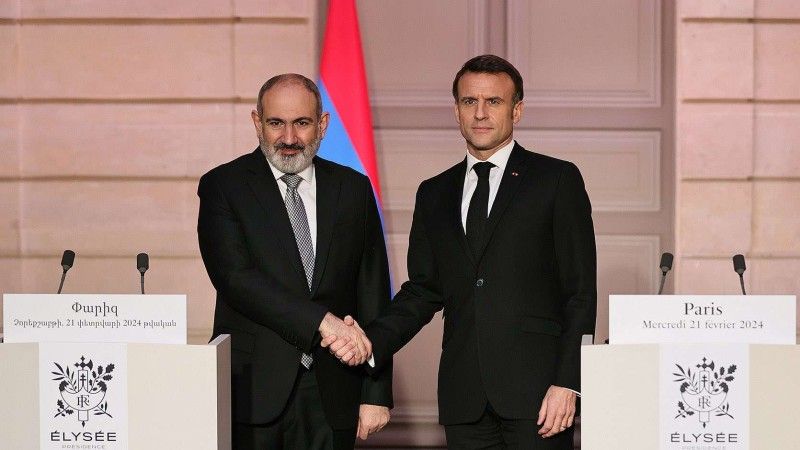
As part of its diversification policy, i.e., the search for new partners, Armenia decided to ask France for help in strengthening its defense capabilities and protecting its population. This defense-oriented cooperation began to include the purchase/sale of military equipment and operational activities in the form of exercises. The cooperation intensified with Azerbaijan’s increasingly aggressive actions. In 2023, after many months of blockade, the separatist Republic of Nagorno-Karabakh ceased to exist thanks to a lightning-fast Azerbaijani military operation. This resulted in a wave of over 100,000 refugees who came to Armenia in the search of a shelter. A month after these events, in October 2023, French Foreign Minister Catherine Colonna flew to Armenia and publicly committed France to supplying military equipment to Armenia, emphasizing the need to strengthen the country’s defenses after repeated Azerbaijani offensives. In the same year, the first French defense mission in the South Caucasus was established in Yerevan. In 2024, French Defense Minister Sébastien Lecornu made his first-ever visit to Armenia. He delivered military equipment and signed defense cooperation agreements. These included the delivery of armored vehicles, weapons, ammunition, and improvements to air defense capabilities.
While French military equipment exports to Armenia were almost non-existent until 2022, end of 2023 and throughout 2024, several contracts were signed for land equipment to strengthen Armenia’s defense capabilities. France supplied bastion-armored personnel carriers, Thales GM200 air surveillance radars, and Caesar howitzers. The value of contracts from 2023 amounted to a total of €74 million and rose to €204 million a year later. Discussions are currently underway on other prospects, as well as projects aimed at developing Armenia’s industrial and technological base in the field of defense. The French-Armenian defense partnership also includes training, with mountain infantry instructors being sent to train Armenian soldiers in mountain warfare, as well as an agreement between the Saint-Cyr Military School and the Vazgen Sargsyan Military Academy on the training of Armenian cadets.

India
Armenia placed an order for 15 Akash missile systems in 2022 for $720 million, becoming the first foreign buyer of the platform. The Akash-1S systems, supplied by India’s Bharat Dynamics Limited, provide protection against airborne threats such as fighter jets, guided missiles, and drones. As part of multi-million dollar defense deals, New Delhi has committed to supplying the Armenian army with Indian howitzers, anti-tank missiles, and anti-drone equipment. In addition to air defense, India has also supplied its Pinaka missile systems to Armenia. The Pinaka system offers long-range strike capabilities and is consistent with Armenia’s broader efforts to modernize its ground and artillery assets in cooperation with India.
Armenia is also finalizing a $3 billion deal to purchase eight to twelve Indian Su-30MKI multi-role fighters, with deliveries scheduled for 2027-2029. Armenia’s deal with India is part of Yerevan’s strategy to diversify its defense partnerships away from its traditional reliance on Russia. In 2023, Armenia also appointed a defense attaché to its embassy in New Delhi to strengthen military ties with India. India’s deepening ties with Armenia provide strategic footholds in the South Caucasus, countering the influence of Pakistan and Turkey in the region while increasing connectivity with European and Eurasian markets.
India and Armenia are close to signing memoranda of understanding worth between $3.5 billion and $4 billion which focus on modernizing Armenia’s air defense, missile, and artillery systems. Active discussions are underway on the inclusion of the new-generation Akash-NG system, characterized by significantly increased range and interception capabilities, in Yerevan’s multi-layered air defense architecture. Yerevan is also interested in BrahMos supersonic cruise missiles. A framework for cooperation in production is currently being established which will enable the licensed assembly of BrahMos components in Armenia, marking a strategic shift towards joint production.
India’s cooperation with Armenia is, in a sense, part of the rivalry between India and Pakistan, which supports Azerbaijan in the South Caucasus region. The above agreement itself follows Azerbaijan’s recent purchase of 40 JF-17 Thunder Block III aircraft from Pakistan, India’s main geopolitical rival. In October, the arrival of Pakistani JF-17 fighters in Azerbaijan sent a wave of unease through Yerevan. In late October, Inter-Services Public Relations (ISPR), the media wing of the Pakistani military, also announced joint combat exercises with Azerbaijan, saying that an air force contingent consisting of JF-17 Thunder Block-III fighter jets had arrived in Azerbaijan for bilateral exercises.
In addition to military cooperation, Armenia is also interested in economic cooperation with India. The main element of this cooperation is the International North-South Transport Corridor (INSTC). It is a multimodal transport system established on September 12, 2000, in St. Petersburg by Iran, Russia, and India to promote transport cooperation between member states. This corridor connects the Indian Ocean and the Persian Gulf with the Caspian Sea through the Islamic Republic of Iran, and is then connected to St. Petersburg and Northern Europe through the Russian Federation. For India, it is a route connecting it to European and Eurasian markets. It runs through Armenia, which plays a significant role in this context as it is one of the transit countries connecting India with Europe, the Persian Gulf, Iran, the Black Sea, and Georgia.
In order to develop the project, a trilateral mechanism was launched in 2023, bringing together representatives from India, Armenia, and Iran. It is a platform for coordinating regional projects. Among other things, it addressed the issue of opening up parts of the Iranian ports of Chabahar and Bandar Abbas to facilitate Yerevan’s trade access to India. Thanks to it, Armenian ships were able to use them as early as January 2024. Both New Delhi and Tehran strongly support Armenia’s efforts to become more involved in regional cooperation and use of Iranian ports. The development of trilateral cooperation between Armenia, India, and Iran aims to improve regional transit infrastructure and increase each country’s influence in the South Caucasus.
Conclusions
An analysis of Armenia’s cooperation with France and India indicates that both partnerships play an important role in the process of redefining Armenian security policy and foreign relations. Both France, as a key European actor and permanent member of the UN Security Council, and India, as a growing regional power and significant arms manufacturer, offer Armenia different but complementary forms of support in the area of defense and security.
Cooperation with these countries enables Armenia to gradually diversify its foreign partners and reduce its excessive dependence on the Russian Federation, which has remained Armenia’s main security guarantor for decades. This diversification has not only a military dimension, but also a political and strategic one, strengthening Armenia’s ability to pursue a more autonomous foreign policy in an unstable regional environment.
At the same time, relations with France and India do not mean a complete break with existing alliances, but rather an attempt to complement and balance them. In this sense, these partnerships should be seen as part of a long-term strategy to increase the country’s resilience and seek alternative sources of support in the face of the changing security architecture in the South Caucasus.


