


- WIADOMOŚCI
- ANALIZA
Comments from German media on the terrorist attack in Kraków

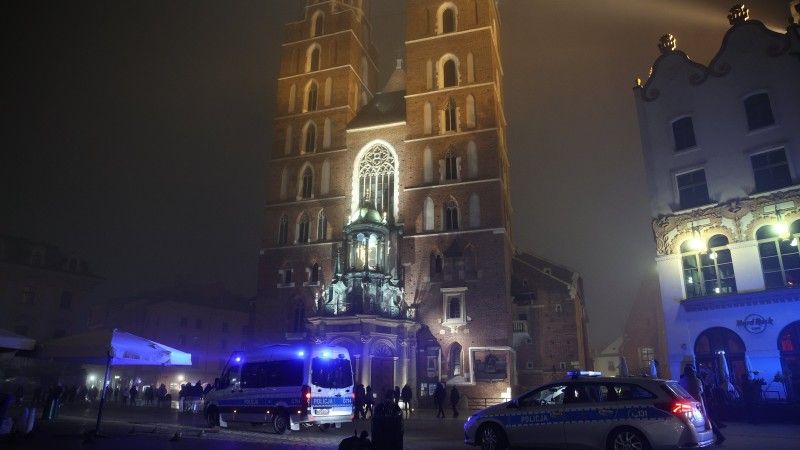
German media outlets are reporting with great interest and engagement on the events surrounding the act of terror that took place in Kraków on 7 November. In addition to the brutal attack itself, the primary points of reference include the current political and social situation in Poland, next year’s parliamentary elections, the level of security, and associated threats, both domestic and external. In this context, references are also being made to the problem of the terrorist threat in Germany, such as the attack in Munich on 13 February 2025. On that occasion, an Afghan citizen drove a speeding car into a group of demonstrators, resulting in two deaths and 44 injuries.
The threat of terrorism in Poland and Germany
According to the latest Europol report titledTE-SAT: European Union Terrorism Situation and Trend Report 2026, there were 45 terrorist attacks recorded across the European Union in 2025. These affected 10 countries, most notably: France (14), Italy (11), Austria (7), and Germany (4). Last year, 486 people were arrested in the EU due to terrorist activities, including 37 in Germany and 9 in Poland. In Germany, 21 people were detained for jihadist activities, 8 for right-wing extremism, 5 for ethno-nationalist and separatist activities, and 3 due to other forms of terrorism. Meanwhile, in Poland during the same period, 2 people were arrested for jihadist activity, 4 for right-wing terrorist activity, and 3 for other forms of terrorism.
Selected comments from the German media
In reports on the Kraków attack, the German press frequently emphasises the bravery of the police officers who risked their lives to stop the perpetrator, thereby preventing further casualties. Attention is also drawn to the phenomenon of „violent extremism.”Bild notes that the attacker first used a vehicle, „driving at high speed into Kraków’s Old Town,” and later opened fire on people. It adds that in addition to the 6 killed and 15 wounded in Kraków’s main square, there were 3 further victims. The bodies of two women and one man were found at the perpetrator’s family home. The publication concludes that „the attacker would likely have killed more people if two brave police officers had not stood in his way.”

A commentator for theFrankfurter Allgemeine Zeitung (FAZ) assesses that the attack in Kraków has ultimately shattered the sense of security that had been built in Poland over many years. As noted, Poles previously believed that „their country was a safe haven on the map of Europe.” However, „this belief had already been wavering for months as the country was rocked by a wave of violence. In the summer, there was a series of attacks on Ukrainian citizens, and in mid-October – following a wave of knife attacks in educational institutions – the government decided to deploy thousands of police officers to patrol schools.” The article adds that the initial reactions to the tragedy in Kraków demonstrated the magnitude of political divisions in Poland, concluding that „one can only hope that the shock of this tragedy will somewhat cool political emotions.”
A correspondent for theSüddeutsche Zeitung (SZ) highlights the watershed nature of the tragedy, stating it was „the day Poland lost its sense of security.” She adds that „the Polish nation knew of shootings and terrorist attacks primarily as a phenomenon occurring in the West,” recalling in this context the 2011 attacks in Norway, where a right-wing extremist murdered 77 people in Oslo and on the island of Utøya.
Deutsche Welle (DW) also emphasises in its commentary that the attack in Kraków marks the end of the sense of security in Poland. It adds that Polish society is in shock because „never before has such a mass terrorist attack with several fatalities occurred in a country considered safe.” It simultaneously points out that many other dangerous incidents have taken place in Poland in recent weeks. For instance, in September, a young Ukrainian man killed a Catholic priest with a knife in Jarosław. In October, there was an attack at a school where a 15-year-old former pupil stabbed a caretaker to death. Later, a man was arrested who was allegedly planning an attack on Prime Minister Donald Tusk. Two weeks ago, Polish security forces were put on high alert when „large groups of people approached the Polish border in the Kaliningrad Oblast.”

Die Welt notes that „Poland is in shock,” and that the attacker, a young man, did not target specific individuals but fired „indiscriminately.” The rapid police action prevented an even greater massacre. The editorial points out that officers fired the first shots at the assailant within three minutes of the alarm. In this context, the publication also refers to the problem of the terrorist threat in Germany, including the 2025 Munich attack.
Tagesspiegel primarily highlights the fact that the perpetrator of the shooting was „fascinated by far-right ideology” and that the problem of „violent extremism” is growing in Poland. „In Poland, in addition to thePrawo i Sprawiedliwość (Law and Justice – PiS) party, which has shifted further to the right in recent years and remains divided, other right-wing parties are gaining political support. Together with the right-wing populistKonfederacja (Confederation) and the far-rightKonfederacja Korony Polskiej (Crown of the Polish Confederation – KKP) led by publicist Grzegorz Braun, they enjoy the support of approximately 40 per cent of the electorate.”
The threat of radicalism
Analysing the Kraków attack, some German media outlets quote Kai-Olaf Lang from the Berlin-basedStiftung Wissenschaft und Politik (German Institute for International and Security Affairs – SWP), indicating that while Poland does not differ from other European countries in terms of the threat of radicalism, it does have its own specificities. These concern the following elements: „Firstly, in a deeply polarised country, the radicalisation of political forces is growing. Secondly, Poland is characterised by low dynamics of left-wing and religious-Islamist extremism. Thirdly, there are strong right-wing radical and nationalist circles in Poland.” At the same time, he warns against prematurely linking the Kraków attacker to specific political movements.
Conclusions
The high level of interest from the German media regarding the tragedy in Kraków stems from several factors. The main point of reference is an interest in the current situation in Poland, viewed particularly through the lens of politics, ongoing social processes and divisions, and manifestations of terror. German media outlets point out that in Poland’s case, the problem proved not to be „imported terrorism” but rather tensions within Polish society. Many commentaries repeat the opinion that Poland has ceased to be a safe country, and that this will be accompanied by various consequences already seen for years in many other European nations, such as Germany, France, Spain, or Belgium. Relatively little attention was paid by the German media to the victims of the attack, including two deceased foreign nationals (from Austria and the United Kingdom) and five wounded (citizens of the United Kingdom, Portugal, Russia, Germany, and Austria). Numerous media reports also draw attention to various political and social problems occurring in Poland, which is particularly significant in the context of next year’s parliamentary elections.


