












- WIADOMOŚCI
Germany’s Trump problem: Why Berlin won’t play hardball?

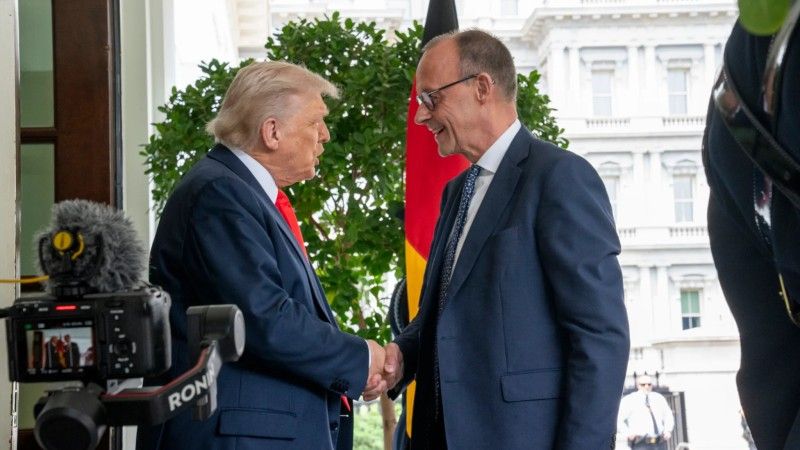
Trump’s Greenland-linked tariff threat evaporated with a sudden U-turn. While Berlin welcomed the climbdown, the episode starkly exposed why Chancellor Friedrich Merz prioritized de-escalation at Davos, urging Europeans not to be too quick to „write off” transatlantic trust.
The core of the issue is economic. The United States has reclaimed its spot as Germany’s largest trading partner, with goods turnover reaching €252.8 billion in 2024. With German statistics indicating that nearly one in four jobs depends on exports, any tariff spiral would immediately threaten domestic employment and investment. Adding to this urgency, the Bundesbank has warned that German exporters are already losing global market share, a pressure felt across diverse sectors, from mechanical engineering to chemicals.
Security concerns loom just as large as economics. Germany remains heavily reliant on US extended nuclear deterrence, a commitment it is reinforcing by purchasing F-35A jets to maintain its role in NATO nuclear sharing. Furthermore, the country hosts critical American infrastructure: the US Air Force describes the Kaiserslautern Military Community, centered around Ramstein, as its largest footprint outside the continental United States. With Washington already planning cuts to certain NATO command posts, Berlin has a strong incentive to ensure that diplomatic tensions do not spill over into a military posture.

Politics serves as a third brake. Chancellor Merz governs with a slim CDU/CSU-SPD majority that has proven fragile from the outset: he needed a second Bundestag ballot just to secure the chancellorship, a precarious start quickly compounded by coalition infighting over flagship pension and military-service reforms. With the Bundesbank pointing to years of stagnation and a lingering industrial downturn, Berlin is reluctant to compound its troubles with the self-inflicted economic pain of a tariff war.
Even if Berlin wished to take a harder line, it is constrained by the need for EU cohesion. Foreign policy decisions still rely on unanimity: divergent national interests and potential vetoes often stall collective action, forcing leaders into ad hoc „coalitions of the willing” during crises.


