












- WIADOMOŚCI
- KOMENTARZ
Is Canada abandoning the F-35 and moving closer to China? An expert responds

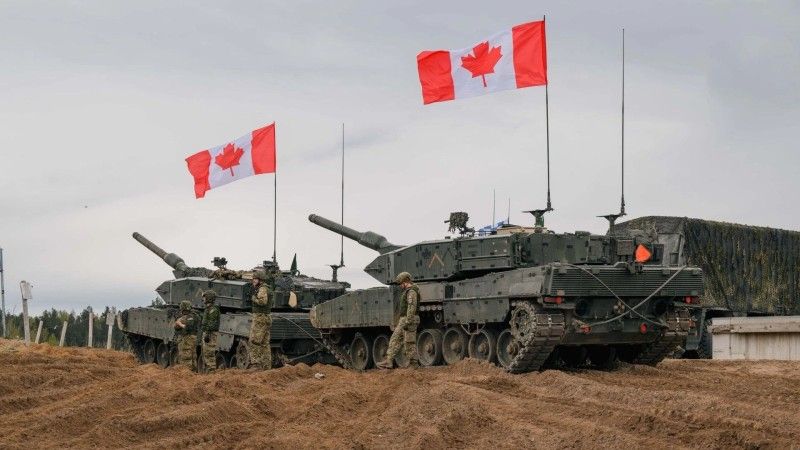
Photo. Canadian Army
Growing tensions in the U.S.-Canada relationship could have far-reaching implications. This concerns not only potential risks to specific military procurement deals but also the strategic alignment of Ottawa with… Beijing.
To what extent could current relations with the U.S. influence Canada’s military procurement decisions? Is Canada entering China’s sphere of interest? How do Canadians plan to cooperate with Europe, including Poland? We discussed these topics with Murray Brewster, a journalist at CBC (Canadian Broadcasting Corporation) specializing in security and international policy.
Will Canada stop buying F-35s?
According to the Canadian journalist, the potential withdrawal of Canada from the F-35 program is a complex matter. Canada signaled its intention to purchase as many as 88 F-35s, but so far has only committed to (and paid for) 16 aircraft. Brewster explains that, in theory, the purchase could stop at these sixteen, since there are no contractual penalties for not completing the remaining order. On the other hand, both the aircraft manufacturer, Lockheed Martin, and the U.S. government have warned that Canadian aerospace contracts related to the F-35 could be at risk.
From a purely political standpoint, buying more F-35s may no longer make sense. Donald Trump’s disparaging remarks about Canada—referring to its northern neighbor as the „51st state” — were very poorly received in Canada, understandably. As a result, the Canadian government would face a tough challenge in convincing the public to continue purchases. The situation is further complicated by the fact that the RCAF (Royal Canadian Air Force) wants the F-35 and considers it essential, while the government and a large part of society are calling for alternative solutions.
The question of further F-35 purchases is not the only topic heating up public debate in Canada. Looking more broadly at military procurement from the U.S., recent events show that Canada has decided to move away from American public procurement programs.
Murray Brewster said that during the last federal elections, the Prime Minister committed to diversifying defence spending, saying that Canada spends over 75 cents of every defense dollar in the United States, and that needs to change. However, he added that implementing such a plan may be difficult, because besides the F-35s, Canada has already previously declared interest in purchasing U.S. HIMARS systems and P-8 Poseidon aircraft.
Moving towards China?
Amid growing U.S.-Canada tensions, Ottawa has recently made a strategic pivot toward… China. On January 16, a preliminary Canada-China trade agreement was signed, including a significant reduction in tariffs on Chinese electric vehicles and Canadian canola. It is also notable that Prime Minister Mark Carney’s visit to Beijing was the first visit by a Canadian head of government to China in nearly ten years (Justin Trudeau visited in 2017). In response, U.S. President Donald Trump threatened Canada with 100% tariffs on Canadian goods, referring to Carney dismissively as „the governor.” „If Governor Carney thinks he can make Canada a transshipment hub for China to send goods to the United States, he is mistaken,” Trump wrote on social media, adding that „Beijing will devour Canada whole.” - Brewster explains.
Despite hostile comments from the U.S., the recent political rapprochement with China has not been universally welcomed within Canada.
Suspicion of China is deeply rooted in both the political and defense communities. Relations between our countries have been tense for nearly a decade. While Canada understands that it must diversify trade to reduce dependence on the U.S., there remains a belief that China poses a threat to national security, Murray Brewster told Defence24.
The public views the agreement with China cautiously. Brewster said the nation has seen how this country behaves. He added that Canada investigated alleged Chinese interference in our elections; it also witnessed diplomacy based on holding two Canadians hostage (in December 2018, Canadians Michael Spavor and Michael Kovrig were detained in China on espionage charges and were only released in 2021), and there were reports of Chinese »police posts« in Canada trying to enforce Beijing’s will among immigrant communities. The Canadian journalist summed up, saying such things are not easily forgotten.
Canada, SAFE, Poland
Finally, it is worth addressing Canada’s cooperation with Europe—and more specifically, Poland. Recall that in June 2025, Canada and the European Union signed a security and defense partnership, and on December 19, Canada became the first non-European country to join the SAFE mechanism.
Given these agreements, it is reasonable to ask to what extent Poland could cooperate with Canada. In August 2025, Prime Ministers Tusk and Carney agreed in Warsaw to resume strategic partnership between the two countries. According to Brewster, one potential area of collaboration could be anti-drone technologies. Cooperation could also extend to the satellite domain, with advanced Canadian satellite technology developed by MDA and Telesat Canada. Canadians are reportedly also conducting intensive development work on low-Earth orbit satellite systems. Whether Poland will benefit from these remains uncertain, but the potential for bilateral cooperation exists and is worth noting.


