












- WIADOMOŚCI
Indonesia at forefront of the Gaza peace mission: Jakarta’s role in the Board of Peace

Indonesia has become the most active member of Donald Trump’s Board of Peace, declaring its readiness to deploy 8,000 troops to a planned peace mission in Gaza. Jakarta presents this move as support for Palestine and an attempt to strengthen its international position, but it may come at a cost of losing of its reputation of a neutral player. Notwithstanding that, the outbreak of war between the United States and Iran and the subsequent suspension of the Board’s activities have now cast doubt on the implementation of these plans.
Following the ceasefire between Israel and Hamas on 10 October 2025, the parties to the conflict provisionally agreed to a peace plan proposed by Trump, in which the Board of Peace (BoP) was to serve as the main institutional platform. The body was created to oversee the post-conflict stabilisation and reconstruction of the Gaza Strip. From the outset, however, the initiative attracted considerable controversy, primarily due to its unclear mandate and the marginalisation of Palestinian representation. Nevertheless, Indonesia joined the organisation and quickly became one of its most active participants, second only to the United States in terms of engagement. On 22 January 2026, President Prabowo Subianto attended the inaugural BoP meeting, where he signed the organisation’s charter, declaring Indonesia’s support for the goal of achieving lasting peace in Gaza.

The Board of Peace is expected to oversee the planned peace mission involving the deployment of a multinational International Stabilisation Force (ISF). In November 2025, the UN Security Council, in an unprecedented move, granted the Board authorisation, effectively empowering an external organisation to conduct this type of operation for the first time. Since the concept of a multinational contingent emerged, Indonesia has assumed a leading role in the process. Among BoP member states, it was the first to declare its readiness to send troops to Gaza and was offered the position of Deputy Commander of the ISF.
In late February 2026, Jakarta announced its intention to deploy 8,000 troops to Gaza, meaning that the Indonesian contingent would constitute the largest national contribution to the ISF, whose target strength is expected to reach around 20,000 personnel. According to statements by the Indonesian government, the troops sent to Gaza would primarily be responsible for humanitarian assistance and infrastructure reconstruction, as well as training the Palestinian police. It has been emphasised that they would not participate in combat operations.
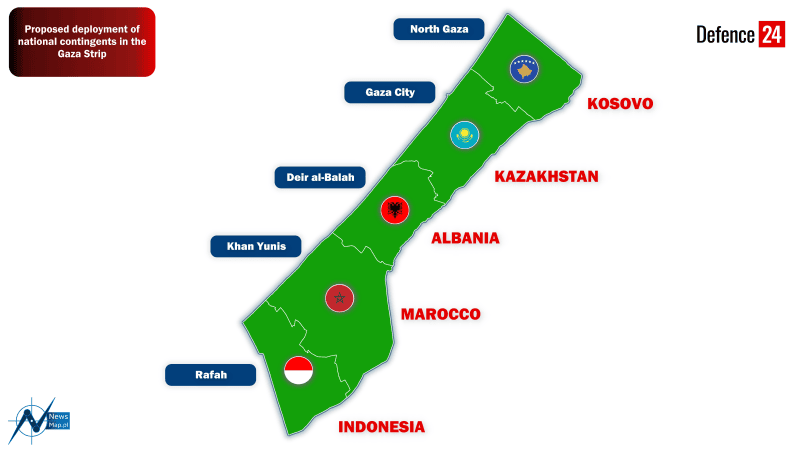
Under current plans, Indonesian forces would be stationed in the southern Gaza Strip near Rafah, with the first contingent of around 1,000 soldiers expected to deploy in early April 2026. It should be noted, however, that following the outbreak of war in Iran, the work of the Board of Peace has been suspended, which will likely delay the planned deployment.
Map caption:Proposed deployment of national contingents in the Gaza Strip. In addition to Indonesia, the mission would also include Moroccan, Kazakh, Albanian and Kosovar forces.

Why has Jakarta become so strongly engaged?
One important reason for President Prabowo Subianto’s strong engagement in the Board of Peace is his personal ambition to become a more prominent figure among global political elites. In a broader perspective, sending the largest contingent to Gaza also reflects Indonesia’s aspiration to increase its visibility and influence on the international stage. At the same time, Jakarta may view participation in the initiative as a way to improve relations with the Trump administration and secure more favourable trade conditions with the United States, which are currently strongly tilted in Washington’s favour.
Domestic politics also plays a significant role. Public support for the Palestinian cause in Indonesia remains extremely strong. Consequently, despite the controversies surrounding the Board of Peace, Jakarta portrays its participation as an attempt to advocate for the two-state solution and Palestinian self-determination. At the same time, aware of these controversies, Indonesian officials have repeatedly emphasised that their involvement is conditional: its aim is to improve the living conditions of Palestinians and strengthen their political prospects. Should these objectives not be met, Indonesia would withdraw from the Board of Peace.
Finally, from an international perspective, Indonesia may be seen as a potentially credible mediator. As a relatively politically neutral Muslim country, it appears to be a natural candidate for the role of arbiter. Moreover, its geographical distance from the Middle East and its lack of direct involvement in regional conflicts make its participation in the peace mission acceptable to most parties to the conflict, including Israel, despite the absence of formal diplomatic relations between the two countries.

Why Jakarta’s involvement is controversial and carries risks
First, the main source of risk lies in the unclear nature of the planned ISF peace mission. Although it received authorisation from the UN Security Council, it would not operate as a traditional UN peacekeeping mission. Instead of functioning within established UN command and funding structures, troops would be contributed directly by participating states. This model creates serious challenges for Indonesia.
Most importantly, the Indonesian contingent would not enjoy the legal protections normally afforded to participants in UN peacekeeping operations. As a result, it could be perceived not as a neutral peacekeeping force but as a party to the conflict, significantly increasing the risks associated with the mission. The absence of a UN command structure also means the absence of UN funding mechanisms. In practice, this would require Indonesia to cover the full cost of its deployment from its own budget. Given that Indonesia’s defence sector has long struggled with financial constraints, independently financing such an operation raises serious concerns.
Beyond operational issues, the initiative also raises questions about its political and moral legitimacy. Critics argue that the Board of Peace disproportionately reflects the interests of Israel and the United States while marginalising Palestinian representation. Many commentators in Indonesia have expressed concerns that the Board effectively serves as an instrument for advancing Israeli strategic interests through the Trump administration. For Indonesia, participation in such an initiative carries reputational risks. For decades, the country’s foreign policy has been built around anti-colonial principles and solidarity with Palestine, and public support for the Palestinian cause remains strong.
It is also important to consider the broader geopolitical implications. Participation in an initiative so closely associated with Washington could be perceived as a shift towards the pro-American camp, potentially undermining Indonesia’s traditional diplomatic posture. Since independence, Indonesia’s foreign policy has been guided by the doctrine of ”free and active” diplomacy, which emphasises strategic autonomy and avoidance of alignment with any major geopolitical bloc.
A visible rapprochement with the United States could therefore be interpreted as a departure from this tradition. In the longer term, it could weaken Indonesia’s credibility as a neutral diplomatic actor, affect its leadership role within ASEAN, and undermine its standing within the Global South, and forums such as BRICS. At the same time, it could reduce Jakarta’s ability to pursue its traditional strategy of balancing between competing great powers.

What comes next? Negotiations temporarily suspended
In early March 2026, amid the escalating confrontation between the United States and Iran, Indonesia’s place at the forefront of the Board of Peace has come into question. Jakarta temporarily suspended discussions on the Board’s planned activities, including the peace mission, citing the need to closely monitor developments in Iran. This reaction is not surprising, as Indonesia has consistently emphasised that its participation is conditional upon the Board’s ability to genuinely support the peace process in Gaza. Recent geopolitical developments have clearly undermined trust in Washington’s intentions in this regard.
Against the backdrop of the crisis in Iran, calls within Indonesia to reassess the country’s participation in the Board of Peace are growing louder. Some politicians, civil society organisations, and influential religious leaders have urged the government to reconsider the strategic and moral implications of continued involvement. Assuming that the US–Iran confrontation does not end quickly, a delay in the deployment of Indonesian troops to Gaza now appears almost inevitable. Under such circumstances, both the Gaza stabilisation plan and the role Indonesia was expected to play within it are becoming increasingly uncertain.
Despite mounting pressure, during the first week following the US strike on Iran the Prabowo administration did not take any concrete steps suggesting an intention to withdraw from the Board of Peace. In response to journalists« questions, government representatives merely stated that Indonesia „could leave the organisation at any moment”, effectively leaving the decision open. Most likely, Jakarta will maintain the current state of suspension rather than formally withdrawing from the organisation. Prabowo may fear the political and economic consequences from the Trump administration that such a move could provoke. The United States is Indonesia’s second-largest trading partner after China, and in recent months Jakarta has made considerable efforts to secure Washington’s favour, even at the cost of accepting highly unfavourable trade conditions. Under these circumstances, a decisive Indonesian withdrawal from the Board of Peace appears unlikely.
Author: Jan Gawroński


