












- WIADOMOŚCI
- KOMENTARZ
Has Poland supplied Ukraine with Patriot missiles? The Ministry of National Defence responds


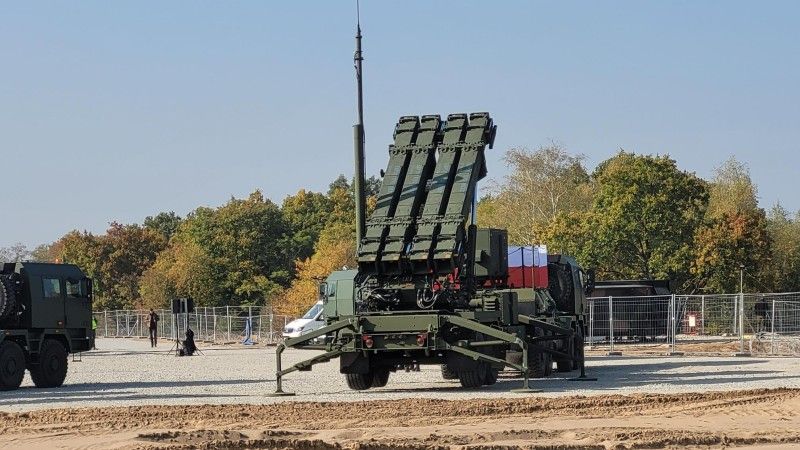
During the latest Ramstein contact group meeting, Ukrainian Defence Minister Mykhailo Fedorov thanked partners for transferring missiles for Patriot air defence systems. Among the countries he named was Poland, but it is not clear whether he was referring to payment for a U.S. purchase or to the physical transfer of missiles. The Defence24.pl editorial team obtained a statement from the Ministry of National Defence on the matter.
During the recent Ramstein contact group meeting dedicated to support for Ukraine, Ukrainian Defence Minister Mykhailo Fedorov thanked allies, particularly for support in the form of air defence systems and Patriot missiles. In essence, he referred to the PURL programme, listing Germany, the Netherlands, Poland, Romania for supplying the Patriot missiles, and the US - as the nation approving the acquisition.
The head of Ukraine’s defence ministry’s remarks can be interpreted in two ways: either he is thanking allies for financing the missiles under the PURL programme (Priority Ukraine Requirements List), which covers European countries purchasing equipment for Ukraine’s needs, or for physically transferring missiles from their own stocks. All of the countries named by Fedorov are European Patriot users and — apart from Poland — have already previously supplied Patriot-related equipment from their inventories to Ukraine, including elements of the system and older PAC-2 missiles.
Poland has recently fielded two Patriot batteries in the latest configuration with the IBCS system, becoming the first country after the United States to do so. The system reached full operational capability last year. More than 200 PAC-3 MSE missiles were purchased for the first phase of the Wisła programme. Last year, PAC-2 missiles were also fired in Ustka, and a small batch was ordered for training purposes. At the same time, Poland has approval to purchase more than 700 missiles from the United States.
It is no secret that Ukraine’s most urgent need is precisely for PAC-3 MSE missiles, as they are the most effective in engaging ballistic missiles such as Iskander and Kinzhal. Cruise missiles, not to mention drones, can be destroyed by other systems. As Der Spiegel reported, in March Germany proposed that a group of states transfer a batch of more than 30 missiles to Ukraine, including five from its own stocks, and they were ultimately delivered to Kyiv.
Defence24.pl asked the Polish Ministry of Defence for comment. The ministry stated: „The Ministry of National Defence does not comment on statements by persons outside the ministry appearing in public debate.” „Poland consistently provides Ukraine with multidimensional military support. This is carried out both through bilateral efforts and multilateral initiatives. Our engagement covers a broad spectrum of assistance activities, ranging from donations of military equipment, through the training of Ukrainian soldiers, to extensive logistical support and medical support. Polish efforts constitute an important element in strengthening the combat potential of the Armed Forces of Ukraine in terms of the capabilities most in demand,” the ministry added.
„Due to the confidentiality of the documents underpinning the implementation of the above measures, and in the interests of the Polish Armed Forces, the Ministry of National Defence does not provide detailed information on the types and categories of military equipment transferred to the Armed Forces of Ukraine.” - the Polish MoD noted.
On the basis of the ministry’s response, it cannot be stated unequivocally whether missiles were transferred to Ukraine or not. It is known, however, that Poland has been a participant in the PURL programme since the end of last year.
What is highly likely, however, is that the next deliveries of PAC-3 MSE missiles to Poland — planned in connection with the second phase of the Wisła programme — will be delayed. In 2023, Poland placed an FMS order for more than 600 of these missiles; elements of the second phase of Wisła were to be delivered from 2026 or 2027 through 2029. Even before the start of the U.S.-Israeli operation against Iran, however, the delivery schedule was tight. At present, despite expanding production capacity — gradually and according to plans made before the latest phase of the war in the Middle East — they will most likely be redirected to replenish U.S. stocks, especially as the White House is seeking the purchase of several thousand missiles in the coming years.
Such a risk was already raised last month by Deputy Prime Minister and Defence Minister Władysław Kosiniak-Kamysz, and Reuters recently reported delays in deliveries of unnamed U.S. equipment to Scandinavian countries and states in the Baltic Sea region, including those bordering Russia. This is also said to concern previously placed orders.
PAC-3 MSE missiles (the version manufactured by Lockheed Martin) are the Patriot system’s primary interceptor for engaging ballistic targets via direct hit. The missile is equipped with an active radar seeker, so it does not require continuous target tracking by an external sensor. The missiles are used by the U.S. Army and most Patriot operators, including Poland, and are employed in combat conditions in the Middle East and in Ukraine. Current PAC-3 MSE production stands at around 650–700 missiles per year; by 2027 it is expected to reach at least 750 annually, and after 2030 it is set to rise to 2,000 per year. In 2023, production totalled 380 missiles, while efforts to redirect production from other users to meet Ukraine’s needs were already being pursued by the Joe Biden administration from 2024 onward.


