- KOMENTARZ
- WIADOMOŚCI
Merz in Munich: “The old order is over”

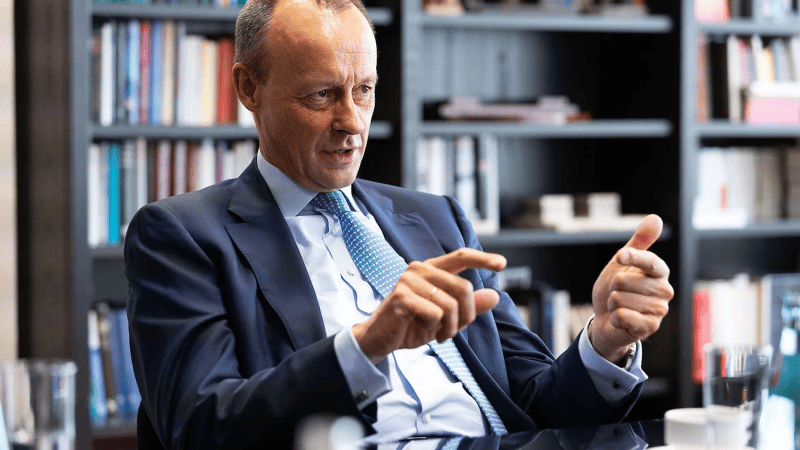
In Munich, Friedrich Merz gave an obituary for the foreign policy of Berlin. Is Germany prepared to leave the comfort zone of pacifism and enter a nuclear age of realism? The leader of the CDU has just declared that the „vacation from world history” is over , and that Europe has a choice between hard power and marginalization.
Friedrich Merz used his speech at the Munich Conference to send a message, as blunt as it was unvarnished, to partners and adversaries alike: „Europe is back,” in a world of hard power, a rules-based order in disarray, and Germany determined to bridge the gap between its aspirations and hard power potential.
„This order … no longer exists in that form”
Merz set the tone early by arguing that the international rules-based order is not merely „under pressure” but structurally fading. He endorsed the conference’s grim framing and sharpened it:”This order, however imperfect it was even at its best, no longer exists in that form.” This sentence is important because it is not just a lament about a rules-based order under strain. It is a recognition of a new status quo ante, a recognition of a world in which the baseline of predictability, interdependence, and institutional crisis management, which Europe knew so well, is no longer operative. This is no mere lament about a crisis, it is a strategic break from the „Wandel durch Handel” doctrine, forcing the German elite to redefine the foundations of security.

Europe's "vacation from world history" is over!
Merz sought a striking metaphor to describe this new reality: „Europe has returned from a vacation from world history. Back to a world shaped by coercion, spheres of influence, and rivalry among powers.” He portrayed Russia’s war as the most visible manifestation of this transformation, speaking of Moscow’s „violent revisionism,” a brutal war against Ukraine and Europe’s political order, with daily serious war crimes.
The transatlantic message: NATO is also America's advantage
Merz’s most biting passages were aimed across the Atlantic. Can America afford isolationism? According to Merz, it cannot - a message aimed directly at proponents of the „America First” doctrine. In the part of the speech he argued:
„In the era of great power rivalry, even the United States will not be powerful enough to go it alone.”
He then made the key sell: NATO’s competitive advantage is not only Europe’s, but also America’s. And we should… repair and revive transatlantic trust together. Politically, what we are seeing here is Merz trying to do two things at once: Dismiss the »America First« logic without portraying the US as the enemy and portray the »more responsibility« agenda of Europe as being within, rather than outside, NATO.
A European nuclear debate: now explicitly on the table
The most important „new” factor surrounding Merz’s Munich initiative was nuclear. Merz announced that he had started confidential negotiations with Emmanuel Macron about a European nuclear deterrent, in which it must be integrated into the NATO nuclear sharing, and in which there must be no „zones of differing security” on the European continent. It is a gamble of high stakes, Merz effectively suggests the „Europeanization” of the French nuclear deterrence, which will be a cognitive shock for a German public that is still deeply rooted in pacifism.
Merz’s idea is constructing a strong, self-supporting European pillar within the alliance, rather than dismissing NATO. This is not about a German nuclear bomb, which is forbidden by treaty and law. It is about whether a French nuclear deterrent can be „political Europeanised” and whether this can be done without undermining unity on NATO. The revelation of these negotiations is a political grenade thrown into the Bundestag, Merz effectively concedes that the American umbrella may no longer be sufficient, and Berlin is thus forced into a nuclear debate that has been taboo for decades.
Germany's self-critique: values without means is a strategic liability
Merz made an exceptionally candid diagnosis of post-Cold War German foreign policy: it had a „normative surplus”, it criticized the disruption of international order but often lacked the means to correct it, and the gaps between aspiration and capability are becoming increasingly wide. We are closing these gaps. He accompanied this with a calculation designed to dispel European fatalism: Russia has a GDP of 2 trillion euros; the EU has a GDP ten times greater than that, but is not ten times more powerful „because we have not yet mobilized our military, political, economic, and technological potential to the necessary extent.”
Merz concluded with a psychological and financial imperative: Europe needs to „flick the switch” now because freedom is no longer „a given,” it will require „firmness and determination,” and readiness to make sacrifices „not one day, but now.”

The culture-war line: drawing a boundary with MAGA politics
In addition, Merz also placed Europe on an ideological stance against some of today’s US political discourse. „The culture wars of MAGA in US are not ours,” he said, and we differ on free speech, trade, and climate/health multilateralism. This part is important because it redefines the transatlantic divide as not only being about budgets and burden sharing, but also about values and governance styles and whether Europe will stand up for its legal-constitutional boundaries even if the US disapproves.
The point of Merz’s speech in Munich is to make one argument politically unavoidable: Europe has the resources to defend itself, but it doesn’t yet have the model of mobilization or the mindset. He’s making Germany accountable for changing this, while at the same time arguing that this has to happen in a way which supports, rather than replaces, NATO.
What does this mean? There will be fierce opposition from the left wing of the SPD and the Greens, who will probably charge Merz with militarism and „atomic delusions of grandeur.” In Paris, the news of „confidential talks” might be seen as a false start, but in Washington, especially among Democrats, the voice of Merz will be heard as a welcome change in European assertiveness that is not anti-American. Merz has brought an end to the era of diplomatic evasiveness, which Germany has avoided for years.