












- KOMENTARZ
- WIADOMOŚCI
Brussels after Russian attack on the EU Delegation in Kyiv

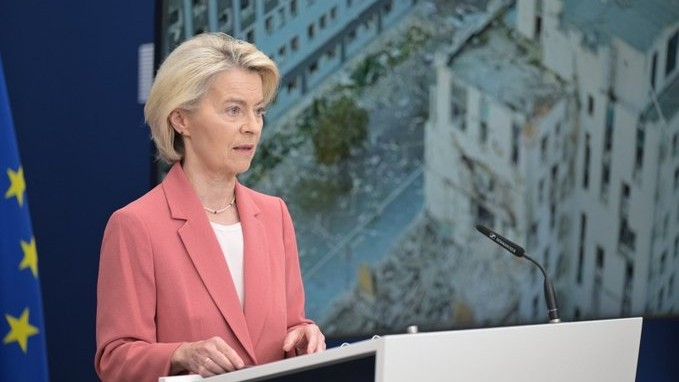
On Tuersday Kremlin carried out a deadly strike on Kyiv, leaving at least 21 people dead and causing damage to the offices of EU and British delegations. Certainly, this attack should be perceived as a symbolic one, as it was targeted in the building related to Ukrainian allies and supporters. Once more it shows the real – brutal and ruthless face of Russian Federation. Currently from Brussels came discussions of plans aimed at broadening efforts to demonstrate European solidarity and support.
The first concerns the visit, launched today by Ursula von der Leyen, to the „frontline” states bordering Russia and Belarus. The President of the European Commission will embark on a four-day tour of Latvia, Finland, Estonia, Poland, Lithuania, Bulgaria, and Romania. The mission aims to underscore the EU’s solidarity with its Member States on the eastern flank and strengthen cooperation on security, defence, and resilience against hybrid threats. Through this tour von der Leyen would like to highlight that European Union stands united in defending its borders, bolstering security, and deepening cooperation with NATO, despite unfriendly rhetoric coming from some member states including Bratislava and Budapest.
Second topic is related to the EU proposal for further tariffs on imports of goods from Russia that could be a part of 19th sanctions package announced by early September. Through these actions Brussels would like to weaken Kremlin war economy and push Vladimir Putin to negotiate the ceasefire. Nevertheless, last eighteen sanctions package have not sufficiently undermined the Russian economy, nor have they compelled Moscow to alter its positions. In fact, recent political developments, such as the Russian–U.S. summit in Alaska, may have even strengthened President Putin’s standing, providing his regime with a significant sense of legitimacy.
UE challenges
For the time being, bloc is struggling with two main challenges – the first one – financing the modernization of military sector. The war has prompted European nations to strengthen their defence capabilities. Even though the EU has relaxed its fiscal rules to enable countries to borrow more for defence purposes, e.g. through the new instrument such as SAFE – the speed of this process is not enough. The bloc as a whole organisation needs to accelerate its armament efforts to ensure readiness for worst-case scenarios. What is more the EU’s internal lack of cohesion, particularly visible through Hungary and Slovakia’s positions, highlights structural obstacles to unified actions. Brussels supposed to stay united in the crucial aspects such as international security because only then will be heard and treated as an equal partner.
Author: Amelia Wojciechowska
.


