












- WIADOMOŚCI
China and Brazil are building a joint space laboratory

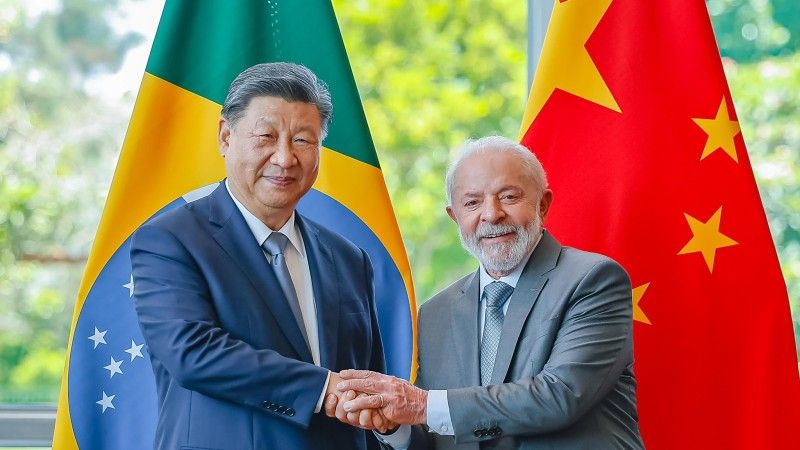
Photo. Twitter (X) / @LulaOficial
The People’s Republic of China and Brazil have announced the launch of a joint laboratory dedicated to space technologies. The two countries are deepening their cooperation despite pressure from the United States.
The information was released by the Chinese defense company CETC. The entity signed an agreement with the Federal University of Campina Grande and the Federal University of Paraíba. The cooperation aims to establish a specialized center, the China–Brazil Joint Laboratory for Radio Astronomy Technology. The facility will support research in deep space exploration and astronomy.
China–Brazil project under U.S. pressure
The initiative is the result of ongoing cooperation between the two countries within the BINGO project, under which a new radio telescope is being built. The construction of the instrument was completed in China in June and shipped to South America. BINGO is scheduled to become operational next year. At that time, it will be the largest facility of its kind in South America.
![Start rakiety Chang Zheng 5B z modułem stacyjnym Tiānhé. Fot. CNSA [cnsa.gov.cn]](https://cdn.defence24.pl/2021/04/29/1920xpx/2021/04/29/originals/YhvogxUVs3JAFWldH3IrF4tOqQwSuP5hKEETl51L.ikdf.jpg)
The radio telescope will not only be used for studying the structure of the Universe and the mysterious dark energy. It will also enable precise tracking of civilian and military satellites, meteoroids, and other small objects, thereby enhancing both nations’ capabilities in detecting potential threats. The system is therefore significant from both a scientific and strategic standpoint.
U.S. officials claim that the facility could be used to expand Beijing’s intelligence capabilities and monitor U.S. activities in a region considered vital to national security. The United States is also seeking to pressure Latin American countries to limit their engagement with China, particularly in the field of space research. The Middle Kingdom accuses the U.S. of political interference and obstructing scientific cooperation.

Brazil backs China
The strengthening of China–Brazil cooperation fits into a broader trend of Beijing’s growing influence in Latin America, particularly in economic matters. “China–Brazil relations are currently the best in history, and China is willing to work with Brazil for the shared future of humanity, a fairer world, and a more sustainable planet,” Xi Jinping emphasized during his recent visit to Brazil.
One of the many agreements signed during that visit was a deal between Shanghai-based company SpaceSail and the Brazilian state-owned telecommunications firm Telecomunicações Brasileiras (TELEBRAS) to provide satellite broadband internet starting in 2026. The service will be made possible through the launch of the Chinese Qianfan constellation (meaning “A Thousand Sails”).
The Chinese project is intended to compete with SpaceX’s Starlink service, which currently operates over 7,000 active units and continues to expand. The Qianfan constellation is expected to consist of 12,000–14,000 satellites in low Earth orbit (LEO) by 2030.
See also 

It is worth noting that this is not the only megaconstellation project being developed by China. In parallel, the Guowang network is also under development, likewise intended as an alternative to Starlink. The network is managed by China SatNet, which plans to deploy half of its 13,000 units into orbit by 2032.


